


Boron neutron capture therapy outcomes for advanced or recurrent head and neck cancer
- PMID: 23955053
- PMCID: PMC3885131
- DOI: 10.1093/jrr/rrt098
Boron neutron capture therapy outcomes for advanced or recurrent head and neck cancer
Abstract
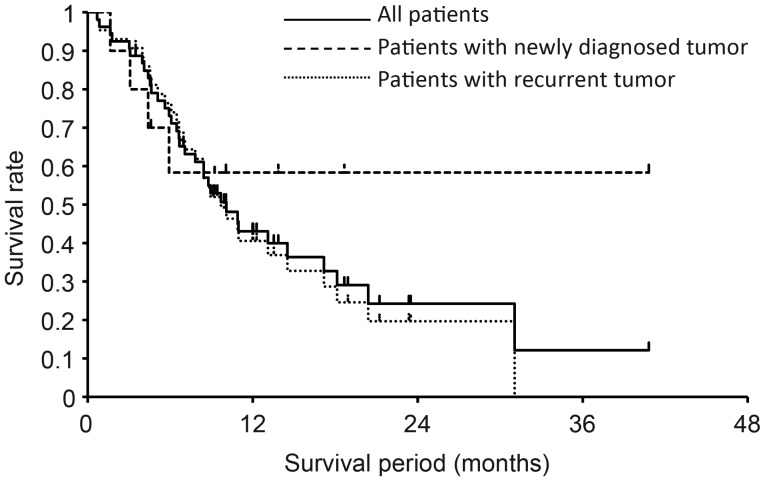
We retrospectively review outcomes of applying boron neutron capture therapy (BNCT) to unresectable advanced or recurrent head and neck cancers. Patients who were treated with BNCT for either local recurrent or newly diagnosed unresectable head or neck cancers between December 2001 and September 2007 were included. Clinicopathological characteristics and clinical outcomes were retrieved from hospital records. Either a combination of borocaptate sodium and boronophenylalanine (BPA) or BPA alone were used as boron compounds. In all the treatment cases, the dose constraint was set to deliver a dose <10-12 Gy-eq to the skin or oral mucosa. There was a patient cohort of 62, with a median follow-up of 18.7 months (range, 0.7-40.8). A total of 87 BNCT procedures were performed. The overall response rate was 58% within 6 months after BNCT. The median survival time was 10.1 months from the time of BNCT. The 1- and 2-year overall survival (OS) rates were 43.1% and 24.2%, respectively. The major acute Grade 3 or 4 toxicities were hyperamylasemia (38.6%), fatigue (6.5%), mucositis/stomatitis (9.7%) and pain (9.7%), all of which were manageable. Three patients died of treatment-related toxicity. Three patients experienced carotid artery hemorrhage, two of whom had coexistent infection of the carotid artery. This study confirmed the feasibility of our dose-estimation method and that controlled trials are warranted.
Keywords: boron neutron capture therapy; head and neck tumors.
Figures
References
-
- Haraf DJ, Weichselbaum RR, Vokes EE. Reirradiation with concomitant chemotherapy of unresectable recurrent head and neck cancer: a potentially curable disease. Ann Oncol. 1996;7:913–8. - PubMed
-
- Spencer SA, Harris J, Wheeler RH, et al. Final report of RTOG 9610, a multi-institutional trial of reirradiation and chemotherapy for unresectable recurrent squamous cell carcinoma of the head and neck. Head Neck. 2008;30:281–8. - PubMed
-
- Coderre JA, Morris GM. The radiation biology of boron neutron capture therapy. Radiat Res. 1999;151:1–18. - PubMed
-
- Kato I, Ono K, Sakurai Y, et al. Effectiveness of BNCT for recurrent head and neck malignancies. Appl Radiat Isot. 2004;61:1069–73. - PubMed
-
- Kankaanranta L, Seppälä T, Koivunoro H, et al. Boron neutron capture therapy in the treatment of locally recurred head-and-neck cancer: final analysis of a phase I/II trial. Int J Radiat Oncol Biol Phys. 2012;82:e67–75. - PubMed
MeSH terms
LinkOut - more resources
Full Text Sources
Other Literature Sources
Medical
