


Measuring the severity of prescribing errors: a systematic review
- PMID: 23955385
- PMCID: PMC3834169
- DOI: 10.1007/s40264-013-0092-0
Measuring the severity of prescribing errors: a systematic review
Erratum in
- Drug Saf. 2014 Mar;37(3):199
Abstract
Background: Prescribing errors are common. It has been suggested that the severity as well as the frequency of errors should be assessed when measuring prescribing error rates. This would provide more clinically relevant information, and allow more complete evaluation of the effectiveness of interventions designed to reduce errors.
Objective: The objective of this systematic review was to describe the tools used to assess prescribing error severity in studies reporting hospital prescribing error rates.
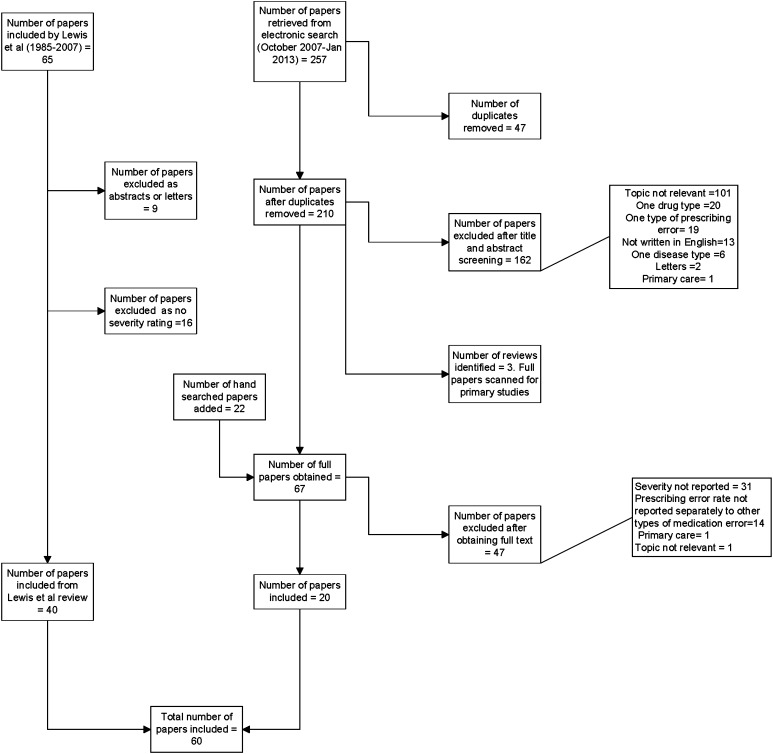
Data sources: The following databases were searched: MEDLINE, EMBASE, International Pharmaceutical Abstracts, and CINAHL (January 1985-January 2013).
Study selection: We included studies that reported the detection and rate of prescribing errors in prescriptions for adult and/or pediatric hospital inpatients, or elaborated on the properties of severity assessment tools used by these studies. Studies not published in English, or that evaluated errors for only one disease or drug class, one route of administration, or one type of prescribing error, were excluded, as were letters and conference abstracts. One reviewer screened all abstracts and obtained complete articles. A second reviewer assessed 10 % of all abstracts and complete articles to check reliability of the screening process.
Appraisal: Tools were appraised for country and method of development, whether the tool assessed actual or potential harm, levels of severity assessed, and results of any validity and reliability studies.
Results: Fifty-seven percent of 107 studies measuring prescribing error rates included an assessment of severity. Forty tools were identified that assessed severity, only two of which had acceptable reliability and validity. In general, little information was given on the method of development or ease of use of the tools, although one tool required four reviewers and was thus potentially time consuming.
Limitations: The review was limited to studies written in English. One of the review authors was also the author of one of the tools, giving a potential source of bias.
Conclusion: A wide range of severity assessment tools are used in the literature. Developing a basis of comparison between tools would potentially be helpful in comparing findings across studies. There is a potential need to establish a less time-consuming method of measuring severity of prescribing error, with acceptable international reliability and validity.
Figures
References
-
- Dean BS, Allan EL, Barber ND, et al. Comparison of medication errors in an American and a British hospital. Am J Health Syst Pharm. 1995;52:2543–2549. - PubMed
-
- Barker KN, Pearson RE, Hepler CD, et al. Effect of an automated bedside dispensing machine on medication errors. Am J Hosp Pharm. 1984;41:1352–1358. - PubMed
-
- Schnell BR. A study of unit-dose drug distribution in four Canadian hospitals. Can J Hosp Pharm. 1976;29:85–90. - PubMed
-
- Uzych L. Medication errors—beyond frequency. Am J Health Syst Pharm. 1996;53:1079. - PubMed
Publication types
MeSH terms
LinkOut - more resources
Full Text Sources
Other Literature Sources
Medical
