Formalizing an integrative, multidisciplinary cancer therapy discovery workflow
- PMID: 23955390
- PMCID: PMC4040396
- DOI: 10.1158/0008-5472.CAN-13-0310
Formalizing an integrative, multidisciplinary cancer therapy discovery workflow
Abstract
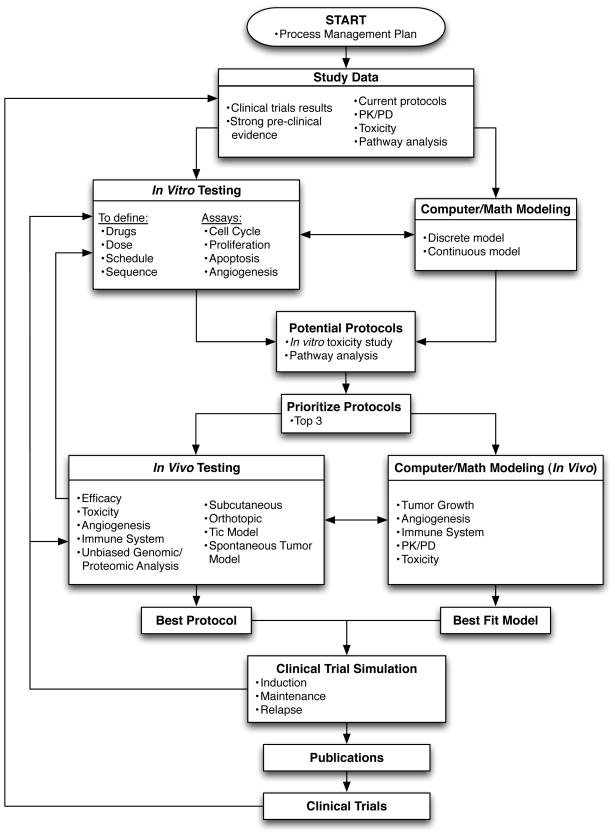
Although many clinicians and researchers work to understand cancer, there has been limited success to effectively combine forces and collaborate over time, distance, data, and budget constraints. Here we present a workflow template for multidisciplinary cancer therapy that was developed during the 2nd Annual Workshop on Cancer Systems Biology sponsored by Tufts University, Boston, Massachusetts, in July 2012. The template was applied to the development of a metronomic therapy backbone for neuroblastoma. Three primary groups were identified: clinicians, biologists, and quantitative scientists (mathematicians, computer scientists, and engineers). The workflow described their integrative interactions; parallel or sequential processes; data sources and computational tools at different stages as well as the iterative nature of therapeutic development from clinical observations to in vitro, in vivo, and clinical trials. We found that theoreticians in dialog with experimentalists could develop calibrated and parameterized predictive models that inform and formalize sets of testable hypotheses, thus speeding up discovery and validation while reducing laboratory resources and costs. The developed template outlines an interdisciplinary collaboration workflow designed to systematically investigate the mechanistic underpinnings of a new therapy and validate that therapy to advance development and clinical acceptance.
©2013 AACR.
Conflict of interest statement
No potential conflicts were disclosed.
References
-
- Holford N, Ma SC, Ploeger BA. Clinical trial simulation: a review. Clinical pharmacology and therapeutics. 2010;88:166–82. - PubMed
-
- Best A, Hiatt RA, Cameron R, Rimer BK, Abrams DB. The evolution of cancer control research: an international perspective from Canada and the United States. Cancer Epidemiol Biomarkers Prev. 2003;12:705–12. - PubMed
Publication types
MeSH terms
Grants and funding
LinkOut - more resources
Full Text Sources
Other Literature Sources
Molecular Biology Databases