. 2013 Dec;21(6):434-9.
doi: 10.3109/09273948.2013.815786. Epub 2013 Aug 19.

Elevated serum levels of interleukin-17A in uveitis patients

Affiliations

Elevated serum levels of interleukin-17A in uveitis patients

Shayma Jawad et al. Ocul Immunol Inflamm. 2013 Dec.

Abstract

Purpose: T helper 17 cells (Th17) are one of the main pathogenic effectors in autoimmune uveitis, and IL-17A is the signature cytokine of Th17 cells. This study aims to assess serum IL-17A levels in patients with autoimmune uveitis and evaluate associations between IL-17A levels and disease characteristics.

Methods: Serum IL-17A levels from 87 autoimmune uveitis patients and 60 healthy controls were assessed using an enzyme-linked immunosorbent assay. Among this cohort, 9 patients were followed longitudinally for IL-17A levels during active and inactive stages of their disease.

Results: Median serum IL-17A levels were higher among uveitis patients compared to controls (p < 0.0001). Moreover, IL-17A levels were elevated among uveitis patients with active disease compared to those with inactive disease (p = 0.0202). Among the 9 patients followed longitudinally, IL-17A levels were elevated during active disease compared to the inactive stage (p = 0.0078).

Conclusions: Serum IL-17A levels are elevated in uveitis patients, particularly in active uveitis.


Conflict of interest statement

DECLARATION OF INTEREST

The authors report no conflicts of interest. The authors alone are responsible for the content and writing of the paper.

Figures
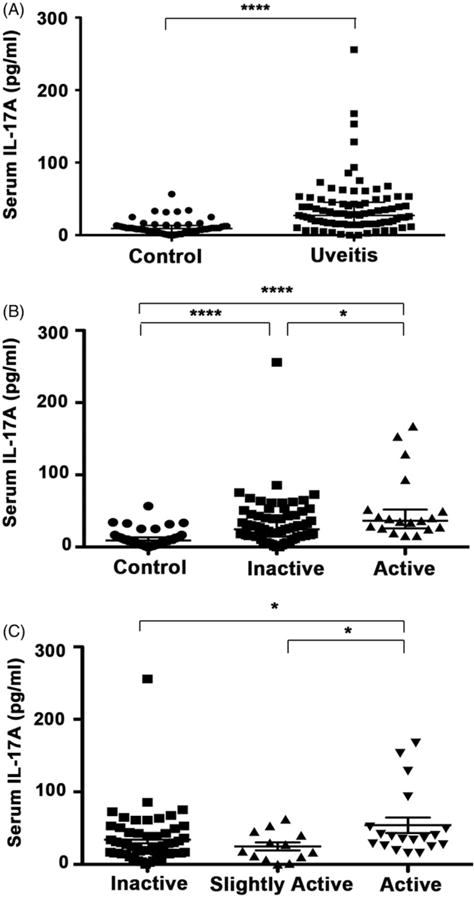
FIGURE 1
FIGURE 1
Serum IL-17A levels. (A) Median IL-17A levels were significantly increased among uveitis patients (27.26 pg/mL; 95% CI: 22.07–35.05) compared to controls (9.17 pg/mL; 95% CI: 7.51–10.84) (p<0.0001). (B) Median IL-17A was higher in patients with active disease (36.35 pg/mL; 95% CI: 27.26–51.93) compared to patients with inactive disease (24.27 pg/mL; 95% CI: 16.88–31.16) (p = 0.0202). Both inactive and active patients had higher levels of IL-17A compared to controls (p<0.0001). (C) When distinguishing between patients with minimal to no disease activity, both inactive (24.67 pg/mL; 95% CI: 18.18–33.76) and slightly active patients (18.18 pg/mL; 95% CI: 6.49–45.44) had decreased IL-17A levels compared to highly active patients (36.35 pg/mL; 95% CI: 27.26–51.93) (p = 0.0323, p = 0.0420). Kruskal-Wallis tests were used to compare groups. * and **** indicate the statistically significant p value <0.05 and 0.0001, respectively.
FIGURE 2
FIGURE 2
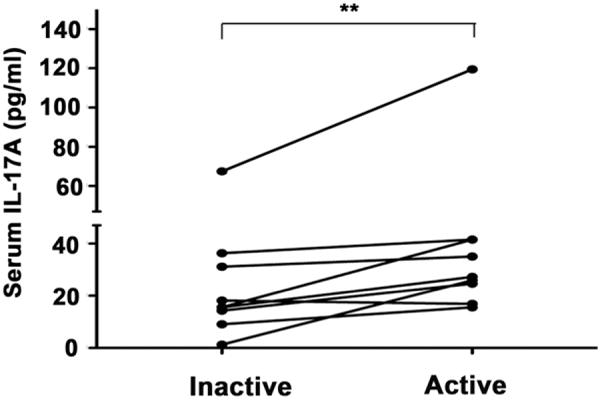
Median serum IL-17A levels were significantly higher during the active phase (27.26 pg/mL; 95 CI: 16.88–41.54) compared to the inactive phase (15.58 pg/mL; 95 CI: 9.09–36.35) of the disease among the 9 patients followed longitudinally (**p = 0.0078). A Wilcoxon matched-pairs test was used to compare the means between visits.

References

    1. Marwaha AK, Leung NJ, McMurchy AN, Levings MK. TH17 cells in autoimmunity and immunodeficiency: protective or pathogenic? Frontiers Immunol. 2012;3:129. - PMC - PubMed
    1. Bending D, Newland S, Krejci A, et al. Epigenetic changes at Il12rb2 and Tbx21 in relation to plasticity behavior of Th17 cells. J Immunol. 2011;186:3373–3382. - PubMed
    1. Gaffen SL. An overview of IL-17 function and signaling. Cytokine. 2008;43:402–407. - PMC - PubMed
    1. Caspi R. Autoimmunity in the immune privileged eye: pathogenic and regulatory T cells. Immunol Res. 2008;42:41–50. - PMC - PubMed
    1. Luger D, Caspi RR. New perspectives on effector mechanisms in uveitis. Semin Immunopathol. 2008;30:135–143. - PMC - PubMed

Publication types

MeSH terms