


Using joint utilities of the times to response and toxicity to adaptively optimize schedule-dose regimes
- PMID: 23957592
- PMCID: PMC3963428
- DOI: 10.1111/biom.12065
Using joint utilities of the times to response and toxicity to adaptively optimize schedule-dose regimes
Abstract
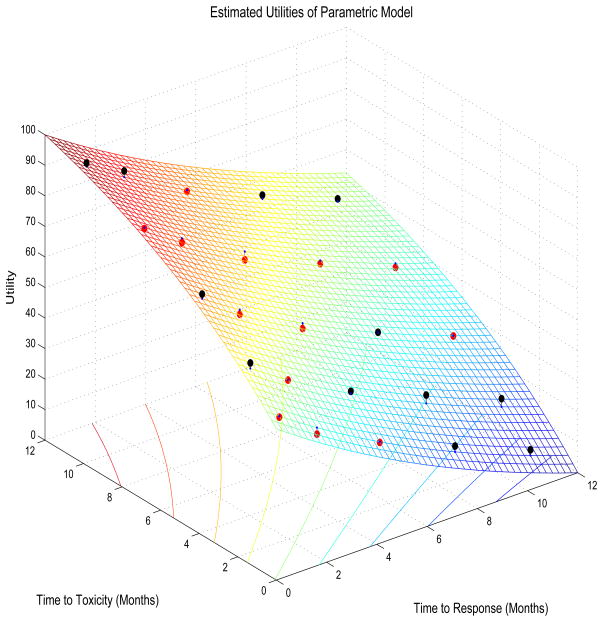
A Bayesian two-stage phase I-II design is proposed for optimizing administration schedule and dose of an experimental agent based on the times to response and toxicity in the case where schedules are non-nested and qualitatively different. Sequentially adaptive decisions are based on the joint utility of the two event times. A utility function is constructed by partitioning the two-dimensional positive real quadrant of possible event time pairs into rectangles, eliciting a numerical utility for each rectangle, and fitting a smooth parametric function to the elicited values. We assume that each event time follows a gamma distribution with shape and scale parameters both modeled as functions of schedule and dose. A copula is assumed to obtain a bivariate distribution. To ensure an ethical trial, adaptive safety and efficacy acceptability conditions are imposed on the (schedule, dose) regimes. In stage 1 of the design, patients are randomized fairly among schedules and, within each schedule, a dose is chosen using a hybrid algorithm that either maximizes posterior mean utility or randomizes among acceptable doses. In stage 2, fair randomization among schedules is replaced by the hybrid algorithm. A modified version of this algorithm is used for nested schedules. Extensions of the model and utility function to accommodate death or discontinuation of follow up are described. The method is illustrated by an autologous stem cell transplantation trial in multiple myeloma, including a simulation study.
Keywords: Adaptive decision making; Bayesian design; Phase I/II clinical trial; Stem cell transplantation; Utility.
© 2013, The International Biometric Society.
Figures
References
-
- Azriel D, Mandel M, Rinott Y. The treatment versus experimentation dilemma in dose-finding studies. Journal of Statistical Planning and Inference. 2011;141:2759–2758.
-
- Braun TM. The bivariate continual reassessment method: extending the CRM to phase I trials of two competing outcomes. Contemporary Clinical Trials. 2002;23:240–256. - PubMed
-
- Braun TM, Yuan Z, Thall PF. Determining a maximum tolerated schedule of a cytotoxic agent. Biometrics. 2005;61:335–343. - PubMed
-
- Braun TM, Thall PF, Nguyen H, de Lima M. Simultaneously optimizing dose and schedule of a new cytotoxic agent. Clinical Trials. 2007;4:113–124. - PubMed
Publication types
MeSH terms
Substances
Grants and funding
LinkOut - more resources
Full Text Sources
Other Literature Sources
