Review
. 2014 May;128(2):115-31.
doi: 10.1037/a0033105. Epub 2013 Aug 19.

Animal metacognition: a tale of two comparative psychologies

Affiliations
Review

Animal metacognition: a tale of two comparative psychologies

J David Smith et al. J Comp Psychol. 2014 May.

Abstract

A growing literature considers whether animals have capacities that are akin to human metacognition (i.e., humans' capacity to monitor their states of uncertainty and knowing). Comparative psychologists have approached this question by testing a dolphin, pigeons, rats, monkeys, and apes using perception, memory, and food-concealment paradigms. As part of this consideration, some associative modelers have attempted to describe animals' "metacognitive" performances in low-level, associative terms-an important goal if achievable. The authors summarize the empirical and theoretical situation regarding these associative descriptions. The associative descriptions in the animal-metacognition literature fail to encompass important phenomena. The sharp focus on abstract, mathematical associative models creates serious interpretative problems. The authors compare these failed associative descriptions with an alternative theoretical approach within contemporary comparative psychology. The alternative approach has the potential to strengthen comparative psychology as an empirical science and integrate it more fully within the mainstream of experimental psychology and cognitive science.


Figures

Figure 1
Figure 1
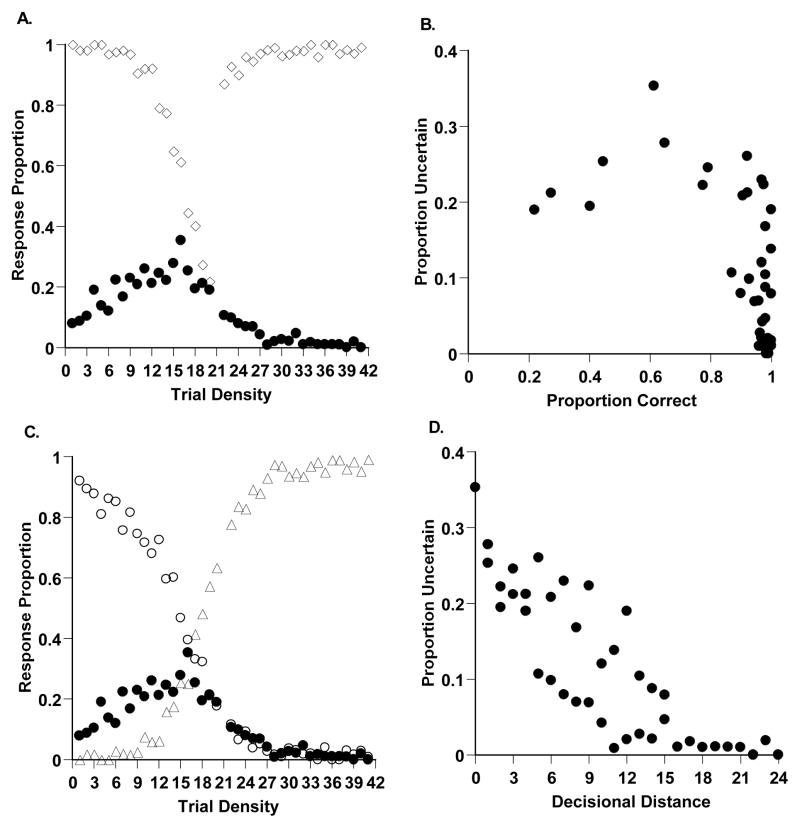
A macaques’ performance in Smith et al.’s (2006) Sparse-Dense discrimination. A. The horizontal axis indicates the density level of the box. The Sparse and Dense responses, respectively, were correct for boxes at density levels 1–20 and 22–41. The open diamonds show the proportion of trials attempted that were answered correctly. The dark circles show the proportion of trials receiving the uncertainty response at each density level. B. The macaque’s performance in the same task, with the proportion of trials declined at each trial level plotted against the proportion of correct responses. C. The macaque’s performance showing separately his use of the Sparse and Dense responses (open diamonds and open triangles). D. The macaque’s performance showing his proportion of trials declined at each trial level plotted against the decisional distance of the level from his decisional breakpoint (Level 16 = 0; Levels 15 and 17 = 1; etc.). From “Dissociating Uncertainty States and Reinforcement Signals in the Comparative Study of Metacognition,” by J. D. Smith, M. J. Beran, J. S. Redford, and D. A. Washburn, 2006, Journal of Experimental Psychology: General, 135, p. 292. Copyright 2006 by the American Psychological Association. Reprinted with permission.
Figure 2
Figure 2
A. The UR (uncertainty response) curves of simulated performers in Le Pelley’s (2012) associative model. B. The mean proportion of URs (averaged across trial levels) plotted against the fulcrum of URs (i.e., the point on the perceptual continuum that placed half of the URs to either side of it). C. The Average Absolute Deviation (a measure described in the text that summarizes the fit of simulated performers’ data pattern to the data in Smith et al., 2006) plotted against the fulcrum of URs.
Figure 3
Figure 3
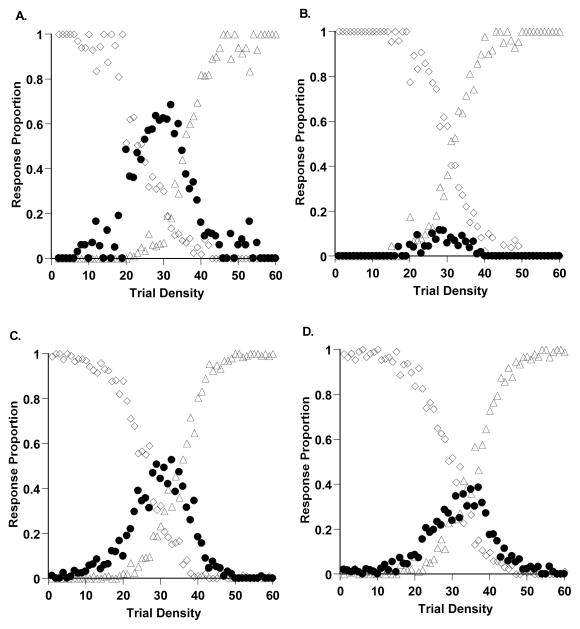
A. The performance of six capuchin monkeys in the Sparse-Uncertain-Dense task of Beran et al. (2009). The horizontal axis indicates the density level of the box. The proportions of trials ending with the Sparse response (open diamonds), Dense response (open triangles), and Uncertain response (filled circles) are shown for each trial level. B. The performance of the same capuchin monkeys in the Sparse-Middle -Dense task of Beran et al. (2009), depicted in a similar way. From “The Curious Incident of the Capuchins,” by J. D. Smith, M. J. Beran, J. J. Couchman, M. V. C. Coutinho, and J. B. Boomer, 2009, Comparative Cognition and Behavior Reviews, 4, p. 62.
Figure 4
Figure 4
A, B. Proportion of uncertainty responses (solid circles), sparse responses (open diamonds), and dense responses (open triangles) made by macaques Murph and Lou in their baseline performance and in their first phase of concurrent-load testing. C, D. Percentage of middle responses (solid circles), sparse responses (open diamonds), and dense responses (open triangles) made by macaques Hank and Gale in their baseline performance and in their first phase of concurrent-load testing. From “Executive-attentional uncertainty responses by rhesus macaques (Macaca mulatta)” by J. D. Smith, M. V. C. Coutinho, B. A. Church, & M. J. Beran, in press, Journal of Experimental Psychology: General. Copyright 2013 by the American Psychological Association. Reprinted with permission.
Figure 5
Figure 5
A. Memory performance by a macaque in the delayed matching-to-sample task of Hampton (2001). The horizontal axis indicates the length of the retention interval before matching could occur. The percentage of trials that received the uncertainty response is shown (solid line). The percentages correct of memory tests completed are also shown, on occasions when the memory test was mandatory (dashed line) or optional and voluntarily selected by the macaque (dotted line). B. Memory performance by a pigeon in the delayed matching-to-sample task of Inman and Shettleworth (1999).
Figure 6
Figure 6
A. Memory performance by a macaque in the metamemory task of Smith et al. (1998). NT denotes probe pictures that were Not There in the memory list of pictures. The serial position (1–4) of the probe picture in the list of pictures is also given along the X-axis for probes on There trials. The percentage of total trials that received the uncertainty response is shown (solid line). The percentage correct (of trials on which the memory test was accepted) is also shown (dashed line). B. Percentage error rates by two macaques (black and gray bars) when the difficulty of the memory test was increased by increasing the length of the memory list from 2, to 4, to 6 pictures. C. Percentage uncertainty responses (URs) by the two macaques when the difficulty of the memory test was increased in the same way. From “Memory monitoring by humans and animals,” by J. D. Smith, W. E. Shields, K. R. Allendoerfer, and D. A. Washburn, 1998, Journal of Experimental Psychology: General, 127, p. 236, p. 238. Copyright 1998 by the American Psychological Association. Reprinted with permission.
Figure A1
Figure A1
Top. The performance of a simulated subject in the paradigm of Smith et al. (2006), as modeled by Le Pelley’s (2012) associative-learning model. The horizontal axis indicates the density level of the box. The Sparse and Dense responses, respectively, were correct for boxes at density levels 1–20 and 22–41. The open diamonds, filled circles, and open triangles show, respectively, the proportion of Sparse, Uncertain, and Dense responses. Bottom. An X-ray of the contents of the simulated subject’s associative array, containing response strengths for Sparse (left), Uncertain (middle), and Dense (right) responses at subjective trial impressions of trials that run from −20 (trials making an intensely sparse impression) to 60 (trials making an intensely dense impression).

Comment in

References

    1. Adams A, Santi A. Pigeons exhibit higher accuracy for chosen memory tests than for forced memory tests in duration matching-to-sample. Learning & Behavior. 2011;39:1–11. - PubMed
    1. Balcomb FK, Gerken L. Three-year-old children can access their own memory to guide responses on a visual matching task. Developmental Science. 2008;11:750–760. - PubMed
    1. Basile BM, Hampton RR, Suomi SJ, Murray EA. An assessment of memory awareness in tufted capuchin monkeys (Cebus apella) Animal Cognition. 2009;12:169–180. - PMC - PubMed
    1. Benjamin AS, Bjork RA, Schwartz BL. The mismeasure of memory: When retrieval fluency is misleading as a metacognitive index. Journal of Experimental Psychology: General. 1998;127:55–68. - PubMed
    1. Beran MJ, Smith JD. Information seeking by rhesus monkeys (Macaca mulatta) and capuchin monkeys (Cebus apella) Cognition. 2011;120:90–105. - PMC - PubMed

Publication types