


Acoustic bubble removal to enhance SWL efficacy at high shock rate: an in vitro study
- PMID: 23957846
- PMCID: PMC3880900
- DOI: 10.1089/end.2013.0313
Acoustic bubble removal to enhance SWL efficacy at high shock rate: an in vitro study
Abstract
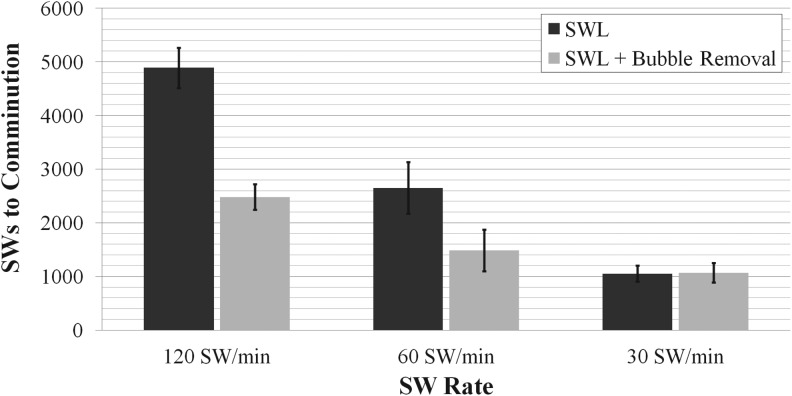
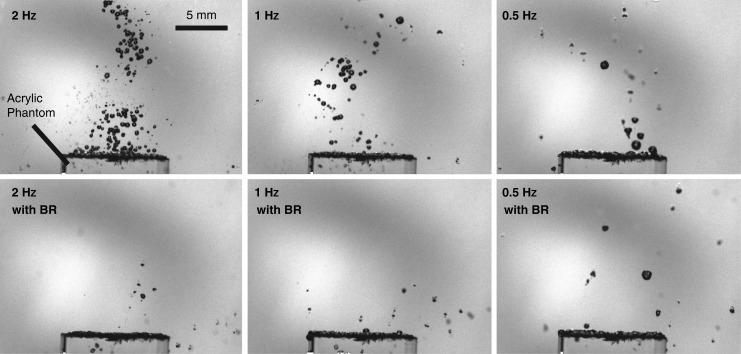
Rate-dependent efficacy has been extensively documented in shock wave lithotripsy (SWL) stone comminution, with shock waves (SWs) delivered at a low rate producing more efficient fragmentation in comparison to those delivered at high rates. Cavitation is postulated to be the primary source underlying this rate phenomenon. Residual bubble nuclei that persist along the axis of SW propagation can drastically attenuate the waveform's negative phase, decreasing the energy which is ultimately delivered to the stone and compromising comminution. The effect is more pronounced at high rates, as residual nuclei have less time to passively dissolve between successive shocks. In this study, we investigate a means of actively removing such nuclei from the field using a low-amplitude acoustic pulse designed to stimulate their aggregation and subsequent coalescence. To test the efficacy of this bubble removal scheme, model kidney stones were treated in vitro using a research electrohydraulic lithotripter. SWL was applied at rates of 120, 60, or 30 SW/min with or without the incorporation of bubble removal pulses. Optical images displaying the extent of cavitation in the vicinity of the stone were also collected for each treatment. Results show that bubble removal pulses drastically enhance the efficacy of stone comminution at the higher rates tested (120 and 60 SW/min), while optical images show a corresponding reduction in bubble excitation along the SW axis when bubble removal pulses are incorporated. At the lower rate of 30 SW/min, no difference in stone comminution or bubble excitation was detected with the addition of bubble removal pulses, suggesting that remnant nuclei had sufficient time for more complete dissolution. These results corroborate previous work regarding the role of cavitation in rate-dependent SWL efficacy, and suggest that the effect can be mitigated via appropriate control of the cavitation environment surrounding the stone.
Figures
References
-
- Vallancien G, Munoz R, Borghi M, Veillon B, Brisset JM, Daudon M. Relationship between the frequency of piezoelectric shock waves and the quality of renal stone fragmentation. In vitro study and clinical implications. Eur Urol 1989;16:41–44 - PubMed
-
- Wiksell H, Kinn AC. Implications of cavitation phenomena for shot intervals in extracorporeal shock wave lithotripsy. Br J Urol 1995;75:720–723 - PubMed
-
- Greenstein A, Matzkin H. Does the rate of extracorporeal shock wave delivery affect stone fragmentation? Urology 1999;54:430–432 - PubMed
-
- Weir MJ, Tariq N, Honey RJ. Shockwave frequency affects fragmentation in a kidney stone model. J Endourol 2000;14:547–550 - PubMed
Publication types
MeSH terms
Grants and funding
LinkOut - more resources
Full Text Sources
Other Literature Sources
