. 2013 Sep 10;52(36):6169-81.
doi: 10.1021/bi4008353. Epub 2013 Aug 29.

Amyloid fiber formation in human γD-Crystallin induced by UV-B photodamage

Affiliations

Amyloid fiber formation in human γD-Crystallin induced by UV-B photodamage

Sean D Moran et al. Biochemistry. .

Abstract

γD-Crystallin is an abundant structural protein of the lens that is found in native and modified forms in cataractous aggregates. We establish that UV-B irradiation of γD-Crystallin leads to structurally specific modifications and precipitation via two mechanisms: amorphous aggregates and amyloid fibers. UV-B radiation causes cleavage of the backbone, in large measure near the interdomain interface, where side chain oxidations are also concentrated. 2D IR spectroscopy and expressed protein ligation localize fiber formation exclusively to the C-terminal domain of γD-Crystallin. The native β-sandwich domains are not retained upon precipitation by either mechanism. The similarities between the amyloid forming pathways when induced by either UV-B radiation or low pH suggest that the propensity for the C-terminal β-sandwich domain to form amyloid β-sheets determines the misfolding pathway independent of the mechanism of denaturation.


Figures
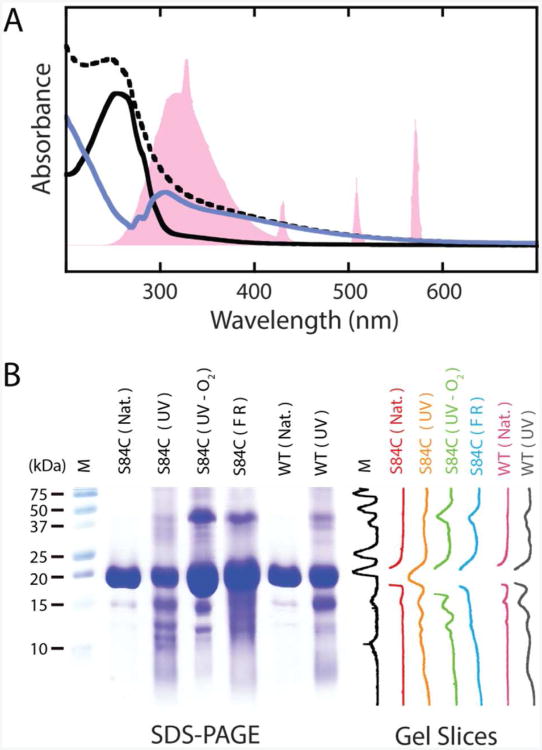
Figure 1
Figure 1
UV-B photodamage products of human γD-crystallin. A. UV-vis spectra of γD-crystallin before and after UV-B illumination. The output spectrum of the mercury vapor lamp, normalized to the protein absorption, is shown in pink. The spectrum of the protein before illumination (solid, black) shows absorption below 300 nm consistent with the tyrosine and tryptophan content of the protein. After exposure to UV-B light, the spectrum (dashed, black) becomes broadened into the visible range. Subtraction of the pre-UV-B spectrum from the spectrum of the photodamaged protein yields a difference spectrum (solid, blue) with a bleach between 250 and 305 nm. The band structure of this bleach suggests a loss of tryptophan absorption. B. SDS-PAGE characterization of γD-crystallin degradation via UV-B photodamage and chemical methods. From left to right are molecular weight marker (M), undamaged γD-crystallin (S84C) (S84C (Nat.)), UV-B photodamaged γD-crystallin (S84C) (S84C (UV)), UV-B photodamaged γD-crystallin (S84C) in deoxygenated buffer (S84C (UV-O2)), γD-crystallin (S84C) exposed to Fenton's reagent (S84C (FR)), undamaged wild type γD-crystallin (WT (Nat.)), and UV-B photodamaged wild type γD-crystallin (WT (UV)), respectively. Vertical slices of the gel image are shown for comparison of each sample.
Figure 2
Figure 2
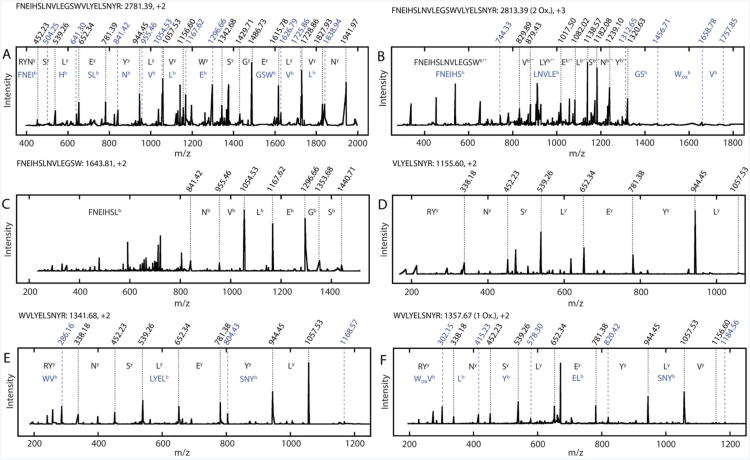
Set of representative CID spectra of tryptic and semitryptic peptides used in the analysis of backbone cleavage and side chain oxidation. The most complete ion series identified (black) are indicated, as are ion series containing information revealing oxidation sites (blue) where appropriate. The m/z values for each assigned peak are indicated on each spectrum, as are the amino acids and/or peptides to which they correspond. Superscripts on peak assignments denote the ion series to which the peak belongs. Full ion data are shown in Tables S1-6. A. CID spectrum of unmodified (control) γD-crystallin tryptic peptide 117-139 prior to UV-B exposure. B. CID spectrum of tryptic peptide 117-139 after UV-B exposure, with oxidation at W130. C. CID spectrum of semitryptic peptide 117-139. D. CID spectrum of semitryptic peptide 131-139. E. CID spectrum of semitryptic peptide 130-139. F. CID spectrum of semitryptic peptide 130-139, with oxidation at W130.
Figure 3
Figure 3
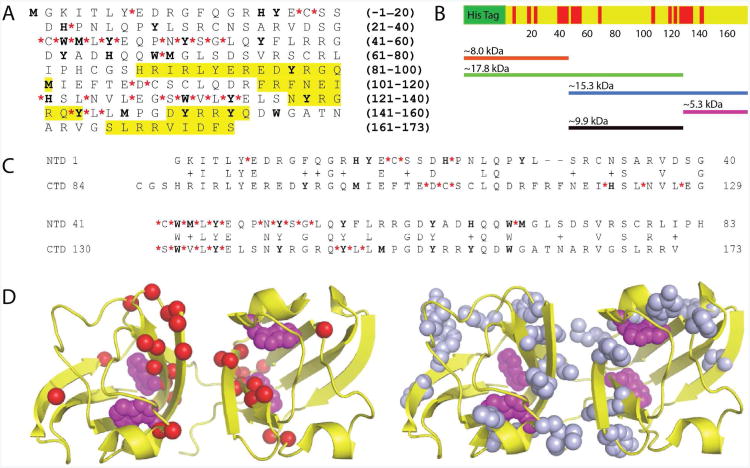
A. Sequence of human γD-crystallin with the locations non-tryptic cleavage sites (red asterisks) and side chain damage sites (bold) identified by LC-MS/MS. Sequences highlighted in yellow were previously identified as containing modifications by antibody reactivity. B. Distribution and density of non-tryptic cleavage sites (red) in the primary structure of γD-crystallin. C. Sequence alignment of the N-terminal domain and C-terminal domain of human γD-crystallin, with UV-B induced modifications identified as in (A). D. Left: Locations of non-tryptic cleavage sites (red spheres) in the native crystal structure of human γD-crystallin (PDB ID: 1HK0). Photoactive tryptophans are also shown (purple spheres). Right: Side chains oxidized by UV-B radiation (blue non-Trp and purple Trp) are shown as spheres.
Figure 4
Figure 4
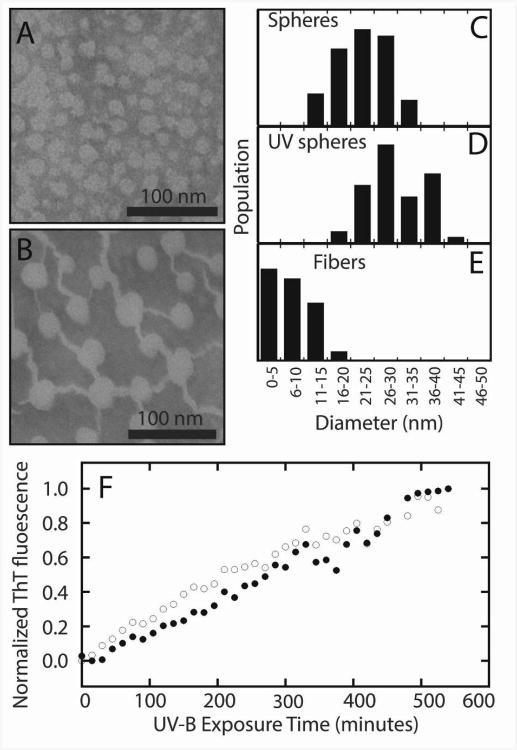
Aggregates of human γD-crystallin. TEM images of undamaged (A) and UV-B photodamaged (B) γD-crystallin (S84C) show the presence of spherical bodies in both samples, and the formation of fibers in the photodamaged sample after 6 hours of illumination. Analysis of the diameters of spheres and fibers in both samples (C-E) shows a slight increase in sphere sizes from ∼20 nm to ∼30 nm and the formation of fibers with a mean diameter of ∼6 nm. The aggregation of wild type (open circles) and S84C (closed circles) γD-crystallin is accompanied by an increase in ThT fluorescence over the course of 9 hours (F).
Figure 5
Figure 5
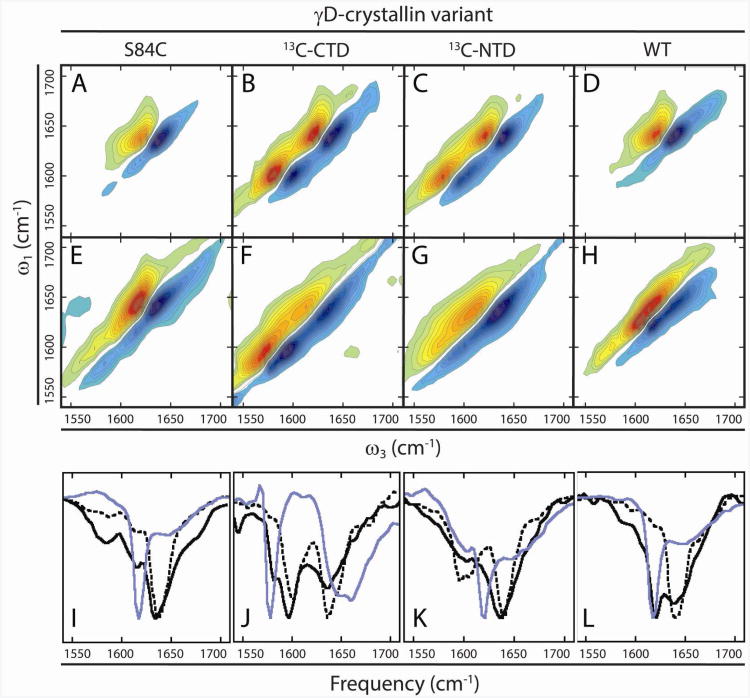
2D IR spectra of γD-crystallin variants. In native, undamaged γD-crystallin (A-D), unlabeled β-sandwich domains appear at ∼1638 cm−1 along the diagonal, and labeled domains appear at ∼1598 cm−1. Segmentally labeled S84C proteins (B,C) have highly similar spectra with two major diagonal peaks. UV-B photodamaged samples of these proteins (E-H) reveal shifts in the spectra consistent with denaturation of the N-terminal domain and the formation of low-frequency amyloid β-sheet signals arising from the C-terminal domain. Diagonal slices (I-L) of native (dashed, black), UV-B photodamaged (solid, black), and acid-induced amyloid fibers (solid, blue) of each variant reveal the appearance of signals consistent with amyloid fiber formation in the UV-B photodamaged samples.

References

    1. Wang Y, King JA. Protein Misfolding Diseases. John Wiley & Sons, Inc; 2010. Cataract as a protein-aggregation disease; pp. 487–515.
    1. Bloemendal H, de Jong W, Jaenicke R, Lubsen NH, Slingsby C, Tardieu A. Ageing and vision: structure, stability and function of lens crystallins. Prog Biophys Mol Biol. 2004;86:407–485. - PubMed
    1. Truscott RJW. Age-related nuclear cataract—oxidation is the key. Experimental Eye Research. 2005;80:709–725. - PubMed
    1. Hanson SRA, Hasan A, Smith DL, Smith JB. The Major in vivo Modifications of the Human Water-insoluble Lens Crystallins are Disulfide Bonds, Deamidation, Methionine Oxidation and Backbone Cleavage. Experimental Eye Research. 2000;71:195–207. - PubMed
    1. Varma SD, Hegde KR, Kovtun S. UV-B-induced damage to the lens in vitro: prevention by caffeine. Journal of ocular pharmacology and therapeutics: the official journal of the Association for Ocular Pharmacology and Therapeutics. 2008;24:439–444. - PMC - PubMed

Publication types

LinkOut - more resources