


A developmental study on the neural circuitry mediating response flexibility in bipolar disorder
- PMID: 23958598
- PMCID: PMC3759594
- DOI: 10.1016/j.pscychresns.2013.05.002
A developmental study on the neural circuitry mediating response flexibility in bipolar disorder
Abstract
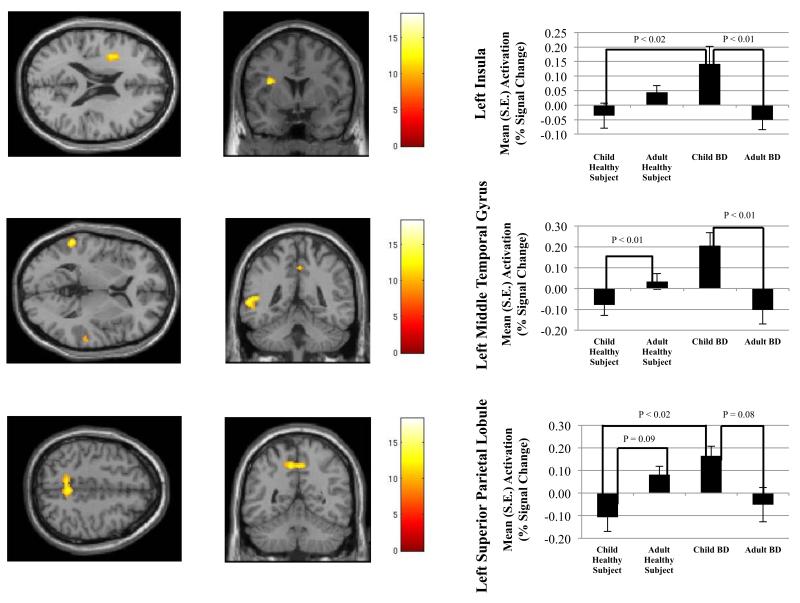
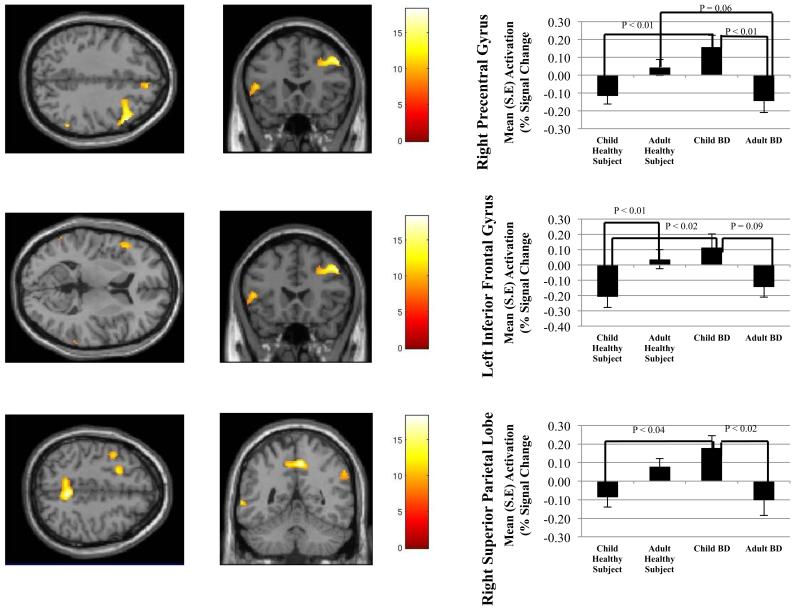
Cross-sectional neuroimaging studies are an important first step in examining developmental differences in brain function between adults and youth with bipolar disorder (BD). Impaired response flexibility may contribute to reduced ability to modify goal-directed behavior in BD appropriately. We compared neural circuitry mediating this process in child (CBD) vs. adult BD (ABD) and age-matched healthy subjects. fMRI data from 15 CBD, 23 ABD, 20 healthy children, and 27 healthy adults were acquired during a response flexibility paradigm, a task where subjects inhibit a prepotent response and execute an alternative response. When successfully executing an alternate response, CBD showed frontal, parietal, and temporal hyperactivation relative to healthy children and ABD, while ABD hypoactivated these regions relative to healthy adults. Previous studies of response flexibility in healthy volunteers revealed frontal, temporal, and parietal cortex hyperactivation in children and hypoactivation in adults. Relative to age-matched healthy subjects, we found hyperactivation in these regions in CBD and hypoactivation in ABD. This suggests that our findings in patients may represent the extreme extension of the age-related response flexibility activation differences found in healthy subjects. Future studies should use longitudinal fMRI to examine the developmental trajectory of the neural circuitry mediating response flexibility in BD.
Keywords: Bipolar disorder; Cross-sectional; Neuroimaging; Response flexibility; Stop-change task.
Published by Elsevier Ireland Ltd.
Figures
References
-
- Aron AR, Robbins TW, Poldrack RA. Inhibition and the right inferior frontal cortex. Trends in Cognitive Sciences. 2004;8:170–177. - PubMed
-
- Birmaher MDB. Longitudinal Course of Pediatric Bipolar Disorder. American Journal of Psychiatry. 2007;164:537–539. - PubMed
-
- Blumberg HP, Kaufman J, Martin A, Whiteman R, Zhang JH, Gore JC, Charney DS, Krystal JH, Peterson BS. Amygdala and hippocampal volumes in adolescents and adults with bipolar disorder. Archives of general psychiatry. 2003;60:1201–1208. - PubMed
-
- Bora E, Yucel M, Pantelis C. Cognitive endophenotypes of bipolar disorder: A meta-analysis of neuropsychological deficits in euthymic patients and their first-degree relatives. Journal of Affective Disorders. 2009;113:1–20. - PubMed
-
- Brambilla P, Harenski K, Nicoletti MA, Mallinger AG, Frank E, Kupfer DJ, Keshavan MS, Soares JC. Anatomical MRI study of basal ganglia in bipolar disorder patients. Psychiatry Research: Neuroimaging. 2001;106:65–80. - PubMed
Publication types
MeSH terms
Grants and funding
LinkOut - more resources
Full Text Sources
Other Literature Sources
Medical
