Review
. 2014 Feb;71(3):449-65.
doi: 10.1007/s00018-013-1438-6.

Molecular mechanisms of CRISPR-mediated microbial immunity

Review

Molecular mechanisms of CRISPR-mediated microbial immunity

Giedrius Gasiunas et al. Cell Mol Life Sci. 2014 Feb.

Abstract

Bacteriophages (phages) infect bacteria in order to replicate and burst out of the host, killing the cell, when reproduction is completed. Thus, from a bacterial perspective, phages pose a persistent lethal threat to bacterial populations. Not surprisingly, bacteria evolved multiple defense barriers to interfere with nearly every step of phage life cycles. Phages respond to this selection pressure by counter-evolving their genomes to evade bacterial resistance. The antagonistic interaction between bacteria and rapidly diversifying viruses promotes the evolution and dissemination of bacteriophage-resistance mechanisms in bacteria. Recently, an adaptive microbial immune system, named clustered regularly interspaced short palindromic repeats (CRISPR) and which provides acquired immunity against viruses and plasmids, has been identified. Unlike the restriction–modification anti-phage barrier that subjects to cleavage any foreign DNA lacking a protective methyl-tag in the target site, the CRISPR–Cas systems are invader-specific, adaptive, and heritable. In this review, we focus on the molecular mechanisms of interference/immunity provided by different CRISPR–Cas systems.


Figures
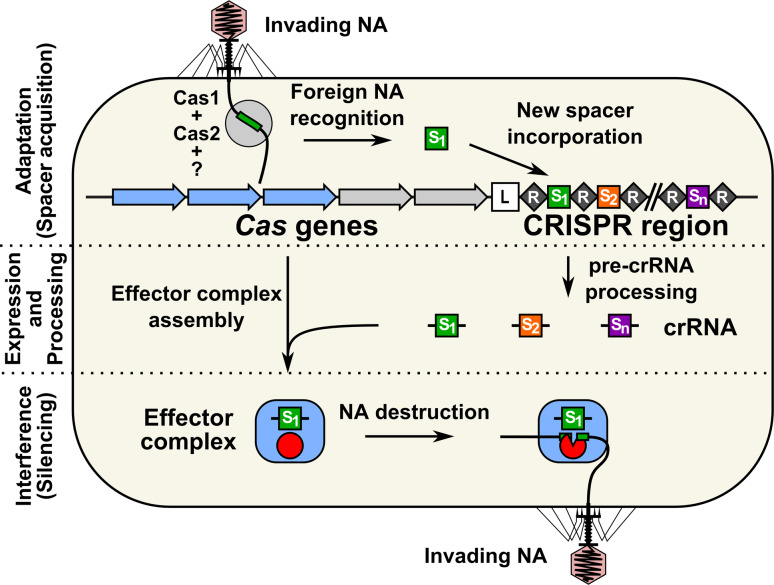
Fig. 1
Fig. 1
The CRISPR–Cas adaptive microbial immune system confers acquired resistance against invading nucleic acids. CRISPR array consists of short partially palindromic repeats (black diamonds) interspaced by unique DNA sequences called spacers (colored squares). Cas genes (arrows) are encoded in the vicinity of the CRISPR array. The CRISPR–Cas mechanism is arbitrarily divided into three main stages: (1) adaptation or spacer acquisition, (2) expression and processing (crRNA generation), and (3) interference or silencing. During adaptation, Cas proteins recognize invasive nucleic acid (NA) and integrate short pieces of foreign DNA into the CRISPR region as new spacers. Spacers are inserted at the leader (L) proximal end followed by duplication of the repeat. From the perspective of the microbial immune system, the adaptation step is analogous to the immunization of bacteria by an invasive nucleic acid and memorization of the invader. In the expression and processing stage, the CRISPR repeat-spacer array is transcribed into a long primary RNA transcript (pre-crRNA) that is further processed into a set of small crRNAs, containing a conserved repeat fragment and a variable spacer sequence (guide) complementary to the invading nucleic acid. crRNAs further combine with Cas proteins into an effector complex. In the interference or silencing stage, the effector complex recognizes the target sequence in the invasive nucleic acid by base pairing and induces sequence-specific cleavage, thereby preventing proliferation and propagation of foreign genetic elements. From the perspective of the microbial immune system, the expression/interference step would be analogous to the immune response of a “vaccinated” host against invasive nucleic acid
Fig. 2
Fig. 2
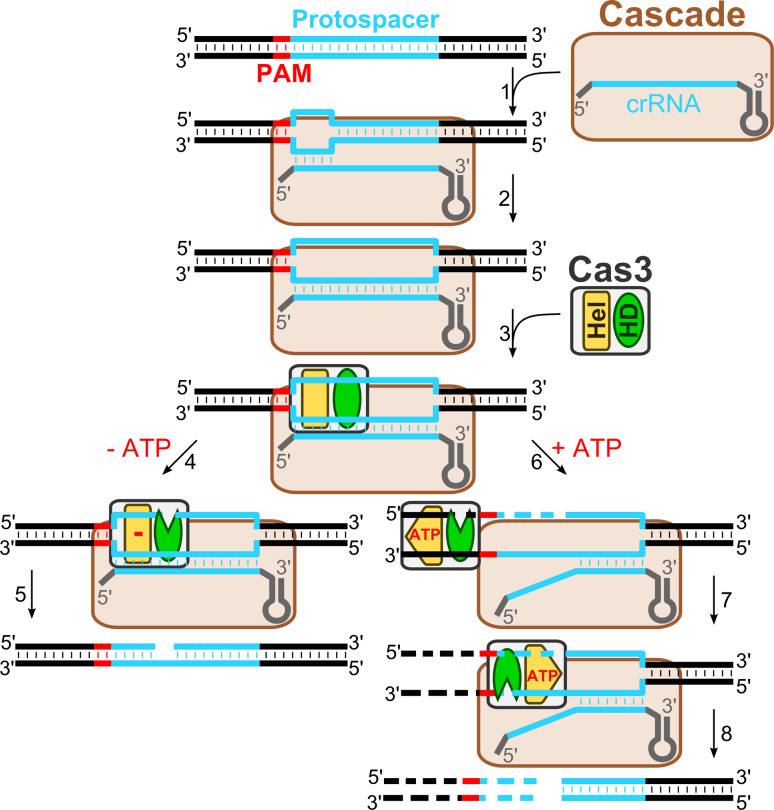
DNA-interference in the Type I CRISPR–Cas systems. Cascade scans DNA for a protospacer sequence and PAM. Once the correct PAM and a short primary hybridization sequence (“seed”) are identified (1), the crRNA basepairs with a complementary DNA strand forming R-loop (2). Displaced DNA strand of the R-loop serves as landing site for Cas3 (3). In the absence of ATP, the Cas3 nuclease domain (HD) cleaves a displaced non-target strand within a protospacer (4) producing a nicked DNA (5). In the presence of ATP, Cas3 remodels the Cascade–DNA complex making both target and non-target strands available for the Cas3 cleavage within a protospacer sequence (6). Cas3 further translocates in the 3′ → 5′ direction powered by a helicase domain (Hel) whereas the HD domain degrades DNA (6; 7) in a unidirectional manner (8)
Fig. 3
Fig. 3
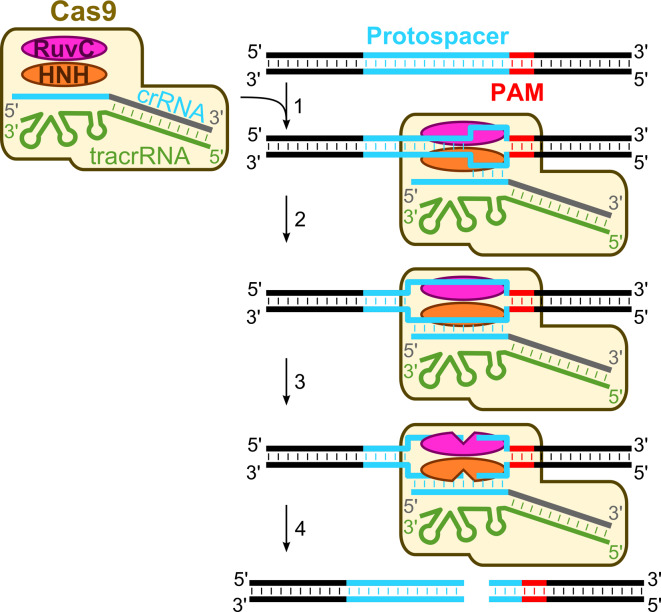
DNA-interference in the Type II CRISPR–Cas systems. The Cas9–crRNA–tracrRNA ternary complex scans DNA for a protospacer sequence and PAM. Once the correct PAM and a short primary hybridization sequence (“seed”) are identified (1), the crRNA basepairs with a complementary DNA strand forming R-loop (2). Once the R-loop is formed, Cas9 cuts both target and non-target DNA strands using the RuvC and the HNH active sites, respectively (3). Cleavage occurs 3 nt before PAM, yielding blunt-end DNA products (4)
Fig. 4
Fig. 4
Interference in the Type III CRISPR–Cas systems. In the case of the Type III-B CRISPR–Cas system, the Cmr complex scans RNA and crRNA basepairs with a matching protospacer sequence (1). Two different RNA cleavage mechanisms are proposed. The Cmr complex from P. furiosus exploits the ruler mechanism to introduce cuts in the target RNA 14 nt from the 3′-end of crRNA (2) to yield two product fragments (3). The Cmr complex of S. sulfolobus guided by crRNA cuts the target RNA in a sequence-specific manner at UA dinucleotides (4) at multiple positions (5). The Cmr complex components involved in the cleavage have yet to be established

References

    1. Sturino JM, Klaenhammer TR. Engineered bacteriophage-defence systems in bioprocessing. Nat Rev Microbiol. 2006;4:395–404. - PubMed
    1. Labrie SJ, Samson JE, Moineau S. Bacteriophage resistance mechanisms. Nat Rev Microbiol. 2010;8:317–327. - PubMed
    1. Bickle TA, Krüger DH. Biology of DNA restriction. Microbiol Rev. 1993;57:434–450. - PMC - PubMed
    1. Rifat D, Wright NT, Varney KM, et al. Restriction endonuclease inhibitor IPI* of bacteriophage T4: a novel structure for a dedicated target. J Mol Biol. 2008;375:720–734. - PMC - PubMed
    1. Makarova KS, Wolf YI, Snir S, Koonin EV. Defence islands in bacterial and archaeal genomes and prediction of novel defence systems. J Bacteriol. 2011;193:6039–6056. - PMC - PubMed

Publication types

MeSH terms