


Association between endothelial dysfunction and frailty: the Toledo Study for Healthy Aging
- PMID: 23959520
- PMCID: PMC3889911
- DOI: 10.1007/s11357-013-9576-1
Association between endothelial dysfunction and frailty: the Toledo Study for Healthy Aging
Abstract
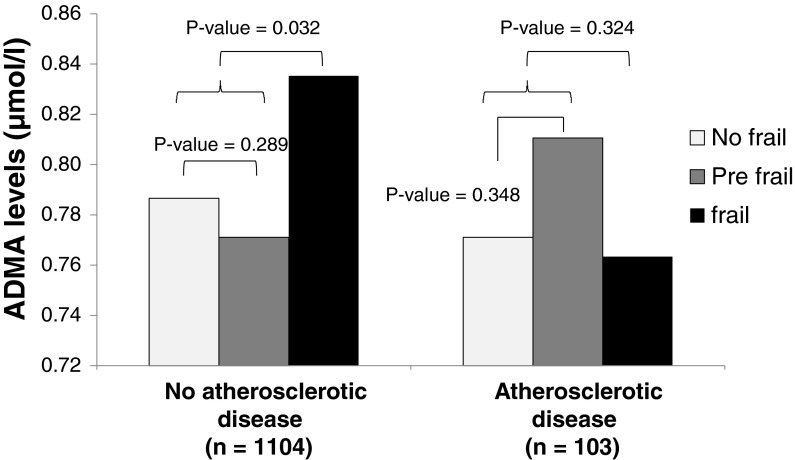
Cardiovascular disease (CVD), both clinical and subclinical, has been proposed as one of the mechanisms underlying frailty. However, there is no evidence addressing the relationship between the earliest stage of CVD (endothelial dysfunction) and frailty. The goal of the study was to analyze the association between endothelial dysfunction, evaluated by asymmetric dimethylarginine (ADMA) levels, and frailty. We used data from the Toledo Study for Healthy Aging, a prospective Spanish cohort study. Biological samples were obtained and ADMA levels were determined using an enzyme immunoassay method. Logistic regression was used to estimate the odds ratio (OR) and 95 % confidence intervals of frailty associated with ADMA. Adjustments were made for age, gender, cardiovascular risk factors, and presence of atherosclerotic disease (assessed by ankle–brachial index; ABI). One thousand two hundred eighty-seven community-dwelling elderly were included. One hundred seven (8.3 %) were identified as frail, 542 (42.1 %) as pre-frail, and 638 (49.6 %) as non-frail. ADMAvalues were higher in frail subjects than in non-frail ones. In addition, an interaction between the presence of atherosclerotic disease and ADMA on the odds of frailty (p=0.045) was detected. After adjustments for age, classical cardiovascular risk factors, and ABI, the risk of frailty was associated with increasing levels of ADMA in subjects without atherosclerotic disease [OR for 1 standard deviation increase in ADMA=1.14 (1.01–1.28), p=0.032] but not in those with atherosclerotic disease. In our study, endothelial dysfunction, assessed by ADMA levels, is associated with frailty. These findings provide additional support for a relevant role of vascular system since its earliest stage in frailty.
Figures
References
-
- ACCF/AHA Focused update of the guideline for the management of patients with peripheral artery disease (Updating the 2005 Guideline): a report of the American College of Cardiology Foundation/American Heart Association Task Force on practice guidelines (2011) Circulation. 2011;124(18):2020–2045. doi: 10.1161/CIR.0b013e31822e80c3. - DOI - PubMed
-
- Achan V, Broadhead M, Malaki M, Whitley G, Leiper J, MacAllister R, Vallance P. Asymmetric dimethylarginine causes hypertension and cardiac dysfunction in humans and is actively metabolized by dimethylarginine dimethylaminohydrolase. Arterioscler Thromb Vasc Biol. 2003;23(8):1455–1459. doi: 10.1161/01.ATV.0000081742.92006.59. - DOI - PubMed
-
- Angulo J, Vallejo S, El Assar M, Garcia-Septiem J, Sanchez-Ferrer CF, Rodriguez-Manas L. Age-related differences in the effects of alpha and gamma peroxisome proliferator-activated receptor subtype agonists on endothelial vasodilation in human microvessels. Exp Gerontol. 2012 - PubMed
-
- Beltowski J, Kedra A. Asymmetric dimethylarginine (ADMA) as a target for pharmacotherapy. Pharmacol Rep. 2006;58(2):159–178. - PubMed
Publication types
MeSH terms
Substances
LinkOut - more resources
Full Text Sources
Other Literature Sources
Medical