


The persistence of adolescent binge drinking into adulthood: findings from a 15-year prospective cohort study
- PMID: 23959750
- PMCID: PMC3753516
- DOI: 10.1136/bmjopen-2013-003015
The persistence of adolescent binge drinking into adulthood: findings from a 15-year prospective cohort study
Abstract
Objectives: To examine the prevalence of binge drinking in adolescence and its persistence into adulthood in an Australian cohort.
Design: 15-year prospective cohort study.
Setting: Victoria, Australia.
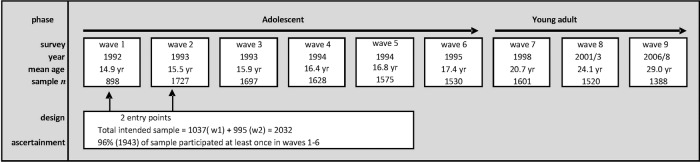
Participants: 1943 adolescents were recruited from secondary schools at age 14-15 years.
Primary outcome measures: Levels of past-week 'binge' drinking (5+ standard drinks on a day, each 10 g alcohol) and 'heavy binge' drinking (20+ standard drinks on a day for males, 11+ for females) were assessed during six adolescent waves, and across three adult waves up to age 29 years.
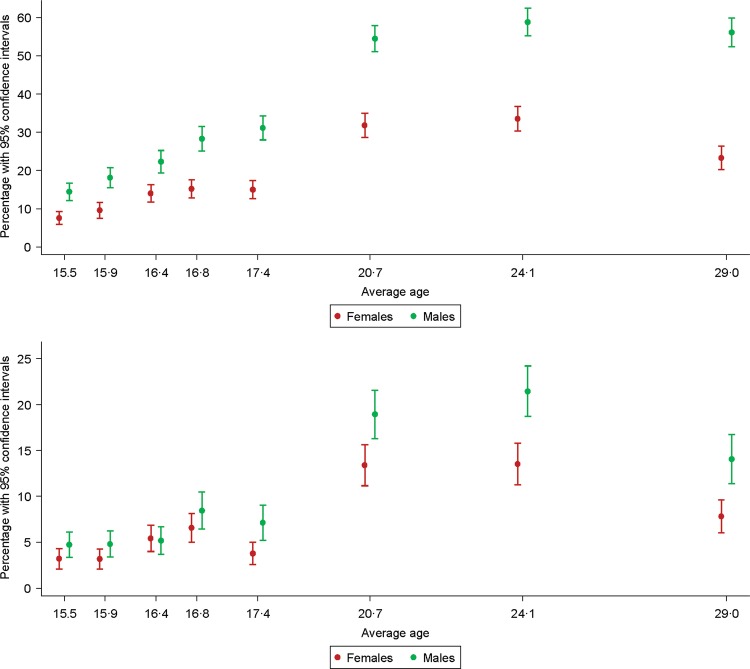
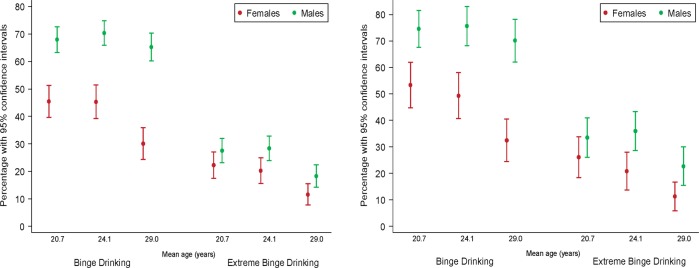
Results: Half of the males (52%) and a third of the females (34%) reported past-week adolescent binge drinking. 90% of male and 70% of female adolescent-onset binge drinkers continued to binge in young adulthood; 70% of males and 48% of females who were not adolescent-onset binge drinkers reported young adult binge drinking. Past-week heavy bingeing was less common in adolescence than adulthood. Overall, 35% of the sample (95% CI 33% to 38%) reported past-week binge drinking in adolescence and young adulthood and one-third (33%; 30% to 35%) first reported binge drinking in young adulthood; only 7% of the sample (6-8%) had binge drinking in adolescence but not young adulthood. 'Heavy binge' drinking occurred in adolescence and young adulthood for 9% (8% to 10%); 8% (7% to 10%) reported it in adolescence but no longer in young adulthood; and 24% (22% to 26%) began 'heavy binge' drinking in young adulthood. Among adolescent binge drinkers (n=821), young adult binge and heavy binge drinking were predicted by being male, adolescent antisocial behaviour and adverse consequences of drinking in adolescence.
Conclusions: Binge alcohol use is common and persistent among young Australians. Efforts to prevent the onset of binge drinking during adolescence may substantially reduce harmful patterns of alcohol use in young adulthood.
Keywords: Epidemiology; Public Health.
Figures
References
-
- Gore FM, Bloem PJN, Patton GC, et al. Global burden of disease in young people aged 10–24 years: a systematic analysis. Lancet 2011;377:2093–102 - PubMed
-
- World Health Organization Global status report on alcohol and health. Geneva: World Health Organization, 2009
-
- World Health Organization The global burden of disease: 2004 update. Geneva: World Health Organization, 2008
-
- Australian Institute of Health and Welfare National Drug Strategy Household Survey 2010—detailed findings. Canberra: Australian Institute of Health and Welfare, 2011
-
- Currie C, Zanotti C, Morgan A, et al. Social determinants of health and well-being among young people. Health behaviour in school-aged children (HBSC) study: International report from the 2009/2010 survey. Health Policy for Children and Adolescents, No. 6. Copenhagen: WHO Regional Office for Europe, 2012
LinkOut - more resources
Full Text Sources
Other Literature Sources
Medical
Miscellaneous
