


Is teenage pregnancy an obstetric risk in a welfare society? A population-based study in Finland, from 2006 to 2011
- PMID: 23959755
- PMCID: PMC3753503
- DOI: 10.1136/bmjopen-2013-003225
Is teenage pregnancy an obstetric risk in a welfare society? A population-based study in Finland, from 2006 to 2011
Abstract
Objective: To assess obstetric outcomes in teenage pregnancies in a country with a low teenage delivery rate and comprehensive high-quality prenatal care.
Design: Retrospective population-based register study.
Setting: Finland.
Participants: All nulliparous teenagers (13-15 years (n=84), 16-17 years (n=1234), 18-19 years (n=5987)) and controls (25-year-old to 29-year-old women (n=51 142)) with singleton deliveries in 2006-2011.
Main outcome measures: Risk of adverse obstetric outcomes adjusted for demographic factors and clinically relevant pregnancy complications, with main focus on maternal pregnancy complications.
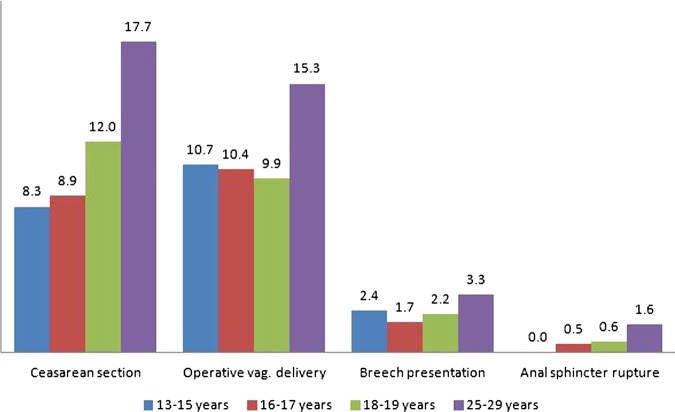
Results: Teenage mothers were more likely than controls to live in rural areas (16% (n=1168) vs 11.8% (n=6035)), smoke (36.4% (n=2661) vs 7% (n=3580)) and misuse alcohol or drugs (1.1% (n=82) vs 0.2% (n=96); p<0.001 for all). Teenagers made a good mean number of antenatal clinic visits (16.4 vs 16.5), but were more likely to have attended fewer than half of the recommended visits (3% (n=210) vs 1.4% (n=716)). Teenagers faced increased risks of several obstetric complications, for example, anaemia (adjusted OR 1.8, 95% CI 1.6 to 2.1), proteinuria (1.8, 1.2 to 2.6), urinary tract infection (UTI; 2.9, 1.8 to 4.8), pyelonephritis (6.3, 3.8 to 10.4) and eclampsia (3.2, 1.4 to 7.3), the risks increasing with descending age for most outcomes. Elevated risks of pre-eclampsia (3.7, 1.5 to 9.0) and preterm delivery (2.5, 1.2 to 5.3) were also found among 13-year-olds to 15-year-olds. However, teenage mothers were more likely to have vaginal delivery (1.9, 1.7 to 2.0) without complications. Inadequate prenatal care among teenagers was a risk factor of eclampsia (12.6, 2.6 to 62.6), UTI (5.8, 1.7 to 19.7) and adverse neonatal outcomes.
Conclusions: Pregnant teenagers tended to be socioeconomically disadvantaged versus controls and faced higher risks of various pregnancy complications. Special attention should be paid to enrolling teenagers into adequate prenatal care in early pregnancy.
Keywords: Adolescent; PERINATOLOGY; PUBLIC HEALTH.
Figures
References
-
- Paranjothy S, Broughton H, Adappa R, et al. Teenage pregnancy: who suffers? Arch Dis Child 2009;94:239–45 - PubMed
-
- E-Risk Study T. Teen-aged mothers in contemporary Britain. J Child Psychol Psychiatry 2002;43:727–42 - PubMed
-
- Olausson PO, Haglund B, Weitoft GR, et al. Teenage childbearing and long-term socioeconomic consequences: a case study in Sweden. Fam Plann Perspect 2001;33:70–4 - PubMed
-
- Otterblad Olausson P, Haglund B, Ringback Weitoft G, et al. Premature death among teenage mothers. BJOG 2004;111:793–9 - PubMed
-
- Olausson PO, Cnattingius S, Haglund B. Teenage pregnancies and risk of late fetal death and infant mortality. Br J Obstet Gynaecol 1999;106:116–21 - PubMed
Grants and funding
LinkOut - more resources
Full Text Sources
Other Literature Sources
