


Do men consult less than women? An analysis of routinely collected UK general practice data
- PMID: 23959757
- PMCID: PMC3753483
- DOI: 10.1136/bmjopen-2013-003320
Do men consult less than women? An analysis of routinely collected UK general practice data
Abstract
Objective: To examine whether gender differences in primary care consultation rates (1) vary by age and deprivation status and (2) diminish when consultation for reproductive reasons or common underlying morbidities are accounted for.
Design: Cross-sectional study of a cohort of patients registered with general practice.
Setting: UK primary care.
Subjects: Patients (1 869 149 men and 1 916 898 women) registered with 446 eligible practices in 2010.
Primary outcome measures: Primary care consultation rate.
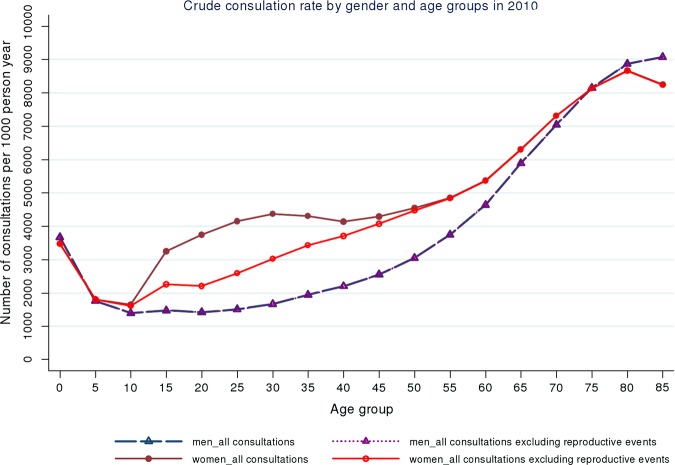
Results: This study analyses routinely collected primary care consultation data. The crude consultation rate was 32% lower in men than women. The magnitude of gender difference varied across the life course, and there was no 'excess' female consulting in early and later life. The greatest gender gap in primary care consultations was seen among those aged between 16 and 60 years. Gender differences in consulting were higher in people from more deprived areas than among those from more affluent areas. Accounting for reproductive-related consultations diminished but did not eradicate the gender gap. However, consultation rates in men and women who had comparable underlying morbidities (as assessed by receipt of medication) were similar; men in receipt of antidepressant medication were only 8% less likely to consult than women in receipt of antidepressant medication (relative risk (RR) 0.916, 95% CI 0.913 to 0.918), and men in receipt of medication to treat cardiovascular disease were just 5% less likely to consult (RR=0.950, 95% CI 0.948 to 0.952) than women receiving similar medication. These small gender differences diminished further, particularly for depression (RR=0.950, 95% CI 0.947 to 0.953), after also taking account of reproductive consultations.
Conclusions: Overall gender differences in consulting are most marked between the ages of 16 and 60 years; these differences are only partially accounted for by consultations for reproductive reasons. Differences in consultation rates between men and women were largely eradicated when comparing men and women in receipt of medication for similar underlying morbidities.
Keywords: Epidemiology; Health Services Administration & Management; Primary Care; Social Medicine.
Figures
References
-
- Bird CE, Rieker PP. Gender matters: an integrated model for understanding men's and women's health. Soc Sci Med 1999;48:745–55 - PubMed
-
- Wizemann TM, Pardue M-L. Exploring the biological contributions to human health: does sex matter? The National Academies Press, 2001 - PubMed
-
- Waldron I. Trends in gender differences in mortality: relationships to changing gender differences in behaviour and other causal factors. In: Annandale E, Hunt K. eds Gender inequalites in health. Buckingham: Open University Press, 2000:150–81
-
- Briscoe ME. Why do people go to the doctor? Sex differences in the correlates of GP consultation. Soc Sci Med 1987;25:507–13 - PubMed
Grants and funding
LinkOut - more resources
Full Text Sources
Other Literature Sources
Miscellaneous
