


Impact of bone and liver metastases on patients with renal cell carcinoma treated with targeted therapy
- PMID: 23962746
- PMCID: PMC4123121
- DOI: 10.1016/j.eururo.2013.08.012
Impact of bone and liver metastases on patients with renal cell carcinoma treated with targeted therapy
Abstract
Background: The skeleton and liver are frequently involved sites of metastasis in patients with metastatic renal cell carcinoma (RCC).
Objective: To analyze outcomes based on the presence of bone metastases (BMs) and/or liver metastases (LMs) in patients with RCC treated with targeted therapy.
Design, setting, and participants: We conducted a review from the International Metastatic Renal Cell Carcinoma Database Consortium (IMDC) of 2027 patients with metastatic RCC.
Outcome measurements and statistical analysis: We analyzed the impact of the site of metastasis on overall survival (OS) and time-to-treatment failure. Statistical analyses were performed using multivariable Cox regression.
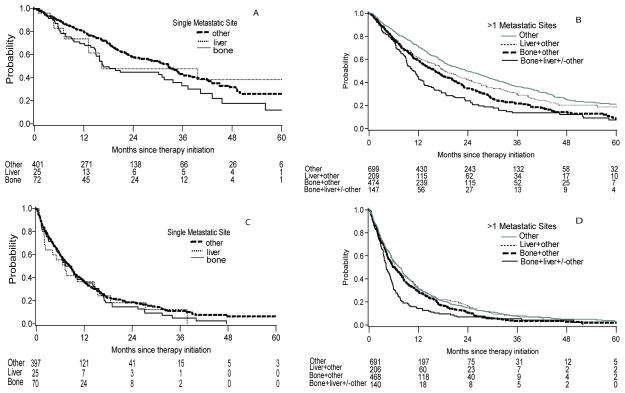
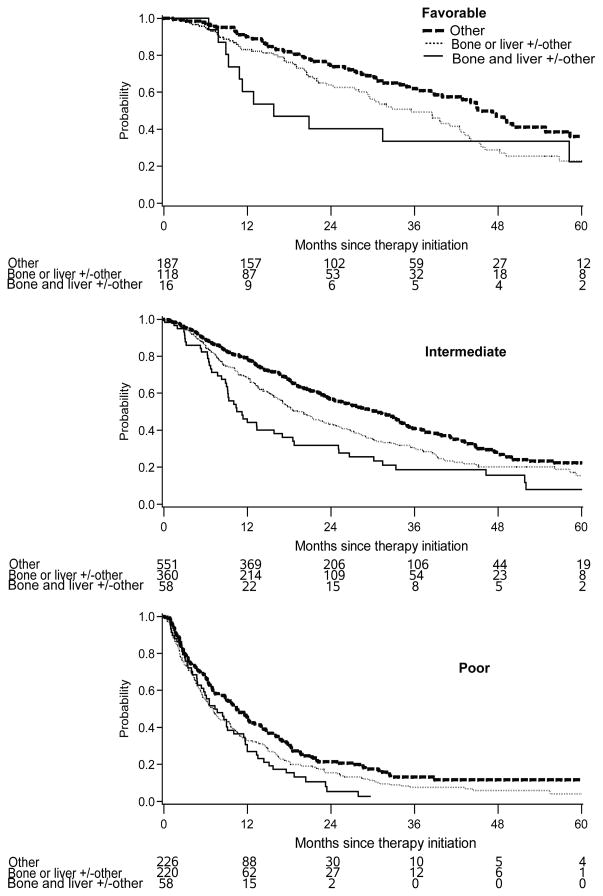
Results and limitations: The presence of BMs was 34% overall, and when stratified by IMDC risk groups was 27%, 33%, and 43% in the favorable-, intermediate-, and poor-risk groups, respectively (p<0.001). The presence of LMs was 19% overall and higher in the poor-risk patients (23%) compared with the favorable- or intermediate-risk groups (17%) (p=0.003). When patients were classified into four groups based on the presence of BMs and/or LMs, the hazard ratio, adjusted for IMDC risk factors, was 1.4 (95% confidence interval [CI], 1.22-1.62) for BMs, 1.42 (95% CI, 1.17-1.73) for LMs, and 1.82 (95% CI, 1.47-2.26) for both BMs and LMs compared with other metastatic sites (p<0.0001). The prediction model performance for OS was significantly improved when BMs and LMs were added to the IMDC prognostic model (likelihood ratio test p<0.0001). Data in this analysis were collected retrospectively.
Conclusions: The presence of BMs and LMs in patients treated with targeted agents has a negative impact on survival. Patients with BMs and/or LMs may benefit from earlier inclusion on clinical trials of novel agents or combination-based therapies.
Keywords: Bone metastases; Liver metastases; Outcome; Renal cell carcinoma; VEGF therapy; mTOR inhibitors.
Copyright © 2013 European Association of Urology. Published by Elsevier B.V. All rights reserved.
Figures
Comment in
-
Kidney cancer: predicting survival after targeted therapy for mRCC.Nat Rev Urol. 2013 Oct;10(10):554. doi: 10.1038/nrurol.2013.205. Epub 2013 Sep 3. Nat Rev Urol. 2013. PMID: 23999581 No abstract available.
-
Do the sites of metastases provide additional information regarding prognosis and biology in renal cell carcinoma?Eur Urol. 2014 Mar;65(3):585-6. doi: 10.1016/j.eururo.2013.09.001. Epub 2013 Sep 9. Eur Urol. 2014. PMID: 24044979 No abstract available.
References
-
- Bianchi M, Sun M, Jeldres C, et al. Distribution of metastatic sites in renal cell carcinoma: a population-based analysis. Ann Oncol. 2012;23:973–80. - PubMed
-
- Woodward E, Jagdev S, McParland L, et al. Skeletal complications and survival in renal cancer patients with bone metastases. Bone. 2011;48:160–6. - PubMed
-
- Heng DY, Xie W, Regan MM, et al. Prognostic factors for overall survival in patients with metastatic renal cell carcinoma treated with vascular endothelial growth factor-targeted agents: results from a large, multicenter study. J Clin Oncol. 2009;27:5794–9. - PubMed
-
- Donskov F, von der Maase H. Impact of immune parameters on long-term survival in metastatic renal cell carcinoma. J Clin Oncol. 2006;24:1997–2005. - PubMed
Publication types
MeSH terms
Grants and funding
LinkOut - more resources
Full Text Sources
Other Literature Sources
Medical
Miscellaneous
