


Genome analysis reveals insights into physiology and longevity of the Brandt's bat Myotis brandtii
- PMID: 23962925
- PMCID: PMC3753542
- DOI: 10.1038/ncomms3212
Genome analysis reveals insights into physiology and longevity of the Brandt's bat Myotis brandtii
Abstract
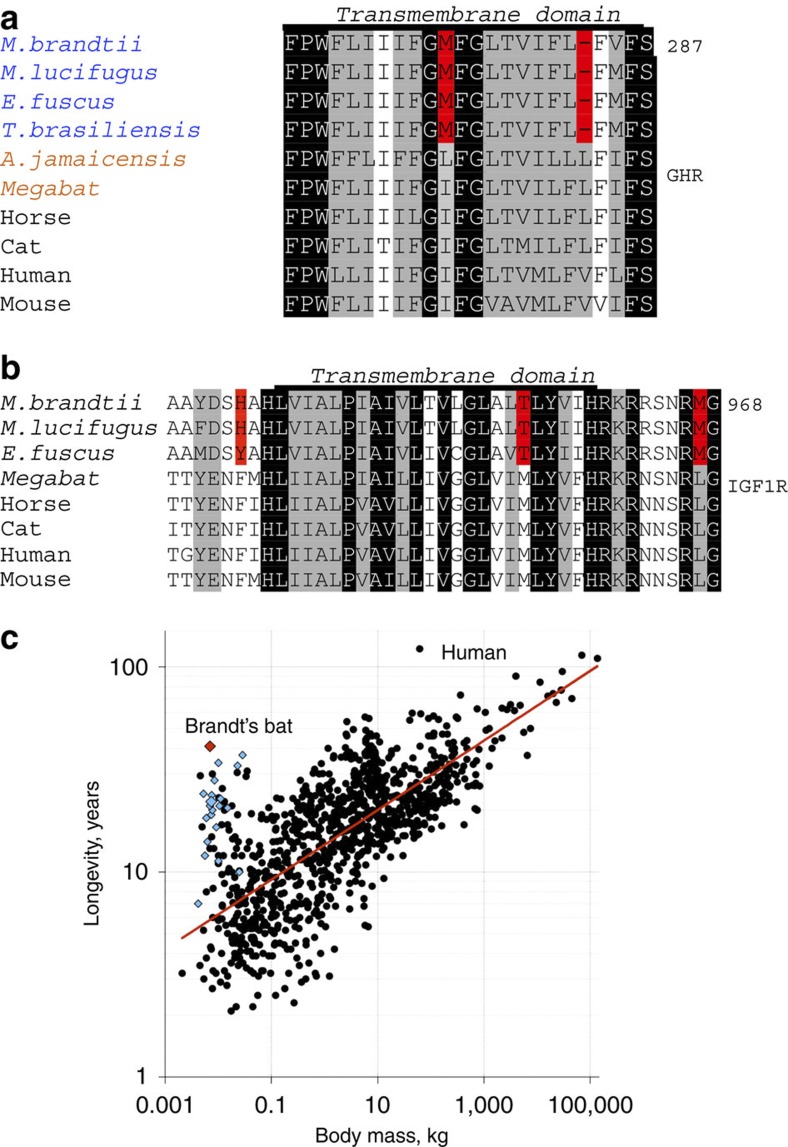
Bats account for one-fifth of mammalian species, are the only mammals with powered flight, and are among the few animals that echolocate. The insect-eating Brandt's bat (Myotis brandtii) is the longest-lived bat species known to date (lifespan exceeds 40 years) and, at 4-8 g adult body weight, is the most extreme mammal with regard to disparity between body mass and longevity. Here we report sequencing and analysis of the Brandt's bat genome and transcriptome, which suggest adaptations consistent with echolocation and hibernation, as well as altered metabolism, reproduction and visual function. Unique sequence changes in growth hormone and insulin-like growth factor 1 receptors are also observed. The data suggest that an altered growth hormone/insulin-like growth factor 1 axis, which may be common to other long-lived bat species, together with adaptations such as hibernation and low reproductive rate, contribute to the exceptional lifespan of the Brandt's bat.
Figures
References
-
- Simmons N. B. InMammal species of the World: A Taxonomic and Geographic Reference Johns Hopkins University Press (2005).
-
- Kirkwood T. B. & Austad S. N. Why do we age? Nature 408, 233–238 (2000). - PubMed
-
- Podlutsky A. J., Khritankov A. M., Ovodov N. D. & Austad S. N. A new field record for bat longevity. J. Gerontol. A Biol. Sci. Med. Sci. 60, 1366–1368 (2005). - PubMed
-
- Hughes A. L. & Hughes M. K. Small genomes for better flyers. Nature. 377, 391 (1995). - PubMed
Publication types
MeSH terms
Substances
Associated data
- Actions
- Actions
Grants and funding
LinkOut - more resources
Full Text Sources
Other Literature Sources
Molecular Biology Databases
