. 2013 Nov;41(21):9651-62.
doi: 10.1093/nar/gkt701. Epub 2013 Aug 20.

Mediator is an intrinsic component of the basal RNA polymerase II machinery in vivo

Affiliations

Mediator is an intrinsic component of the basal RNA polymerase II machinery in vivo

Thierry Lacombe et al. Nucleic Acids Res. 2013 Nov.

Abstract

Mediator is a prominent multisubunit coactivator that functions as a bridge between gene-specific activators and the basal RNA polymerase (Pol) II initiation machinery. Here, we study the poorly documented role of Mediator in basal, or activator-independent, transcription in vivo. We show that Mediator is still present at the promoter when the Pol II machinery is recruited in the absence of an activator, in this case through a direct fusion between a basal transcription factor and a heterologous DNA binding protein bound to the promoter. Moreover, transcription resulting from activator-independent recruitment of the Pol II machinery is impaired by inactivation of the essential Mediator subunit Med17 due to the loss of Pol II from the promoter. Our results strongly support that Mediator is an integral component of the minimal machinery essential in vivo for stable Pol II association with the promoter.


Figures
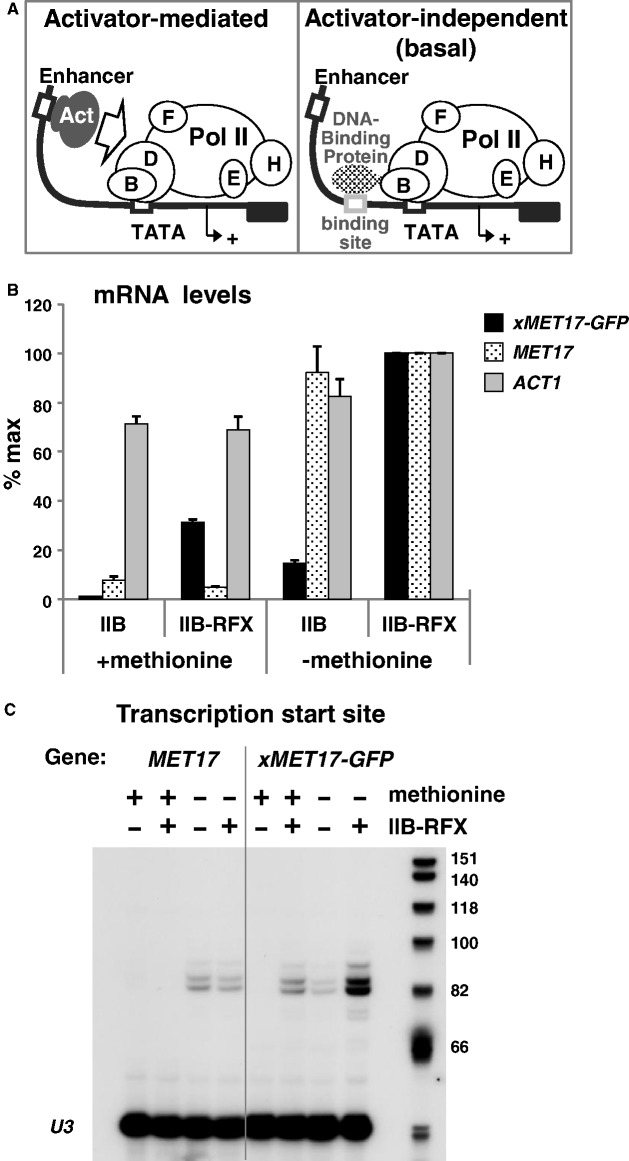
Figure 1.
Figure 1.
TFIIB-RFX supports accurate transcription initiation from a MET17 promoter containing an upstream RFX binding site. (A) Experimental strategy. See text for details. (B) Strain Y892 (see Supplementary Table S1) containing YCp33-xMET17-GFP, and either pRS314-TFIIB (IIB) or pRS314-TFIIB-RFX (IIB-RFX), were grown in glucose-containing CSM medium supplemented with 0.5 mM methionine (+methionine), or in glucose-containing YNB medium with no methionine (−methionine). RNA levels for xMET17-GFP, MET17 and ACT1 were quantified by RT-qPCR and normalized to 25S rRNA levels. Values are expressed as a percentage of the maximum value. Error bars represent standard deviations from three independent experiments. (C) Same RNA preparations as in (B) were subjected to primer extension analysis with primers for MET17 and xMET17-GFP starting in both cases at exactly the same distance from MET17 TATA box (175 bp). U3 snoRNA was used as a control.
Figure 2.
Figure 2.
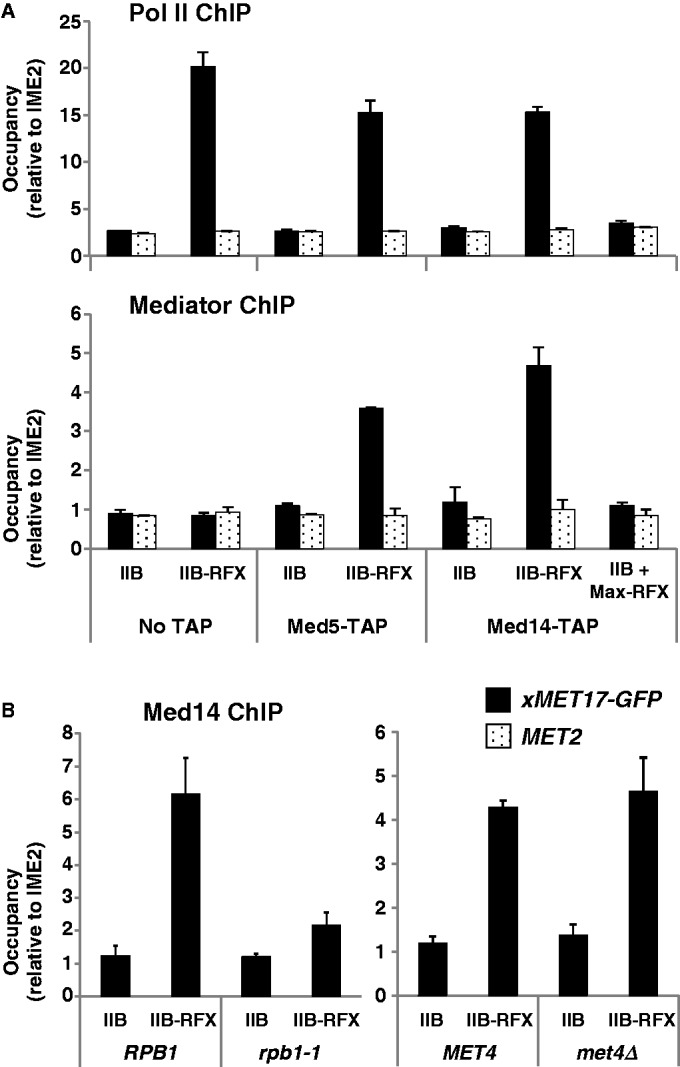
Transcriptional activation of xMET17 by TFIIB-RFX leads to Mediator recruitment. (A) Untagged (No TAP) and TAP-tagged cells (Y892, Y893 and Y894) containing YCp33-xMET17-GFP and either pRS313-IIB or pRS313-IIB-RFX, or pRS313-IIB plus pRS315-Max-RFX, were grown in glucose-containing CSM medium supplemented with 0.5 mM methionine. Mediator and Pol II occupancy at xMET17-GFP and MET2 was measured by ChIP. DNA was quantitated by qPCR using primers specific for the ORF (Pol II ChIP) or for the promoter (Mediator ChIP). Occupancy levels were normalized using the ORF of the transcriptionally inactive gene IME2. Error bars indicate standard deviations from three independent experiments. (B) Left graph: A Med14 TAP-tagged rpb1-1 mutant and the isogenic wild-type strain (Y909 and Y911) containing YCp33-xMET17-GFP and pRS313-IIB or pRS313-IIB-RFX, were grown to early log phase at 25°C in CSM medium supplemented with 0.5 mM methionine, and were shifted to 37°C for 45 min before formaldehyde fixation. Mediator occupancy was measured by ChIP as in (A). Right graph: A met4-disrupted, Med14 TAP-tagged strain (met4Δ) and the isogenic wild-type strain (Y894 and Y963) containing YCp33-xMET17-GFP, and pRS314-IIB or pRS314-IIB-RFX, were grown and submitted to ChIP as above.
Figure 3.
Figure 3.
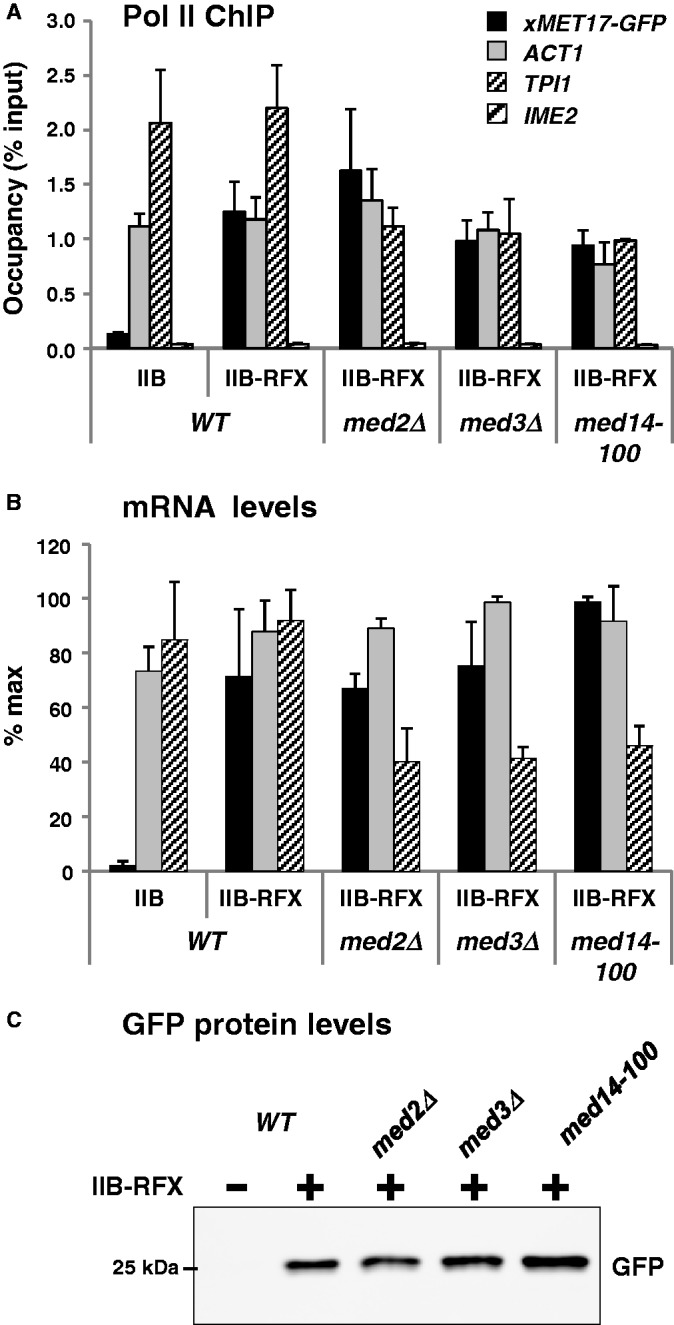
Mutation of Mediator tail module has no effect on transcriptional activation of xMET17 by TFIIB-RFX. The med2Δ, med3 Δ and med14-100 mutants (Y807, Y809 and Y811) and the isogenic wild-type strain (Y805) containing YCp33-xMET17-GFP, and either pRS314-IIB or pRS314-IIB-RFX, were grown at 28°C in glucose-containing CSM medium supplemented with 0.5 mM methionine. (A) Pol II occupancy at xMET17-GFP, ACT1, TPI1 and IME2 was measured by ChIP. DNA was analysed by qPCR using primers for the ORFs of GFP (5′ORF), ACT1, TPI1 and IME2. Error bars indicate standard deviations from three independent experiments. (B) RNA levels quantified as in Figure 1. (C) Western blot on whole cell extracts using anti-GFP antibody.
Figure 4.
Figure 4.
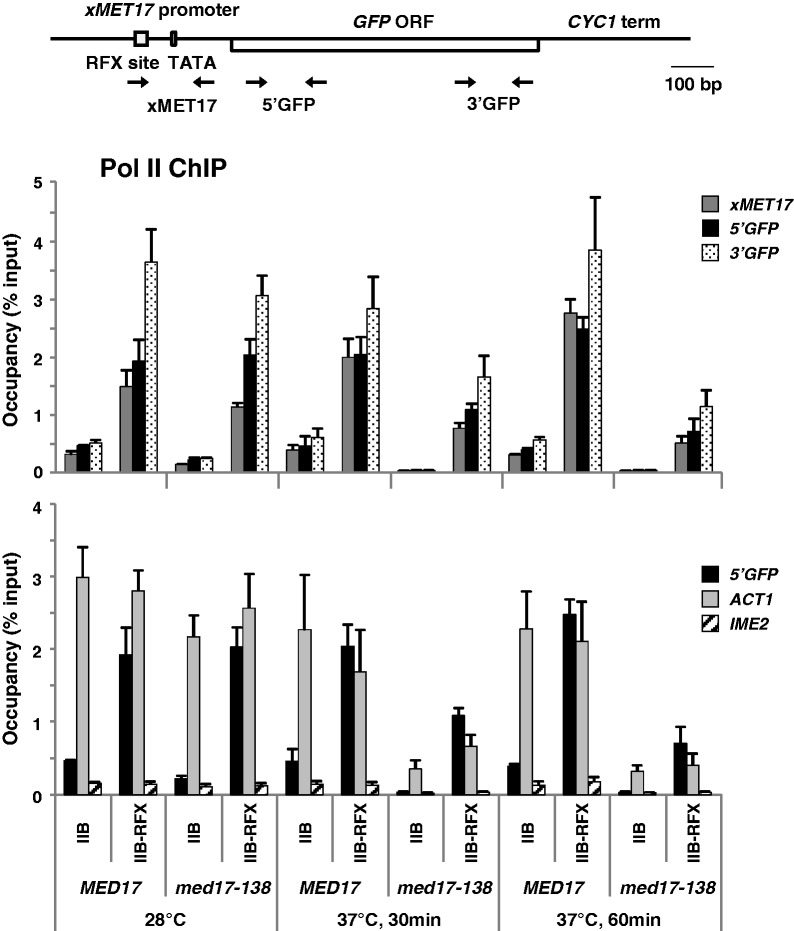
Med17 inactivation affects transcriptional activation by TFIIB-RFX from the xMET17 promoter. The med17-138 mutant and an isogenic wild-type strain (Y822 and Y823) containing YCp33-xMET17-GFP, and either pRS314-IIB or pRS314-IIB-RFX, were grown at 28°C to early log phase in glucose-containing CSM medium supplemented with 0.5 mM methionine, and were shifted at 37°C. Pol II occupancy was analysed by ChIP. Samples were fixed with formaldehyde before, and 30 or 60 min after the temperature shift. DNA was analysed by qPCR using primers for the promoter or the ORF of xMET17-GFP (see top schematic diagram), and primers for the ORF of ACT1 and IME2. Error bars indicate standard deviations from four independent experiments.
Figure 5.
Figure 5.
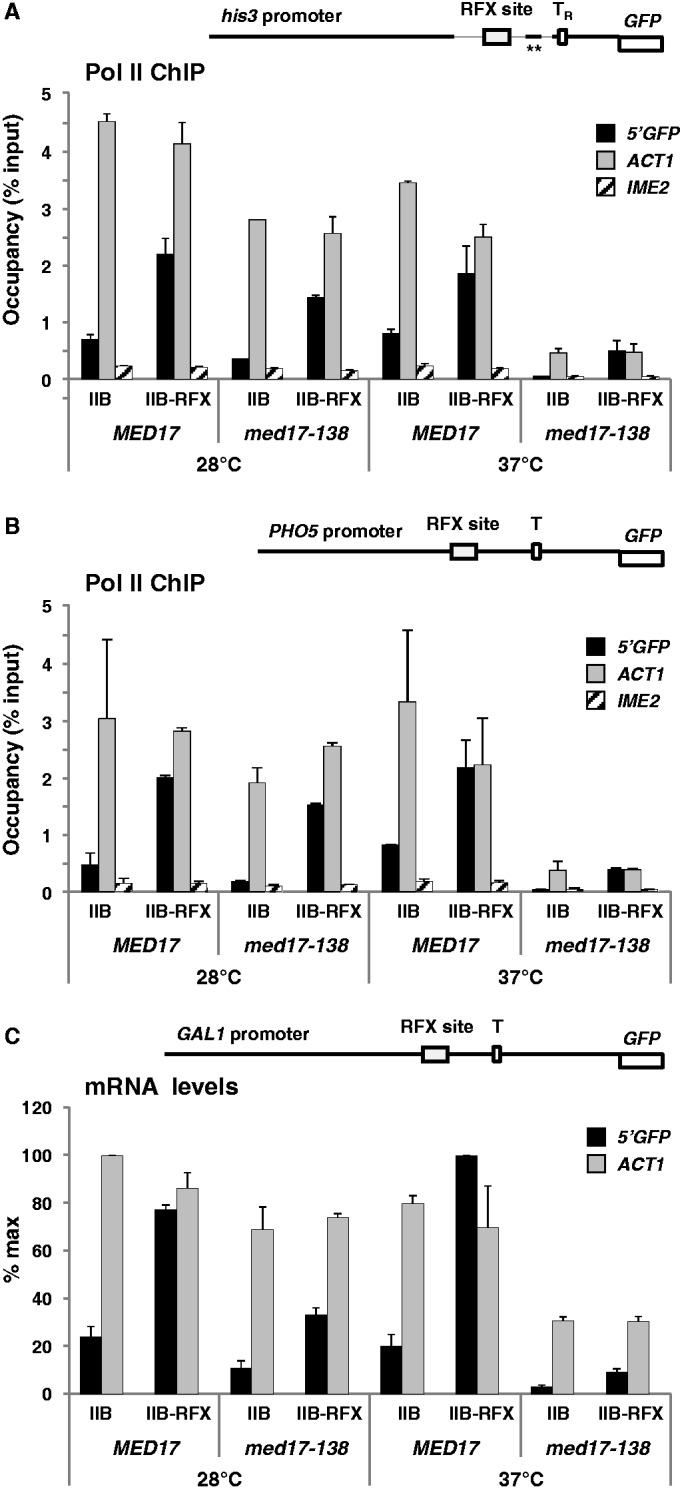
Transcriptional activation by TFIIB-RFX from HIS3, PHO5 and GAL1 promoter derivatives containing the RFX binding site is affected in the med17-138 mutant. (A) Top diagram: schematic representation of the xhis3-GFP test gene containing an RFX binding site 72 bp upstream the canonical TATA element (TR) of HIS3. The thick lines corresponds from left to right to positions −750 to −464, −125 to −108 and −78 to −1 of HIS3, and the asterisks indicate mutations in the Gcn4 binding site. TR is at −70. Graph: Pol II occupancy at GFP, ACT1 and IME2 ORF measured by ChIP. The med17-138 mutant and an isogenic wild-type strain (Y822 and Y823) containing YCp33-xhis3-GFP, and either pRS314-IIB or pRS314-IIB-RFX, were grown in glucose-containing CSM medium at 28°C to early log phase, and were shifted to 37°C. Samples were processed for ChIP analysis as in Figure 4. Error bars represent standard deviations from two independent experiments. (B) Upper diagram: schematic representation of the xPHO5-GFP gene containing an RFX binding site 80 bp upstream PHO5 TATA element. The thick line corresponds to positions −392 to −1 of PHO5. The TATA element is at −101. Graph: Pol II occupancy at GFP, ACT1 and IME2 ORF measured by ChIP. The med17-138 mutant and an isogenic wild-type strain (Y822 and Y823) containing YCp33-xPHO5-GFP, and either pRS314-IIB or pRS314-IIB-RFX, were grown and processed for ChIP analysis as in (A). (C) Top diagram: schematic representation of the xGAL1-GFP gene containing an RFX binding site 67 bp upstream of the GAL1 TATA element. The thick line corresponds to positions −500 to −1 of GAL1. The TATA element is at −147. Graph: RNA levels for xGAL1-GFP and ACT1 quantified by RT-qPCR as shown in Figure 1. Error bars represent standard deviations from two independent experiments.
Figure 6.
Figure 6.
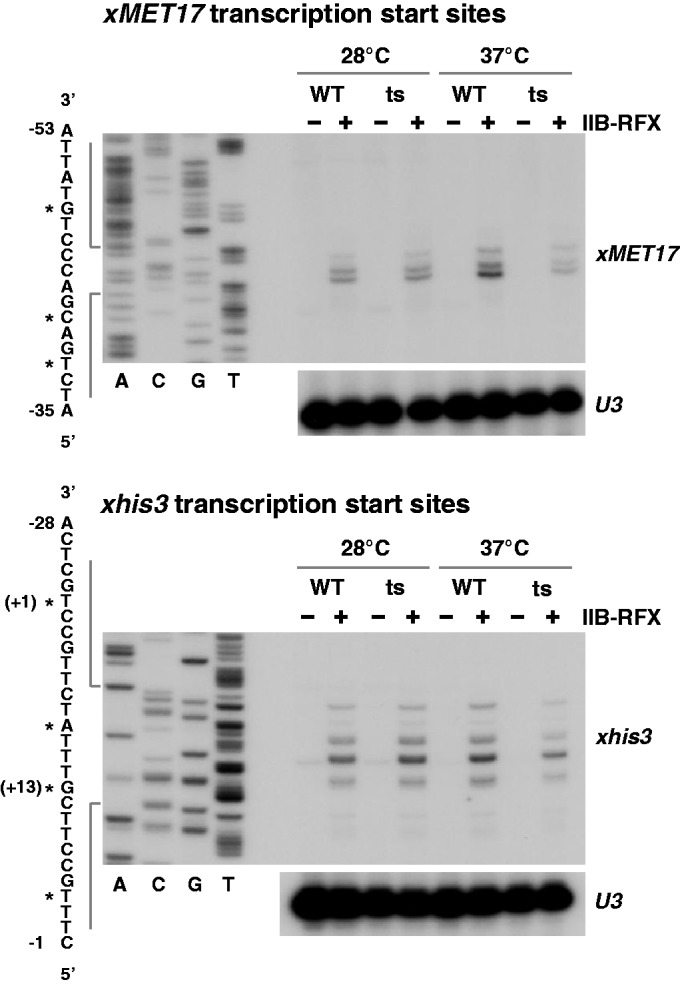
Med17 inactivation has no effect on start site selection at xMET17 and xhis3 promoters. Primer extension analysis was performed using the same RNA preparations as shown in Figure 4 (xMET17 start sites) and Figure 5 (xhis3 start sites) with a primer starting at position +74 of GFP. The sequencing DNA ladder was generated using the same primer and a plasmid bearing xMET17-GFP or xhis3-GFP. The asterisks indicate the major TSSs. Positions are given relative to the start codon. U3 snoRNA was used as a control.
Figure 7.
Figure 7.
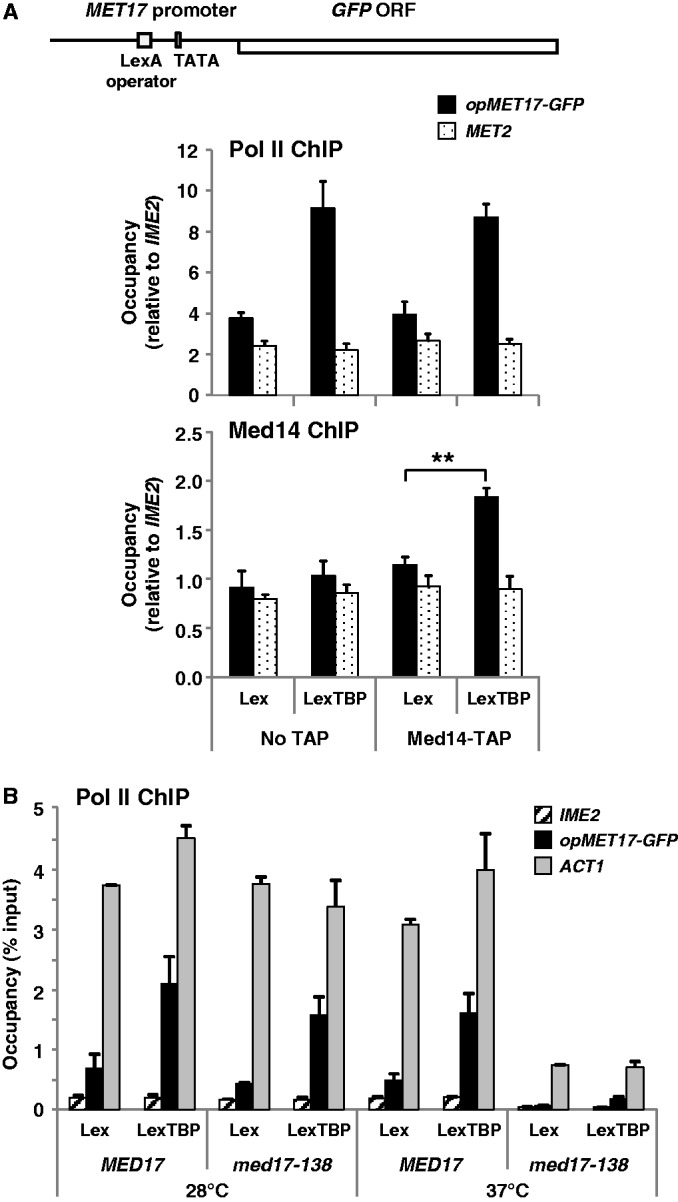
Transcriptional activation by LexA-TBP from a MET17 derivative containing the LexA operator requires Mediator. (A) Untagged (No TAP) and Med14 TAP-tagged cells (Y14 and Y84) containing YCp33-opMET17-GFP (see schematic representation) and either pRS313-LexA (Lex) or pRS313-LexA-TBP (LexTBP) were grown as shown in Figure 2. Pol II and Med14-TAP occupancy at opMET17-GFP and MET2 was measured by ChIP. DNA was analysed by qPCR using primers for the ORF (Pol II ChIP) or the promoter (Mediator ChIP). Occupancy levels were normalized using IME2 ORF. Error bars indicate standard deviations from three (Pol II ChIP) or four (Mediator ChIP) independent experiments. Asterisks indicate P < 0.005 in a Student’s t test. (B) The med17(srb4)-138 mutant and an isogenic wild-type strain (Y400 and Y402) containing YCp33-opMET17-GFP and either YCp91-LexA (Lex) or YCp91-LexA-TBP (LexTBP) were grown at 28°C to early log phase in CSM medium supplemented with 0.5 mM methionine, and were shifted to 37°C. Pol II occupancy was measured by ChIP before and 60 min after the shift. DNA was analysed by qPCR using primers for the 5′-end of GFP ORF, ACT1 ORF and IME2 ORF. Error bars indicate standard deviations from two independent experiments.

References

    1. Kornberg RD. Mediator and the mechanism of transcriptional activation. Trends Biochem. Sci. 2005;30:235–239. - PubMed
    1. Malik S, Roeder RG. The metazoan Mediator co-activator complex as an integrative hub for transcriptional regulation. Nat. Rev. Genet. 2010;11:761–772. - PMC - PubMed
    1. Guglielmi B, van Berkum NL, Klapholz B, Bijma T, Boube M, Boschiero C, Bourbon HM, Holstege FC, Werner M. A high resolution protein interaction map of the yeast mediator complex. Nucleic Acids Res. 2004;32:5379–5391. - PMC - PubMed
    1. Davis JA, Takagi Y, Kornberg RD, Asturias FA. Structure of the yeast RNA polymerase II holoenzyme: mediator conformation and polymerase interaction. Mol. Cell. 2002;10:409–415. - PubMed
    1. Borggrefe T, Davis R, Erdjument-Bromage H, Tempst P, Kornberg RD. A complex of the Srb8, -9, -10, and -11 transcriptional regulatory proteins from yeast. J. Biol. Chem. 2002;277:44202–44207. - PubMed

Publication types

MeSH terms