


De novo Ixodes ricinus salivary gland transcriptome analysis using two next-generation sequencing methodologies
- PMID: 23964076
- PMCID: PMC3834774
- DOI: 10.1096/fj.13-232140
De novo Ixodes ricinus salivary gland transcriptome analysis using two next-generation sequencing methodologies
Abstract
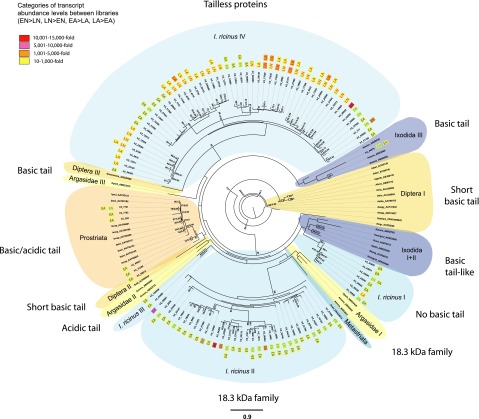
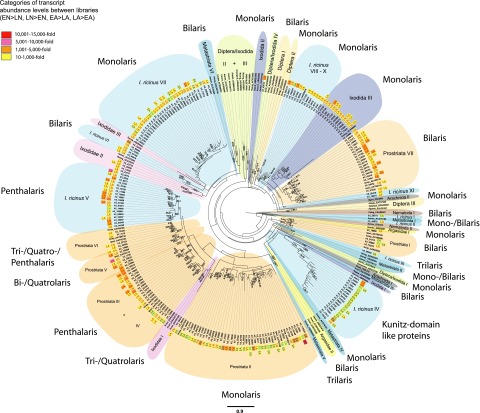
Tick salivary gland (SG) proteins possess powerful pharmacologic properties that facilitate tick feeding and pathogen transmission. For the first time, SG transcriptomes of Ixodes ricinus, an important disease vector for humans and animals, were analyzed using next-generation sequencing. SGs were collected from different tick life stages fed on various animal species, including cofeeding of nymphs and adults on the same host. Four cDNA samples were sequenced, discriminating tick SG transcriptomes of early- and late-feeding nymphs or adults. In total, 441,381,454 pyrosequencing reads and 67,703,183 Illumina reads were assembled into 272,220 contigs, of which 34,560 extensively annotated coding sequences are disclosed; 8686 coding sequences were submitted to GenBank. Overall, 13% of contigs were classified as secreted proteins that showed significant differences in the transcript representation among the 4 SG samples, including high numbers of sample-specific transcripts. Detailed phylogenetic reconstructions of two relatively abundant SG-secreted protein families demonstrated how this study improves our understanding of the molecular evolution of hematophagy in arthropods. Our data significantly increase the available genomic information for I. ricinus and form a solid basis for future tick genome/transcriptome assemblies and the functional analysis of effectors that mediate the feeding physiology and parasite-vector interaction of I. ricinus.
Keywords: cDNA; high-throughput annotation; molecular evolution; public database; tick feeding; tick life stages.
Figures

References
-
- Florin-Christensen M., Schnittger L. (2009) Piroplasmids and ticks: a long-lasting intimate relationship. Front. Biosci. 14, 3064–3073 - PubMed
-
- Mansfield K. L., Johnson N., Phipps L. P., Stephenson J. R., Fooks A. R., Solomon T. (2009) Tick-borne encephalitis virus—a review of an emerging zoonosis. J. Gen. Virol. 90, 1781–1794 - PubMed
-
- Stanek G. (2009) Pandora's Box: pathogens in Ixodes ricinus ticks in Central Europe. Wien. Klin. Wochenschr. 121, 673–683 - PubMed
-
- Schwarz A., Hönig V., Vavrušková Z., Grubhoffer L., Balczun C., Albring A., Schaub G. A. (2012) Abundance of Ixodes ricinus and prevalence of Borrelia burgdorferi s.l. in the nature reserve Siebengebirge, Germany, in comparison to three former studies from 1978 onwards. Parasit. Vectors 5, 268. - PMC - PubMed
Publication types
MeSH terms
Substances
Grants and funding
LinkOut - more resources
Full Text Sources
Other Literature Sources
