. 2014 Jun;63(6):891-902.
doi: 10.1136/gutjnl-2013-305008. Epub 2013 Aug 20.

Obese patients after gastric bypass surgery have lower brain-hedonic responses to food than after gastric banding

Affiliations
Free PMC article

Obese patients after gastric bypass surgery have lower brain-hedonic responses to food than after gastric banding

Samantha Scholtz et al. Gut. 2014 Jun.
Free PMC article

Abstract

Objectives: Roux-en-Y gastric bypass (RYGB) has greater efficacy for weight loss in obese patients than gastric banding (BAND) surgery. We hypothesise that this may result from different effects on food hedonics via physiological changes secondary to distinct gut anatomy manipulations.

Design: We used functional MRI, eating behaviour and hormonal phenotyping to compare body mass index (BMI)-matched unoperated controls and patients after RYGB and BAND surgery for obesity.

Results: Obese patients after RYGB had lower brain-hedonic responses to food than patients after BAND surgery. RYGB patients had lower activation than BAND patients in brain reward systems, particularly to high-calorie foods, including the orbitofrontal cortex, amygdala, caudate nucleus, nucleus accumbens and hippocampus. This was associated with lower palatability and appeal of high-calorie foods and healthier eating behaviour, including less fat intake, in RYGB compared with BAND patients and/or BMI-matched unoperated controls. These differences were not explicable by differences in hunger or psychological traits between the surgical groups, but anorexigenic plasma gut hormones (GLP-1 and PYY), plasma bile acids and symptoms of dumping syndrome were increased in RYGB patients.

Conclusions: The identification of these differences in food hedonic responses as a result of altered gut anatomy/physiology provides a novel explanation for the more favourable long-term weight loss seen after RYGB than after BAND surgery, highlighting the importance of the gut-brain axis in the control of reward-based eating behaviour.

Keywords: Bile Acid; Brain Imaging; Brain/Gut Interaction; Gastrointestinal Hormones; Obesity Surgery.


Figures
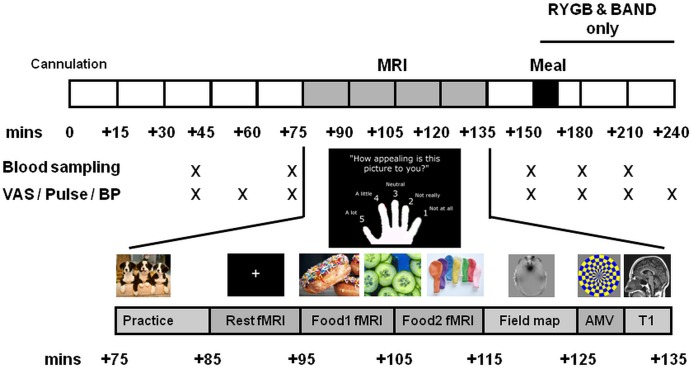
Figure 1
Figure 1
Study protocol. AMV, audio–motor–visual task; BAND, gastric banding; BP, blood pressure; fMRI, functional MRI; RYGB, gastric bypass; VAS, visual analogue scales.
Figure 2
Figure 2
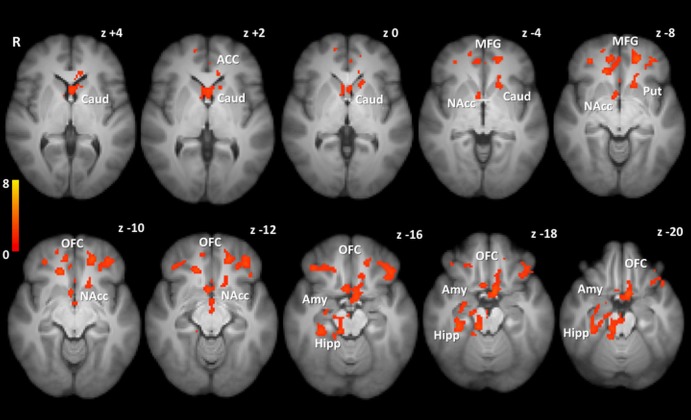
Whole brain comparison of activation to high-calorie foods between obese patients after gastric bypass and gastric banding. Whole brain group level comparison for high-calorie versus object picture contrast to demonstrate clusters in which blood oxygen level-dependent (BOLD) signal was lower in patients after gastric bypass (RYGB) compared with gastric banding (BAND) surgery, adjusting for age, gender and body mass index. No clusters showed greater activation in RYGB than BAND groups. Colour bar indicates Z values. Cluster activation thresholded at Z>2.1, familywise error p<0.05, overlaid onto the average T1 scan for all subjects (n=20 per group). Co-ordinates given in standard Montreal Neurological Institute (MNI) space. ACC: anterior cingulate cortex, Amy: amygdala, Caud: caudate, NAcc: nucleus accumbens, Hipp: hippocampus, MFG: middle frontal gyrus, OFC: orbitofrontal cortex, Put: putamen. Voxel-wise differences in BOLD activation between groups did not survive false discovery rate p<0.05 correction.
Figure 3
Figure 3
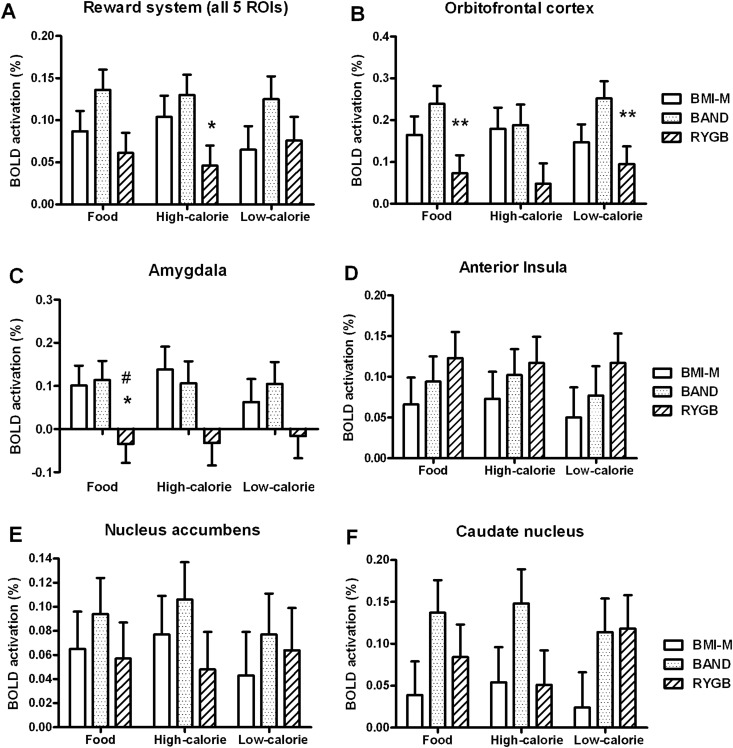
Region of interest activation to food in obese patients after gastric bypass and gastric banding and unoperated controls. Comparison of blood oxygen level-dependent (BOLD) signal to any food, only high-calorie or only low-calorie food (vs objects) in a priori functional regions of interest (fROI) between body mass index-matched unoperated controls (BMI-M, white), and obese patients after gastric banding (BAND, dotted) and gastric bypass (RYGB, striped) surgery, adjusting for age, gender and BMI. (A) Average in all five fROIs, (B) orbitofrontal cortex, (C) amygdala, (D) anterior insula, (E) nucleus accumbens, (F) caudate. Data are presented as mean±SEM. #p<0.05, ##p<0.01, ###p<0.005 versus BMI-M; *p<0.05, **p<0.01, ***p<0.005 versus BAND; n=19–20 per group.
Figure 4
Figure 4
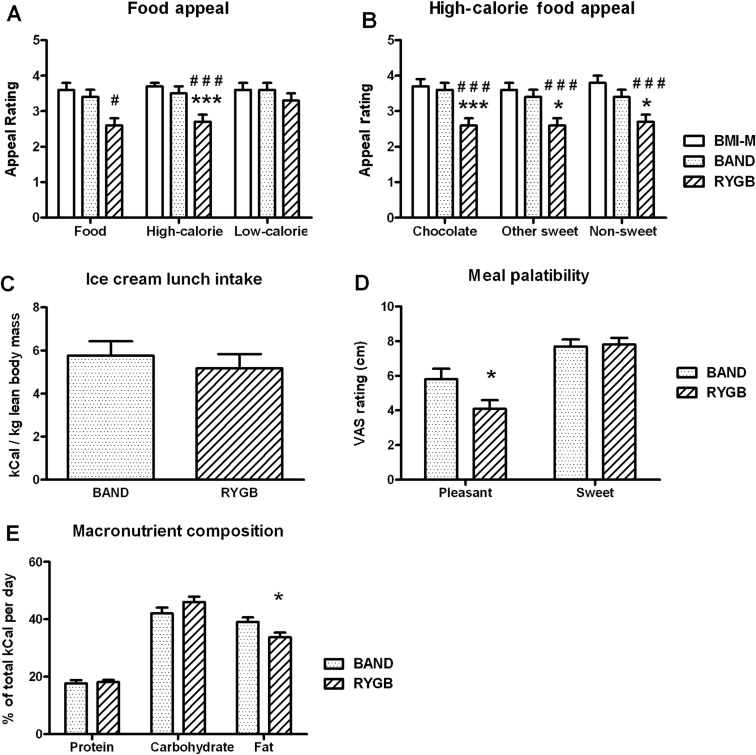
Food hedonics and dietary composition in obese patients after gastric bypass and gastric banding. Comparison of (A) appeal of any food, only high-calorie or only low-calorie food pictures; (B) appeal of subcategories of high-calorie food pictures; (C) ice cream consumption and (D) ice cream palatability rating at meal after fMRI scan; and (E) average percentage of total calories from fat from 3 day food diary, between body mass index-matched unoperated controls (BMI-M, white) and obese patients after gastric banding (BAND, dotted) and gastric bypass (RYGB, striped) surgery. Data are presented as mean±SEM. #p<0.05, ###p<0.005 versus BMI-M; *p<0.05, ***p<0.005 versus BAND; n=20–21 per group.
Figure 5
Figure 5
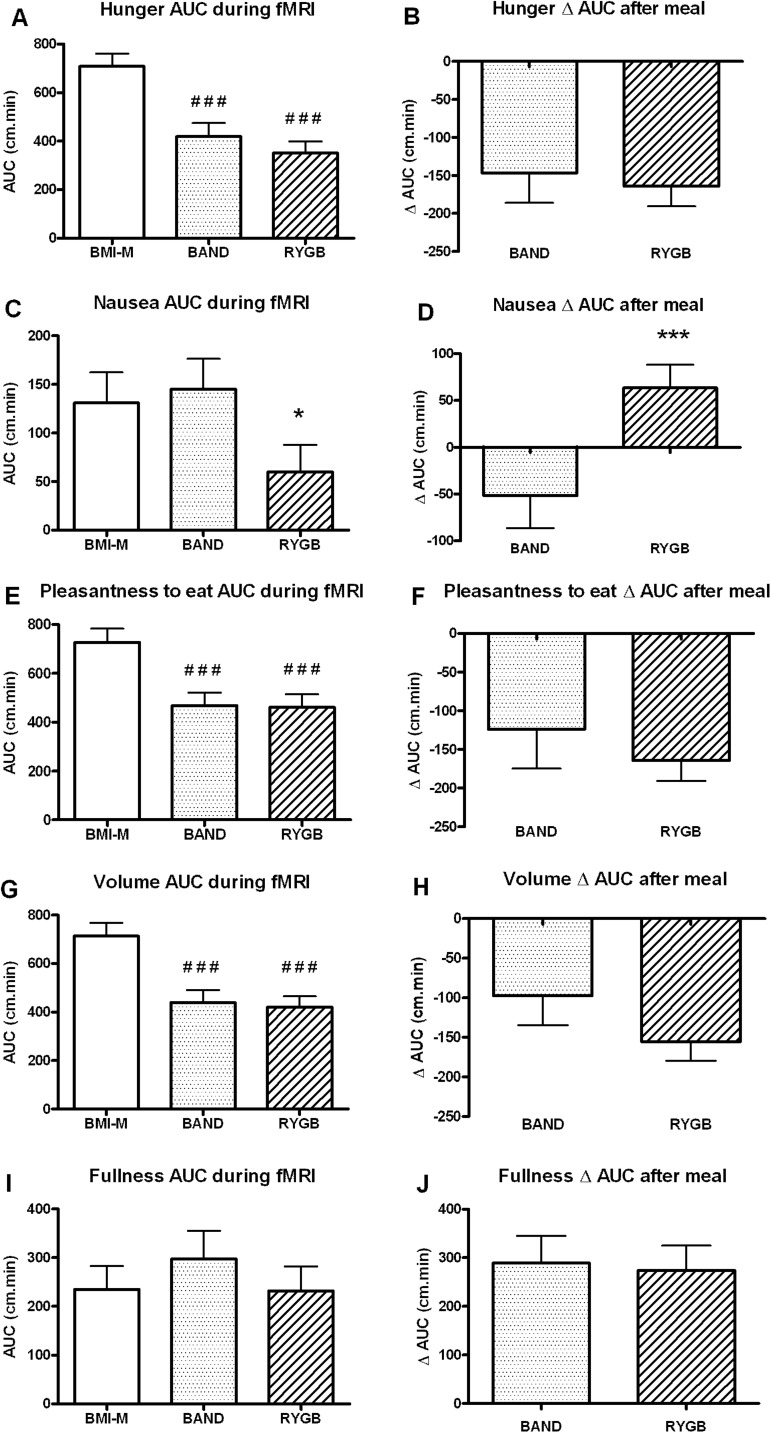
Appetite visual analogue scales during fMRI and after meal. Comparison of visual analogue scale ratings of (A and B) hunger, (C and D) nausea, (E and F) pleasantness to eat, (G and H) volume of food that could be eaten and (I and J) fullness. (A,C,E,G and I) Levels during fMRI scanning (area under curve (AUC) +40 to +150 min) between body mass index-matched unoperated controls (BMI-M, white) and obese patients after gastric banding (BAND, dotted) and gastric bypass (RYGB, striped) surgery. (B,D,F,H and J) change in levels after ice cream meal (ΔAUC +150 to +210 min) in surgical groups. Data are presented as mean±SEM. ###p<0.005 versus BMI-M; *p<0.05, ***p<0.005 versus BAND; n=20–21 per group.
Figure 6
Figure 6
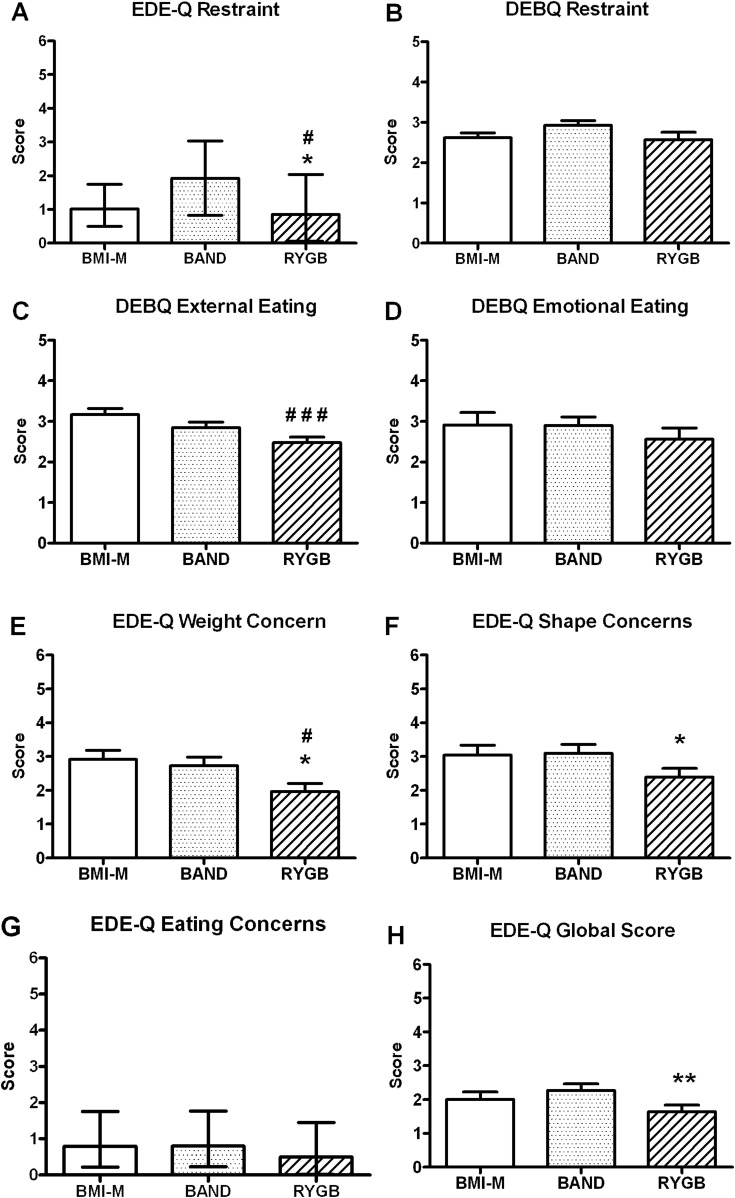
Eating behaviour. (A) EDE-Q dietary restraint, (B) DEBQ dietary restraint, (C) DEBQ external eating, (D) DEBQ emotional eating and EDE-Q (E) weight concerns, (F) shape concerns, (G) eating concerns and (H) global score of body mass index-matched unoperated controls (BMI-M, white) and obese patients after gastric banding (BAND, dotted) and gastric bypass (RYGB, striped) surgery. Data are presented as (A and G) median and IQR, or (B,C–F and H) mean±SEM. #p<0.05, ###p<0.005 versus BMI-M; *p<0.05, **p<0.01 versus BAND; n=20–21 per group. DEBQ: Dutch Eating Behaviour Questionnaire, EDE-Q: Eating Disorders Examination Questionnaire.
Figure 7
Figure 7
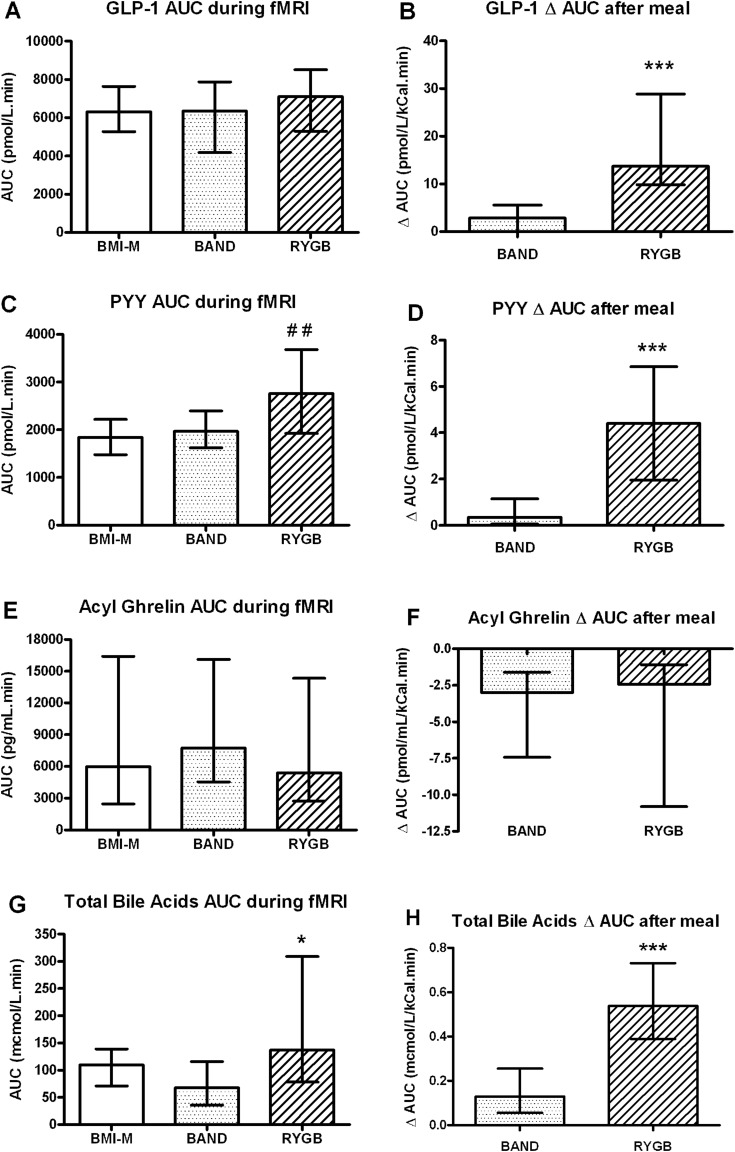
Plasma levels of gut hormones and bile acids in obese patients after gastric bypass and gastric banding and controls. Comparison of (A,C and E) plasma hormone levels (GLP-1, peptide YY, acyl ghrelin, area under curve (AUC) +40 to +150 min) and (G) total bile acid levels during fMRI scan (AUC +70 to +150 min) between body mass index-matched unoperated controls (BMI-M, white) and obese patients after gastric banding (BAND, dotted) and gastric bypass (RYGB, striped) surgery. Comparison of (B,D and F) change in plasma hormone levels and (H) change in total bile acid levels after ice cream meal (both ΔAUC +150 to +210 min) between two surgical groups. Data are presented as median and IQR. ##p<0.01 versus BMI-M; *p<0.05, ***p<0.005 versus BAND; n=20–21 per group.
Figure 8
Figure 8
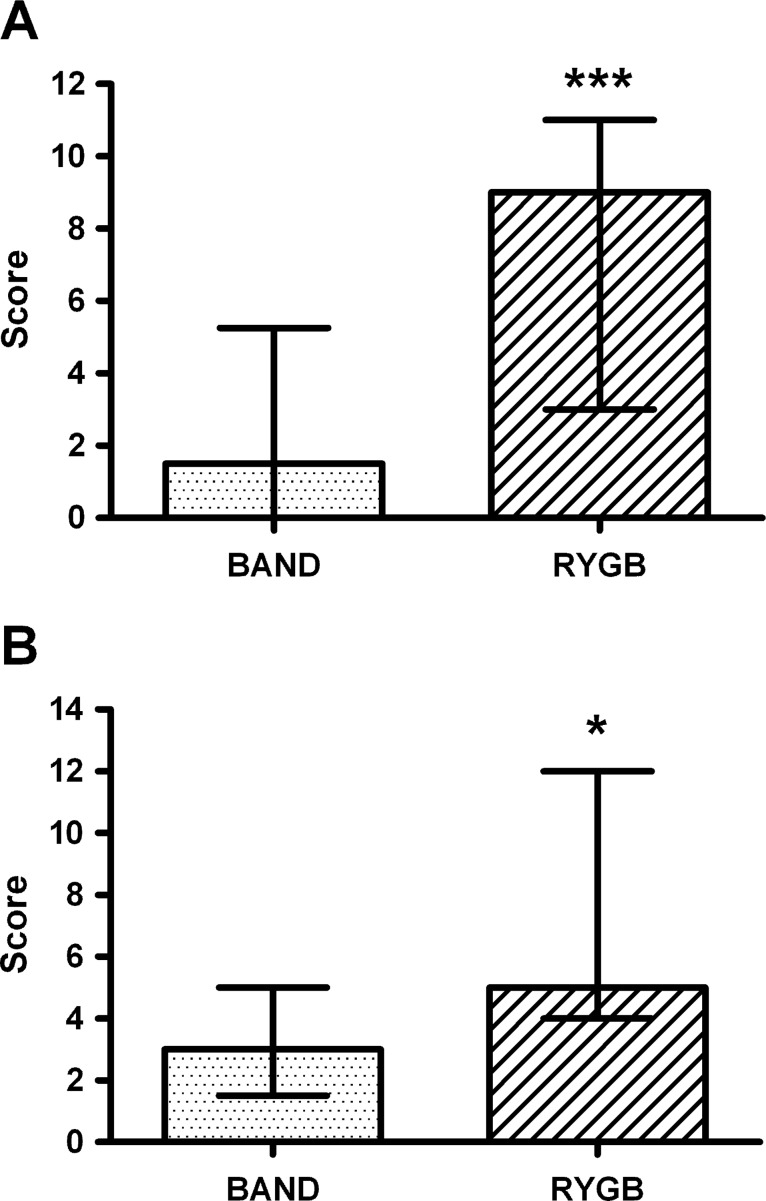
Assessment of dumping syndrome in surgical groups. Comparison of retrospective (A) Sigstad's and (B) Arts’ dumping syndrome scores during first 3 months after surgery (n=18–19 per group), between obese patients after gastric banding (BAND, dotted) and gastric bypass (RYGB, striped) surgery. Data are presented as median and IQR. *p<0.05, ***p<0.005 versus BAND.

Comment in

References

    1. Sjostrom L, Peltonen M, Jacobson P, et al. Bariatric surgery and long-term cardiovascular events. JAMA 2012;307:56–65 - PubMed
    1. Stefater MA, Wilson-Perez HE, Chambers AP, et al. All bariatric surgeries are not created equal: insights from mechanistic comparisons. Endocr Rev 2012;33:595–622 - PMC - PubMed
    1. Dixon JB, le Roux CW, Rubino F, et al. Bariatric surgery for type 2 diabetes. Lancet 2012;379:2300–11 - PubMed
    1. Rubino F, Schauer PR, Kaplan LM, et al. Metabolic surgery to treat type 2 diabetes: clinical outcomes and mechanisms of action. Annu Rev Med 2010;61:393–411 - PubMed
    1. le Roux CW, Aylwin SJ, Batterham RL, et al. Gut hormone profiles following bariatric surgery favor an anorectic state, facilitate weight loss, and improve metabolic parameters. Ann Surg 2006;243:108–14 - PMC - PubMed

Publication types

MeSH terms