Review
. 2013 Nov;94(5):913-9.
doi: 10.1189/jlb.0413236. Epub 2013 Aug 20.

Extrinsic and intrinsic control of macrophage inflammatory responses

Affiliations
Review

Extrinsic and intrinsic control of macrophage inflammatory responses

Heather B Cohen et al. J Leukoc Biol. 2013 Nov.

Abstract

Macrophages make major contributions to inflammatory immunopathology. In this work, we examine three disease scenarios, in which M1s play a major role early in the disease but eventually transitions into a population of cells with immunoregulatory activity. We propose that the transition from an inflammatory to a regulatory phenotype is a natural progression that regularly occurs in stimulated macrophages and that the timing of this transition is critical to maintaining homeostasis. In the first section of this review, we discuss the exogenous microenvironmental cues that may induce macrophages to enter a regulatory state. In the second half of this review, we discuss a novel mechanism, whereby TLR-stimulated macrophages can intrinsically induce their own regulatory activation state. They do so by secreting and synthesizing endogenous "reprogramming" signals that work in an autocrine fashion to promote a regulatory phenotype. We propose that these endogenous regulatory mechanisms exist to prevent macrophage-mediated immunopathology. Thus, macrophages can respond to endogenous and exogenous cues to regulate their activation state, and without these controlled regulatory responses, M1 would persist to the detriment of the host.

Keywords: inflammation; pathology; regulation.


Figures
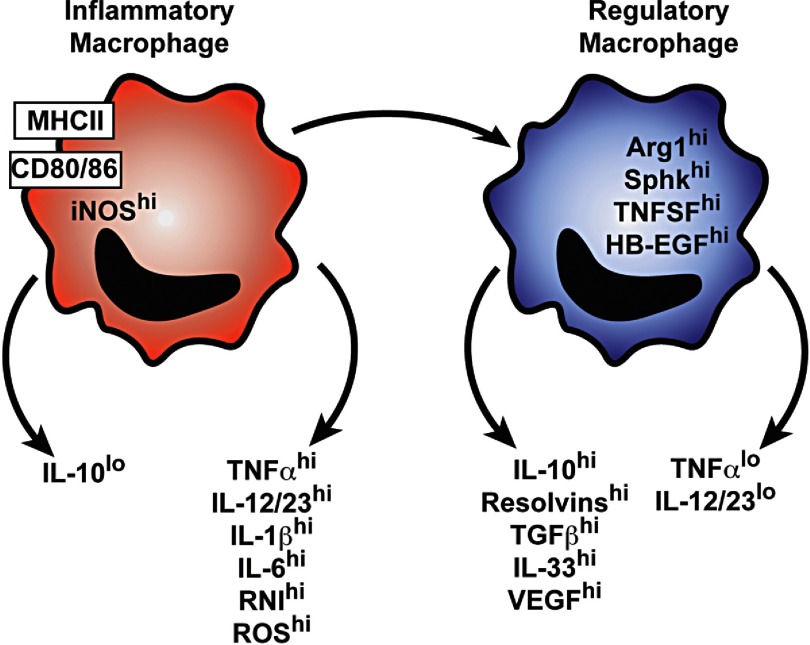
Figure 1.
Figure 1.. Schematic representation of phenotypic markers of macrophages at different stages of disease.
During muscle development, tissue damage, and sepsis, the initial macrophage activation state is characterized by the expression of biomarkers associated with inflammation. At later stages of these diseases, macrophages switch to a regulatory activation state by expressing phenotypic markers that suppress inflammation and promote tissue repair. RNI, Reactive nitrogen intermediates; TNFSF, TNF superfamily.
Figure 2.
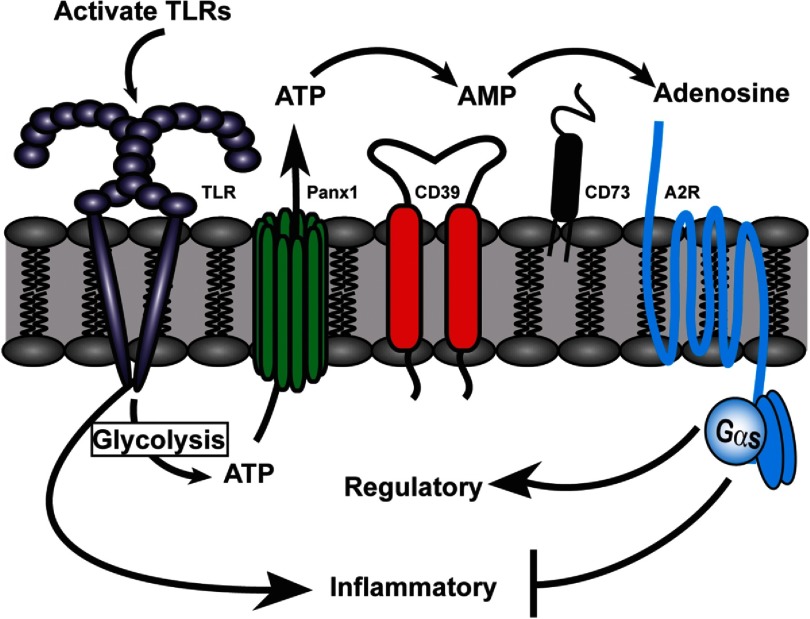
Figure 2.. A model depicting intrinsic regulation of the macrophage activation response.
In response to TLR stimulation, macrophages initially induce the expression of proinflammatory mediators and also glycolysis-mediated ATP generation, some of which is released via pannexin-1 (Panx1) channels into the extracellular milieu. Over the next 4 h, macrophages use the ENTPDase1/CD39 to mediate the conversion of eATP to adenosine, which signals via A2bRs (A2R) on the macrophage to dampen inflammatory responses and promote regulatory macrophage development. Blockade of any step of this macrophage-intrinsic regulatory cascade renders macrophages hyperinflammatory.

References

    1. Tidball J. G., Villalta S. A. (2010) Regulatory interactions between muscle and the immune system during muscle regeneration. Am. J. Physiol. 298, R1173–R1187 - PMC - PubMed
    1. Saclier M., Cuvellier S., Magnan M., Mounier R., Chazaud B. (2013) Monocyte/macrophage interactions with myogenic precursor cells during skeletal muscle regeneration. FEBS J. 10.1111/febs.12166 [Epub ahead of print] - DOI - PubMed
    1. Bosurgi L., Manfredi A. A., Rovere-Querini P. (2011) Macrophages in injured skeletal muscle: a perpetuum mobile causing and limiting fibrosis, prompting or restricting resolution and regeneration. Front. Immunol. 2, 62. - PMC - PubMed
    1. Chazaud B., Sonnet C., Lafuste P., Bassez G., Rimaniol A. C., Poron F., Authier F. J., Dreyfus P. A., Gherardi R. K. (2003) Satellite cells attract monocytes and use macrophages as a support to escape apoptosis and enhance muscle growth. J. Cell Biol. 163, 1133–1143 - PMC - PubMed
    1. Cantini M., Massimino M. L., Bruson A., Catani C., Dalla Libera L., Carraro U. (1994) Macrophages regulate proliferation and differentiation of satellite cells. Biochem. Biophys. Res. Commun. 202, 1688–1696 - PubMed