


The autobiographical IAT: a review
- PMID: 23964261
- PMCID: PMC3741633
- DOI: 10.3389/fpsyg.2013.00519
The autobiographical IAT: a review
Abstract
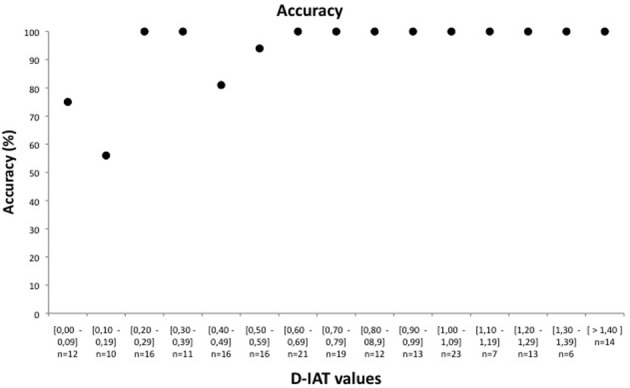
The autobiographical Implicit Association Test (aIAT; Sartori et al., 2008) is a variant of the Implicit Association Test (IAT; Greenwald et al., 1998) that is used to establish whether an autobiographical memory is encoded in the respondent's mind/brain. More specifically, with the aIAT, it is possible to evaluate which one of two autobiographical events is true. The method consists of a computerized categorization task. The aIAT includes stimuli belonging to four categories, two of them are logical categories and are represented by sentences that are always true (e.g., I am in front of a computer) or always false (e.g., I am climbing a mountain) for the respondent; two other categories are represented by alternative versions of an autobiographical event (e.g., I went to Paris for Christmas, or I went to New York for Christmas), only one of which is true. The true autobiographical event is identified because, in a combined block, it gives rise to faster reaction times when it shares the same motor response with true sentences. Here, we reviewed all the validation experiments and found more than 90% accuracy in detecting the true memory. We show that agreement in identifying the true autobiographical memory of the same aIAT repeated twice is, on average, more than 90%, and we report a technique for estimating accuracy associated with a single classification based on the D-IAT value, which may be used in single subject's investigations. We show that the aIAT might be used to identify also true intentions and reasons and conclude with a series of guidelines for building an effective aIAT.
Keywords: associations; autobiographical memory; implicit; intentions; memory detection.
Figures
References
-
- Agosta S., Ghirardi V., Zogmaister C., Castiello U., Sartori G. (2011b). Detecting fakers of the autobiographical IAT. Appl. Cogn. Psychol. 25, 299–306 10.1002/acp.1691 - DOI
-
- Agosta S., Pezzoli P., Sartori G. (2013). How to detect deception in everyday life and reasons underlying it. Appl. Cogn. Psychol. 27, 256–262 10.1002/acp.2902 - DOI
-
- Balota D. A., Cortese M. J., Duchek J. M., Adams D., Roediger H. L., McDermott K. B., et al. (1999). Veridical and false memories in healthy older adults and in dementia of the Alzheimer's type. Cogn. Neuropsychol. 16, 361–384 10.1080/026432999380834 - DOI
LinkOut - more resources
Full Text Sources
Other Literature Sources
