


Life-space mobility predicts nursing home admission over 6 years
- PMID: 23965310
- PMCID: PMC4071297
- DOI: 10.1177/0898264313497507
Life-space mobility predicts nursing home admission over 6 years
Abstract
Objective: To explore the association between baseline life-space mobility and nursing home (NH) admission among community-dwelling older adults over 6 years.
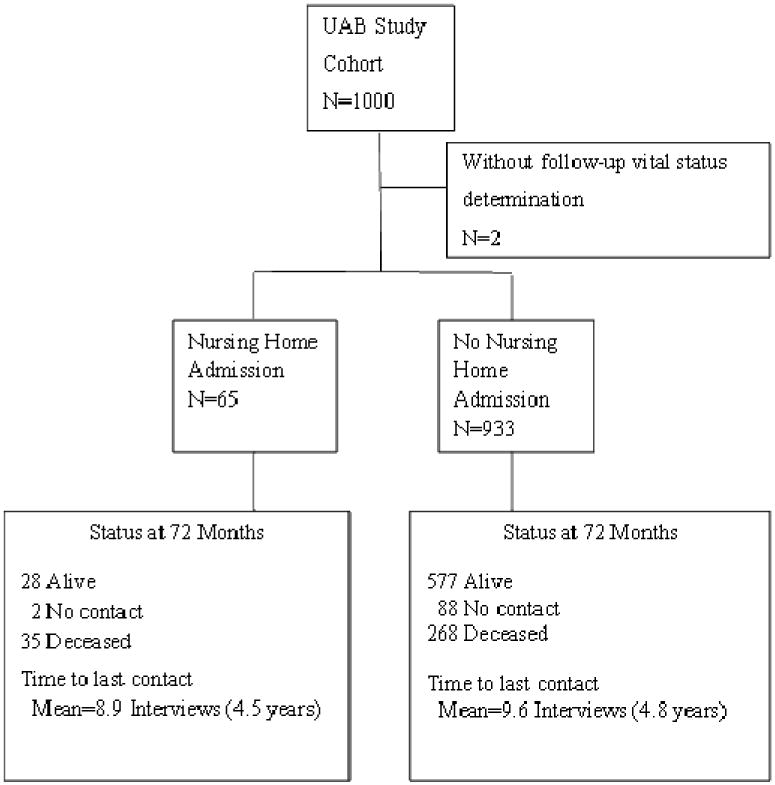
Methods: Using data from a prospective, observational cohort study consisting of a random sample of 1,000 Medicare beneficiaries ≥ 65 years of age stratified by race (African American and non-Hispanic White), sex, and rural/urban residence. Baseline life-space mobility was assessed during in-home interviews. Participants were contacted by telephone every 6 months to ascertain NH admissions, Life-Space Assessment (LSA) scores, and vital status (living or deceased). Using multivariate logistic regression, the significance and independence of the relationship of life-space mobility with NH admission were examined.
Results: Over 6 years, the odds of NH admission increased 2% for every one point lower baseline life-space score independent of previously recognized risk factors.
Discussion: The LSA may be a useful tool to identify older adults at risk of NH admission.
Keywords: geriatric assessment; nursing homes; risk factors.
References
-
- Agresti A. Categorical data analysis. 2nd. New York: Wiley-Interscience; 2002.
-
- Akamigbo AB, Wolinsky FD. New evidence of racial differences in access and their effects on the use of nursing homes among older adults. Med Care. 2007;45:672–679. - PubMed
-
- Allman RM, Sawyer P, Roseman JM. The UAB Study of Aging: background and insights into life-space mobility among older Americans in rural and urban settings. Aging Health. 2006;2:417–429.
-
- Andel R, Hyer K, Slack A. Risk factors for nursing home placement in older adults with and without dementia. J Aging Health. 2007;19(2):213–28. - PubMed
Publication types
MeSH terms
Grants and funding
LinkOut - more resources
Full Text Sources
Other Literature Sources
Medical
