


Review
doi: 10.3390/ijms140816280.
Principles of miRNA-target regulation in metazoan models
Affiliations
- PMID: 23965954
- PMCID: PMC3759911
- DOI: 10.3390/ijms140816280
Item in Clipboard
Review
Principles of miRNA-target regulation in metazoan models
Int J Mol Sci.
.
Abstract
MicroRNAs (miRs) are key post-transcriptional regulators that silence gene expression by direct base pairing to target sites of RNAs. They have a wide variety of tissue expression patterns and are differentially expressed during development and disease. Their activity and abundance is subject to various levels of control ranging from transcription and biogenesis to miR response elements on RNAs, target cellular levels and miR turnover. This review summarizes and discusses current knowledge on the regulation of miR activity and concludes with novel non-canonical functions that have recently emerged.
Figures
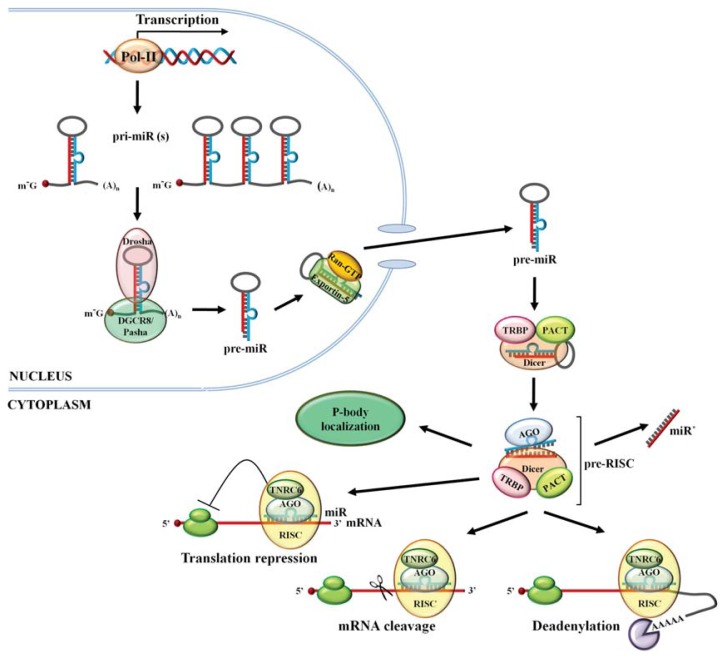
miR biogenesis. Monocistronic or polycistronic miRs are transcribed by RNA polymerase II into long pri-miR transcripts. These pri-miRs are, subsequently, processed by RNase III Drosha complex to ~70 nt pre-miRs that are exported out of the nucleus and into the cytosol by Exportin-5. In the cytoplasm, the RNase III Dicer complex cleaves pre-miRs to double-stranded ~22 nt miRs. One strand is then selected and loaded onto an Argonaute protein, which is part of the miRISC complex. The single-stranded miR then serves as a guide for RNA interference based on the partial complementarity with the various RNA substrates.
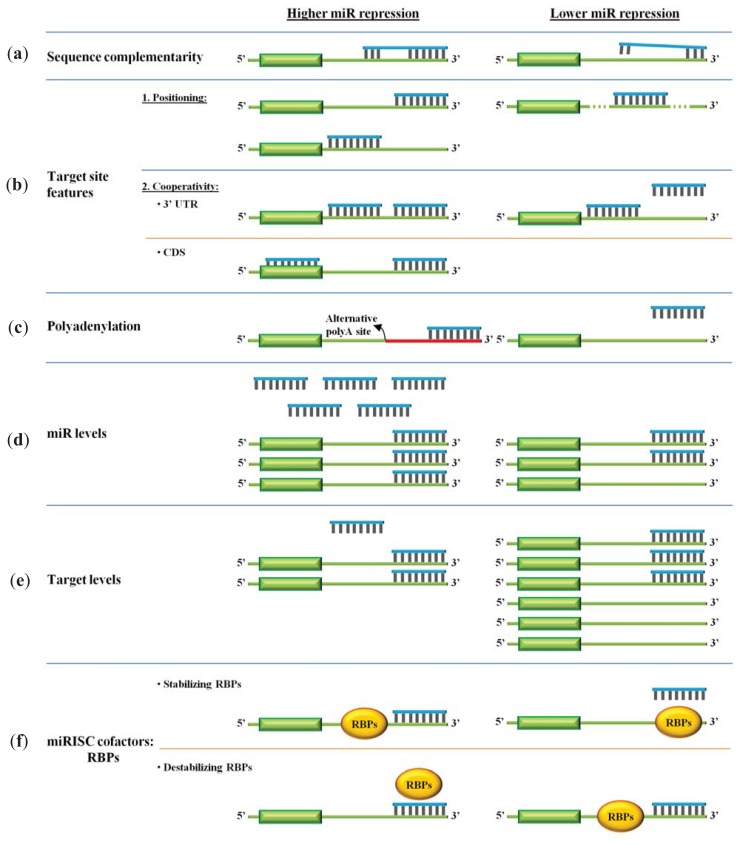
miR repression determinants. Multiple factors determine repression effectiveness of miRs. These include: (a) Sequence complementarity at positions 2–7 or 2–8 of the 5′ end of the mature miR; (b) Target site features: binding site location near the edges of 3′ UTR or multiple binding sites for miRs; (c) Alternative cleavage and polyadenylation to maintain miR binding sites; (d) Relatively high miR levels; (e) Relatively low target levels; and (f) Presence of stabilizing and absence of destabilizing RNA binding protein sites.
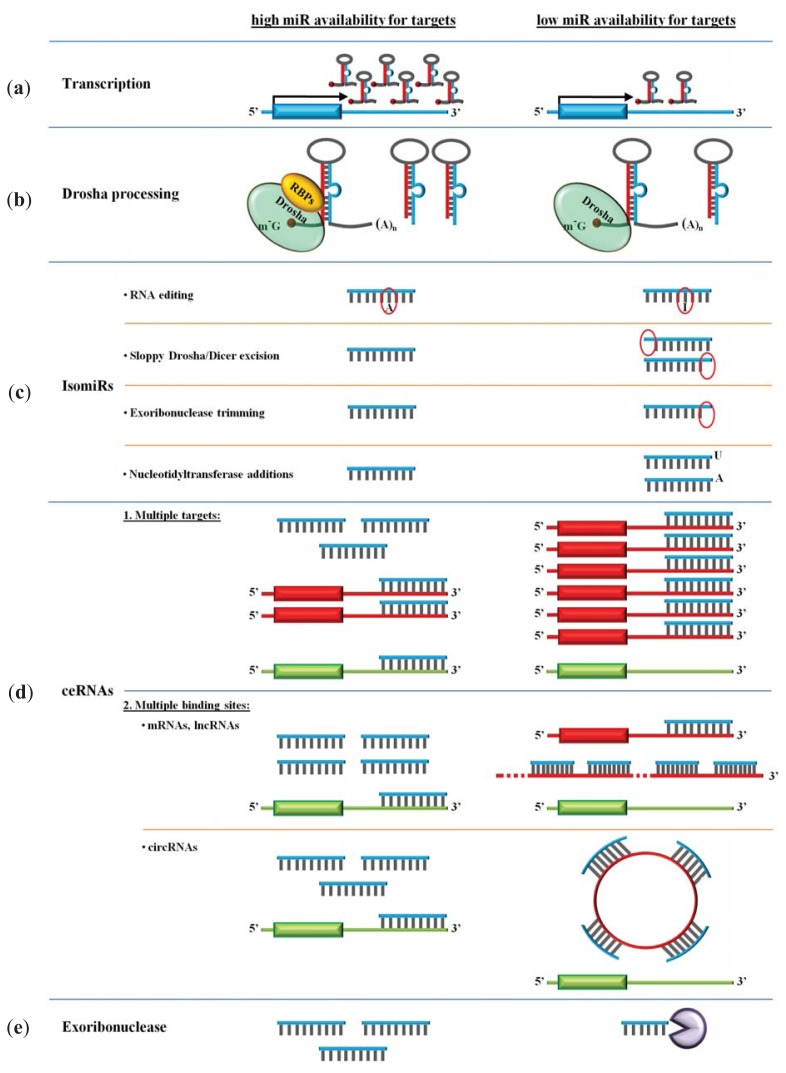
miR availability determinants. Multiple factors determine availability of miRs. These include: (a) High transcription rates; (b) Enhanced Drosha processing; (c) Lower levels of isomiRs that result from RNA editing, sloppy Drosha/Dicer cleavage, exoribonuclease trimming and nucleotidyl transferase additions; (d) Lower levels of miR sequestering ceRNAs; and (e) Lower levels of exoribonucleases.
References
Publication types
MeSH terms
Substances
LinkOut - more resources
Full Text Sources
Other Literature Sources
