. 2013 Aug 8;14(8):16473-84.
doi: 10.3390/ijms140816473.

A nitric oxide-responsive quorum sensing circuit in Vibrio harveyi regulates flagella production and biofilm formation

Affiliations

A nitric oxide-responsive quorum sensing circuit in Vibrio harveyi regulates flagella production and biofilm formation

Bernadette M Henares et al. Int J Mol Sci. .

Abstract

Cell signaling plays an important role in the survival of bacterial colonies. They use small molecules to coordinate gene expression in a cell density dependent manner. This process, known as quorum sensing, helps bacteria regulate diverse functions such as bioluminescence, biofilm formation and virulence. In Vibrio harveyi, a bioluminescent marine bacterium, four parallel quorum-sensing systems have been identified to regulate light production. We have previously reported that nitric oxide (NO), through the H-NOX/HqsK quorum sensing pathway contributes to light production in V. harveyi through the LuxU/LuxO/LuxR quorum sensing pathway. In this study, we show that nitric oxide (NO) also regulates flagellar production and enhances biofilm formation. Our data suggest that V. harveyi is capable of switching between lifestyles to be able to adapt to changes in the environment.


Figures

Figure 1
Figure 1
Effect of nitric oxide (NO) on biofilm thickness and cell viability, quantified by confocal laser scanning microscope (CLSM). (A) Phase-contrast image of a biofilm at 10× magnification stained with calcofluor to show extracellular polysaccharide matrix (EPS) production. This biofilm was grown without the addition of NO; (B) Confocal images of biofilm at 40× magnification, grown in the presence of the indicated amount of NO. Cells were stained with SYTO 9 (green; stains all cells) and propidium iodide (red; stains dead cells only). Top pictures are the xy view, bottom pictures show the y-dimension as viewed on the side; (C) Summary of biofilm thickness as a function of NO concentration.
Figure 2
Figure 2
Effect of NO on biofilm formation in V. harveyi WT strain quantified using the crystal violet staining method. Normalized crystal violet (CV) is reported as the CV absorbance at 570 nm divided by OD of all cells, planktonic and biofilm, at 570 nm. Error bars represent one standard deviation from the mean of triplicate experiments.
Figure 3
Figure 3
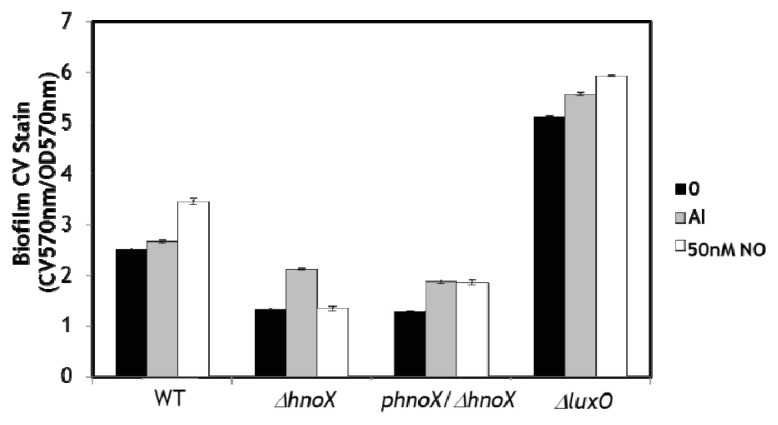
Effect of NO on biofilm formation in V. harveyi WT, ΔhnoX, phnoXhnoX, and ΔluxO strains. Normalized CV is reported as the CV absorbance at 570 nm divided by OD of all cells, planktonic and biofilm, at 570 nm. The black bars indicate no additives, the grey bars indicate the addition of cell-free medium from an overnight culture, which is rich in AIs, and the white bars indicate the addition of 50 nM NO. Error bars represent one standard deviation from the mean of triplicate experiments.
Figure 4
Figure 4
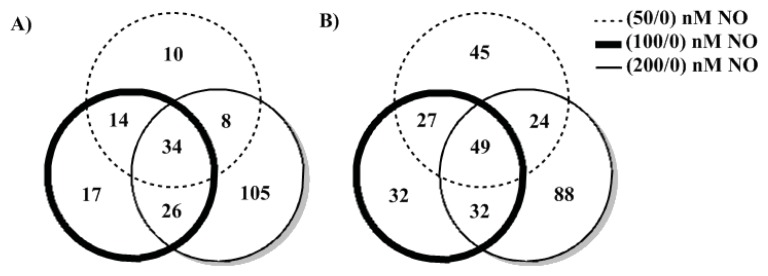
Summary of V. harveyi iTRAQ analysis. Proteins that were down-regulated (A) or upregulated (B) by at least 20% were selected and compared under different NO concentrations. Numbers in the common areas indicate proteins that show the same trend as a function of NO concentration. Remaining numbers represent proteins that are up- or down-regulated only under one condition.

References

    1. Costerton J.W., Stewart P.S., Greenberg E.P. Bacterial biofilms: A common cause of persistent infections. Science. 1999;284:1318–1322. - PubMed
    1. Hall-Stoodley L., Costerton J.W., Stoodley P. Bacterial biofilms: From the natural environment to infectious diseases. Nat. Rev. Microbiol. 2004;2:95–108. - PubMed
    1. Donlan R.M., Costerton J.W. Biofilms: Survival mechanisms of clinically relevant microorganisms. Clin. Microbiol. Rev. 2002;15:167–193. - PMC - PubMed
    1. Stewart P.S., Costerton J.W. Antibiotic resistance of bacteria in biofilms. Lancet. 2001;358:135–138. - PubMed
    1. Miller M.B., Bassler B.L. Quorum sensing in bacteria. Annu. Rev. Microbiol. 2001;55:165–199. - PubMed

Publication types

LinkOut - more resources