


Review
doi: 10.3390/ijms140817085.
Non-coding RNAs and cancer
Affiliations
- PMID: 23965974
- PMCID: PMC3759953
- DOI: 10.3390/ijms140817085
Item in Clipboard
Review
Non-coding RNAs and cancer
Int J Mol Sci.
.
Abstract
The discovery of the biological relevance of non-coding RNA (ncRNAs) molecules represents one of the most significant advances in contemporary molecular biology. Expression profiling of human tumors, based on the expression of miRNAs and other short or long ncRNAs, has identified signatures associated with diagnosis, staging, progression, prognosis, and response to treatment. In this review we will discuss the recent remarkable advancement in the understanding the biological functions of human ncRNAs in cancer, the mechanisms of expression and the therapeutic potential.
Figures
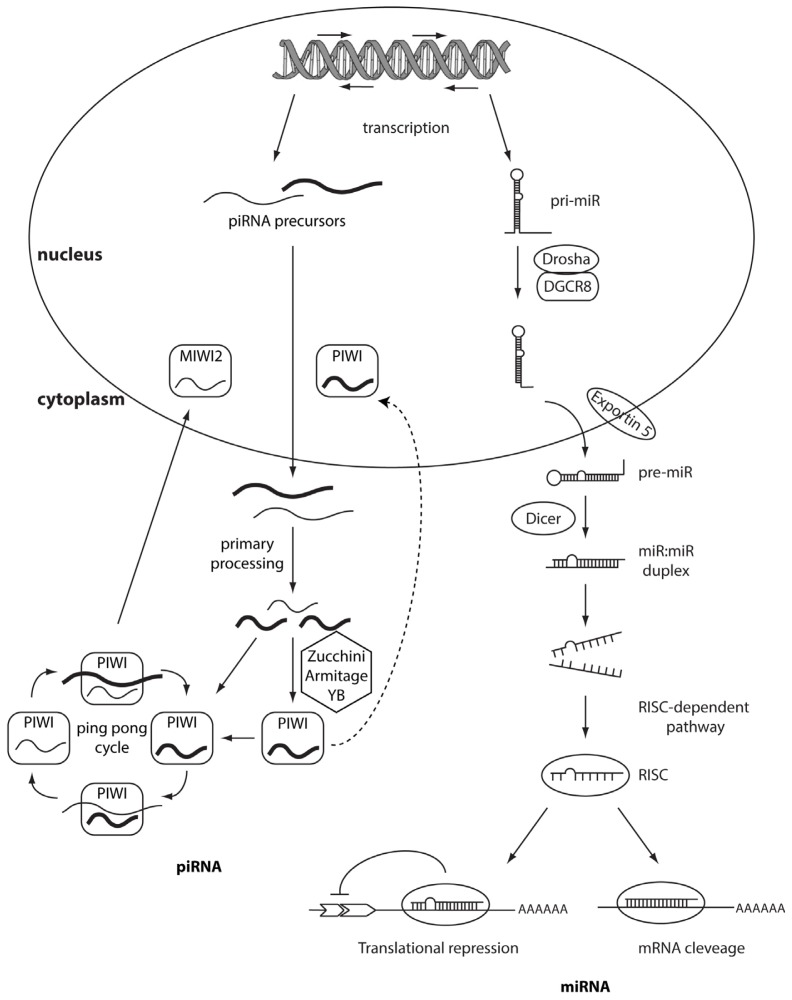
PiRNAs and microRNAs biogenesis. On the left, piRNAs biogenesis. PiRNAs are processed from single-stranded RNA precursors. The biogenesis of piRNAs could be divided in two main pathways: primary processing and ping-pong amplification cycle. MIWI2, a PIWI protein, translocates processed piRNAs into the nucleus, where they block the transcription of the TE (trasposon elements). On the right, miRNA biogenesis. Primary transcripts (pri-miRs) are transcribed by the RNA polymerase II. In the nucleus pri-miRs are processed by Drosha-DGCR8 into pre-miRs of ~60–70 nt. The produced pre-miRNAs are exported by the Exportin 5 to the cytoplasm where they are processed in ~18–22-nucleotide miRNA duplexes by the cytoplasmic RNase III Dicer. Normally, one strand of this duplex is degraded, whereas the other strand accumulates as a mature miRNA. From the miRNA-miRNA duplex, only the miRNA enters preferentially in the protein effector complex, formed by the RNA-induced silencing complex (RISC) and miRgonaute. Perfect or nearly perfect complementarities between miRNA and its target 3′ UTR induce RISC to cleave the target mRNA, whereas imperfect base matching induces mainly translational silencing of the target.

OncomiRs and tumor suppressor miRs. Correct cellular homeostasis is driven by a proper balance between oncomiRs and tumor suppressor miRs. OncomiRs are usually located in the amplified regions of the genome and are frequently over-expressed in cancer, promoting tumor growth and metastasis. Tumor suppressor miRs are often down-regulated in cancer and inhibit tumor growth inducing apoptosis and blocking cell migration.
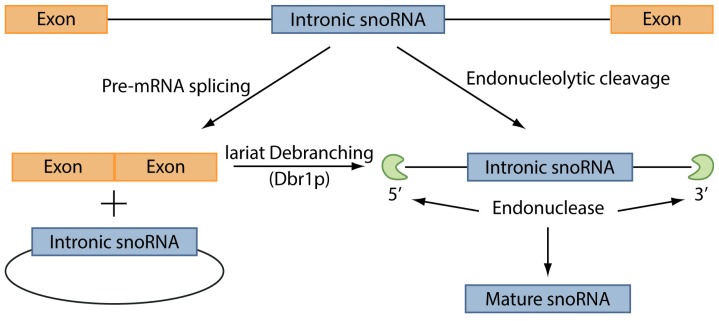
Intronic snoRNA processing. SnoRNA maturation occurs through two distinct pathways: splicing-dependent and splicing-independent. In the first pathway, the splicing of a pre-mRNA leads to a snoRNA-containing lariat, which is linearized by the enzyme Dbr1p and then endonucleases and exonucleases release the mature snoRNA. In the splicing-independent pathway the snoRNA is directly excided from the intron of the pre-mRNA by endonucleolytic cleavage.
References
-
- International Human Genome Sequencing Consortium. Finishing the euchromatic sequence of the human genome. Nature. 2004;431:931–945. - PubMed
-
- Kapranov P., Cheng J., Dike S., Nix D.A., Duttagupta R., Willingham A.T., Stadler P.F., Hertel J., Hackermuller J., Hofacker I.L., et al. RNA maps reveal new RNA classes and a possible function for pervasive transcription. Science. 2007;316:1484–1488. - PubMed
-
- Carninci P., Kasukawa T., Katayama S., Gough J., Frith M.C., Maeda N., Oyama R., Ravasi T., Lenhard B., Wells C., et al. The transcriptional landscape of the mammalian genome. Science. 2005;309:1559–1563. - PubMed
-
- Vagin V.V., Sigova A., Li C., Seitz H., Gvozdev V., Zamore P.D. A distinct small RNA pathway silences selfish genetic elements in the germline. Science. 2006;313:320–324. - PubMed
Publication types
MeSH terms
Substances
LinkOut - more resources
Full Text Sources
Other Literature Sources
