


Using AD biomarker research results for clinical care: a survey of ADNI investigators
- PMID: 23966249
- PMCID: PMC3795601
- DOI: 10.1212/WNL.0b013e3182a55f4a
Using AD biomarker research results for clinical care: a survey of ADNI investigators
Abstract
Objective: To inform whether the Alzheimer's Disease Neuroimaging Initiative (ADNI) should change its policy of not returning research results to ADNI participants, we surveyed investigators and research staff about disclosing ADNI biomarker information to research participants, with particular emphasis on amyloid imaging results.
Methods: In April 2012, just before Food and Drug Administration approval of the amyloid-binding radiotracer, florbetapir, all ADNI investigators and personnel were recruited to complete an anonymous online survey that contained fixed choice and free-text questions.
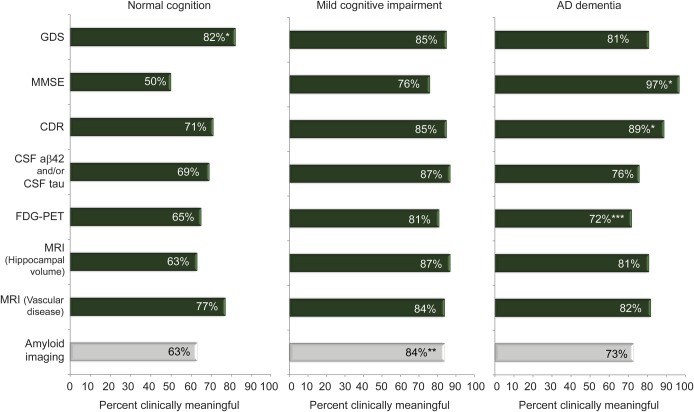
Results: Although ADNI participants often requested amyloid imaging results (the proportions of investigators who reported requests from more than half of their participants with normal cognition or mild cognitive impairment were 20% and 22%, respectively), across all diagnostic groups, the majority of ADNI investigators (approximately 90%) did not return amyloid imaging results to ADNI participants. However, the majority of investigators reported that, if the Food and Drug Administration approved florbetapir, they would support the return of amyloid imaging results to participants with mild cognitive impairment and normal cognition, but they emphasized the need for guidance on how to provide these results to participants and for research to assess the value of returning results as well as how returning results will affect study validity and participant well-being.
Conclusions: A majority of ADNI investigators support returning amyloid imaging results to ADNI participants. The findings that they want guidance on how to do this and research on the impact of disclosure suggest how to develop and monitor a disclosure process.
Figures
Comment in
-
Amyloid imaging: the court of public opinion.Neurology. 2013 Sep 24;81(13):1108-9. doi: 10.1212/WNL.0b013e3182a55fe3. Epub 2013 Aug 21. Neurology. 2013. PMID: 23966257
-
Dementia: Disclosure of results to participants in dementia research.Nat Rev Neurol. 2013 Nov;9(11):608-9. doi: 10.1038/nrneurol.2013.213. Epub 2013 Oct 22. Nat Rev Neurol. 2013. PMID: 24145370 No abstract available.
References
-
- Alzheimer's Disease Neuroimaging Initiative Clinicaltrials.gov identifier: NCT00106899 [online]. Available at: http://clinicaltrials.gov/show/NCT00106899. Accessed January 16, 2013
-
- Miller G. Alzheimer’s biomarker initiative hits its stride. Science 2009;326:386–389 - PubMed
-
- Alzheimer's Disease Neuroimaging Initiative ADNI protocol [online]. Available at: http://adni-info.org/PPSB/Pdfs/adni_protocol_03.02.2005_ss.pdf. Accessed January 16, 2013
-
- Fabsitz RR, McGuire A, Sharp RR, et al. ; National Heart, Lung, and Blood Institute Working Group Ethical and practical guidelines for reporting genetic research results to study participants: updated guidelines from a National Heart, Lung, and Blood Institute Working Group. Circ Cardiovasc Genet 2010;3:574–580 - PMC - PubMed
-
- Bredenoord A, Kroes H, Cuppen E, Parker M, van Delden JJ. Disclosure of individual genetic data to research participants: the debate reconsidered. Trends Genet 2011;27:41–47 - PubMed
Publication types
MeSH terms
Substances
Grants and funding
- P30 AG010124/AG/NIA NIH HHS/United States
- AG027841/AG/NIA NIH HHS/United States
- P50 HG005550/HG/NHGRI NIH HHS/United States
- AR047782/AR/NIAMS NIH HHS/United States
- K24 AG027841/AG/NIA NIH HHS/United States
- HG024904/HG/NHGRI NIH HHS/United States
- HG006500/HG/NHGRI NIH HHS/United States
- U01 HG006500/HG/NHGRI NIH HHS/United States
- R01 HG002213/HG/NHGRI NIH HHS/United States
- R01 HG005092/HG/NHGRI NIH HHS/United States
- HG002213/HG/NHGRI NIH HHS/United States
- P30 AG008051/AG/NIA NIH HHS/United States
- P60 AR047782/AR/NIAMS NIH HHS/United States
- HG02213/HG/NHGRI NIH HHS/United States
- HG005550/HG/NHGRI NIH HHS/United States
- HG005092/HG/NHGRI NIH HHS/United States
LinkOut - more resources
Full Text Sources
Other Literature Sources
Medical
Miscellaneous
