Review
. 2013 Dec;43(12):3098-107.
doi: 10.1002/eji.201343740. Epub 2013 Aug 21.

Dendritic cell subsets in the intestinal lamina propria: ontogeny and function

Affiliations
Free PMC article
Review

Dendritic cell subsets in the intestinal lamina propria: ontogeny and function

Emma K Persson et al. Eur J Immunol. 2013 Dec.
Free PMC article

Abstract

The intestinal mucosa is exposed to large amounts of foreign antigen (Ag) derived from commensal bacteria, dietary Ags, and intestinal pathogens. Dendritic cells (DCs) are believed to be involved in the induction of tolerance to harmless Ags and in mounting protective immune responses to pathogens and, as such, to play key roles in regulating intestinal immune homeostasis. The characterization of classical DCs (cDCs) in the intestinal lamina propria has been under intense investigation in recent years but the use of markers (including CD11c, CD11b, MHC class II), which are also expressed by intestinal MΦs, has led to some controversy regarding their definition. Here we review recent studies that help to distinguish cDCs subsets from monocyte-derived cells in the intestinal mucosa. We address the phenotype and ontogeny of these cDC subsets and highlight recent findings indicating that these subsets play distinct roles in the regulation of mucosal immune responses in vivo.

Keywords: Antigen tolerance; Dendritic cells; Intestine; Lamina propria; Mucosa.


Figures

Figure 1
Figure 1
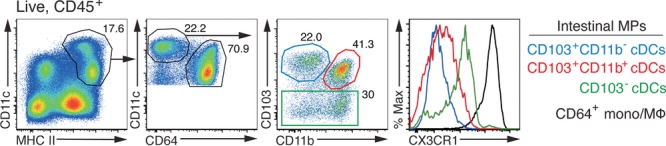
Phenotypic characterization of MPs in the SI LP. Representative flow cytometry plots of MPs in the steady-state SI LP of CX3CR1gfp/wt mice (PPs are removed prior to analysis). Leukocytes are identified among live cells as CD45+. Monocytes/ MΦs are identified among the CD11c+MHCII+ cells as CD64+ cells, and cDCs are identified as CD64 cells. cDCs can be separated into two major subsets of CD103+ cells: CD103+CD11b+ cDCs and CD103+CD11b cDCs, both of which are CX3CR1lo/−. In addition there is a minor population of CD103 cDCs that express variable levels of CD11b, the majority of which are CX3CR1int. The CD11b cells within this latter population are not present in intestinal preparations of RORγt−/− mice, which lack PPs and ILFs, suggesting they derive from GALT and not intestinal LP .
Figure 2
Figure 2
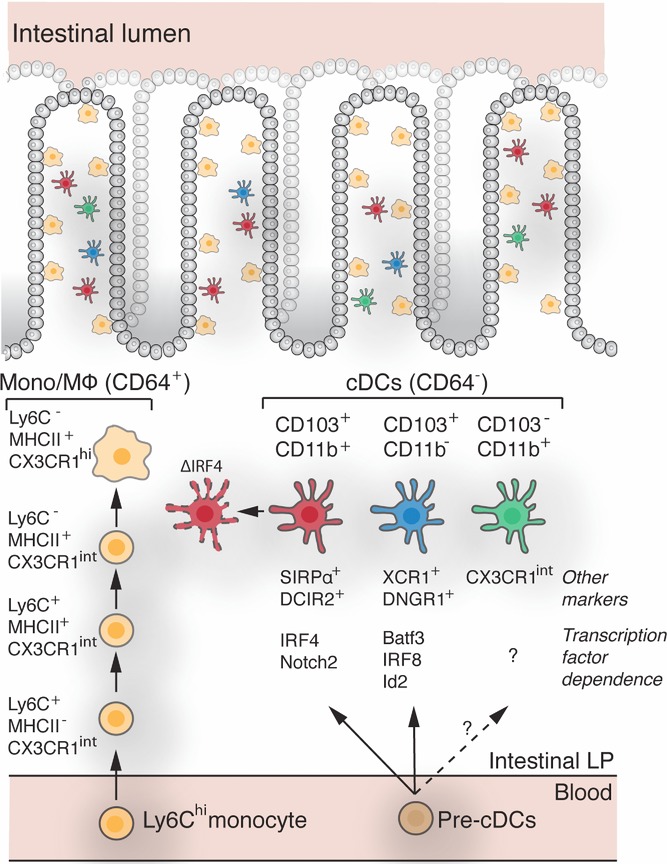
Overview of intestinal MPs. Ly6Chi monocytes and cDC precursors seed the intestine from the blood where they give rise to distinct populations of MPs. cDC precursors, but not monocytes, give rise to CD103+CD11b and CD103+CD11b+ cDCs whose development/maintenance depends on distinct transcription factors. CD103+CD11b cDC are dependent on BatF3, IRF8, and Id2; CD103+CD11b+ cDC on IRF4 and Notch2. In the absence of IRF4 (ΔIRF4) CD103+CD11b+ cDC survival is compromised. It is currently unclear whether cDC precursors entering the intestine are precommitted to developing into one or other of these populations or whether the same precursor can develop into either subset depending on the signals it receives within the intestinal environment. In addition to CD103+ cDCs there is a minor population of CD103CD64CD11b+ cells in intestinal LP ,, which likely represent bona fide cDCs (see main text). In contrast to CD64 cDCs, CD64+ MΦs develop from Ly6Chi monocytes through a series of intermediate steps during which they lose the expression of Ly6C and gain expression of MHC class II ,.

References

    1. Tamoutounour S, Henri S, Lelouard H, Bovis de B, Haar de C, Woude van der CJ, Woltman AM, et al. CD64 distinguishes macrophages from dendritic cells in the gut and reveals the Th1-inducing role of mesenteric lymph node macrophages during colitis. Eur. J. Immunol. 2012;42:3150–3166. - PubMed
    1. Bain CC, Scott CL, Uronen-Hansson H, Gudjonsson S, Jansson O, Grip O, Guilliams Metal. Resident and pro-inflammatory macrophages in the colon represent alternative context-dependent fates of the same Ly6Chi monocytes precursors. Mucosal Immunol. 2013;6:498–510. - PMC - PubMed
    1. Rivollier A, He J, Kole A, Valatas V, Kelsall BL. Inflammation switches the differentiation program of Ly6Chi monocytes from antiinflammatory macrophages to inflammatory dendritic cells in the colon. J. Exp. Med. 2012;209:139–155. - PMC - PubMed
    1. Schlitzer A, McGovern N, Teo P, Zelante T, Atarashi K, Low D, Ho AWS, et al. IRF4 transcription factor-dependent CD11b+ dendritic cells in human and mouse control mucosal IL-17 cytokine responses. Immunity. 2013;38:970–983. - PMC - PubMed
    1. Cerovic V, Houston SA, Scott CL, Aumeunier A, Yrlid U, Mowat AM, Milling SW. Intestinal CD103(-) dendritic cells migrate in lymph and prime effector T cells. Mucosal Immunol. 2012;6:104–113. - PubMed

Publication types