


doi: 10.1053/j.semss.2009.08.003.
Decision Analysis and Cost-effectiveness Analysis
- PMID: 23966758
- PMCID: PMC3746772
- DOI: 10.1053/j.semss.2009.08.003
Item in Clipboard
Decision Analysis and Cost-effectiveness Analysis
Semin Spine Surg.
2009 Dec.
Abstract
Healthcare decision-making can be complex, often requiring decision makers to weigh serious trade-offs, consider patients' values, and incorporate evidence in the face of uncertainty. Medical decisions are made implicitly by clinicians and other decision-makers on a daily basis. Decisions based largely on personal experience are subject to many biases. Decision analysis and cost-effectiveness analysis are systematic approaches used to support decision-making under conditions of uncertainty that involve important trade-offs. These mathematical tools can provide patients, physicians and policy makers with a useful approach to complex medical decision making.
Figures
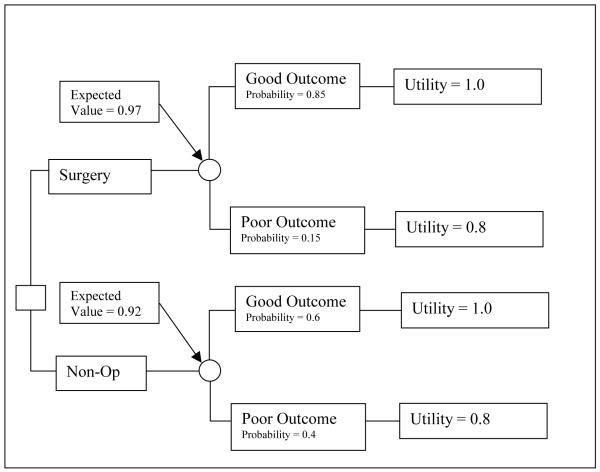
A basic decision tree.
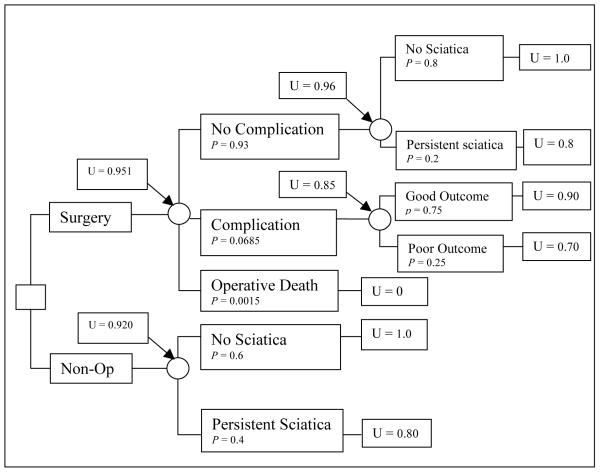
A simple decision tree for lumbar discectomy for a hypothetical patient with severe sciatica. p represents the probability of each outcome at the chance node and U represents the utility of each outcome.
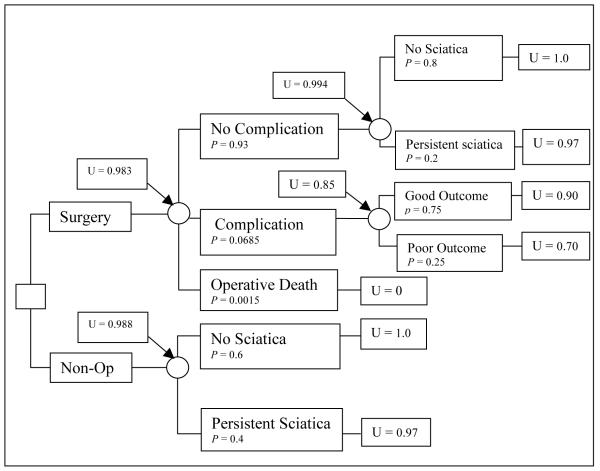
A simple decision tree for lumbar discectomy for a hypothetical patient with mild sciatica. p represents the probability of each outcome at the chance node and U represents the utility of each outcome.
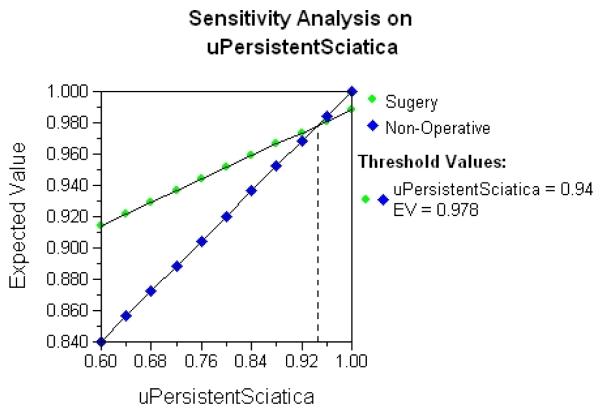
Results from a one-way sensitivity analysis where the utility for persistent sciatica is systematically varied from 0.6 to 1.0. Crossing lines indicate that a threshold health state utility for persistent sciatica exists. (Color version of figure is available online.)
References
-
- Sox H, Blatt M, Higgins M, Marton K. Medical Decision Making. 2nd ed American College of Physicians; Philadelphia: 2007.
-
- Hunink M, Glasziou P, Siegel J. Integrating Evidence and Values. Cambridge University Press; Cambridge: 2001. Decision Making in Health and Medicine. al. e.
-
- von Neumann J, Morgenstern O. Theory of games and economic behavior. Princeton University Press; Princeton, NJ: 1944.
-
- Torrance G, Feeny D, Furlong W. Visual analog scales: Do they have a role in the measurement of preferences for health states? Medical Decision Making. 2001;21:329–334. - PubMed
-
- Parkin D, Devlin N. Is there a case for using visual analogue scale valuations in cost-utility analysis? Health Economics. 2006;15:653–664. - PubMed
Grants and funding
LinkOut - more resources
Full Text Sources