Expanding disease definitions in guidelines and expert panel ties to industry: a cross-sectional study of common conditions in the United States
- PMID: 23966841
- PMCID: PMC3742441
- DOI: 10.1371/journal.pmed.1001500
Expanding disease definitions in guidelines and expert panel ties to industry: a cross-sectional study of common conditions in the United States
Abstract
Background: Financial ties between health professionals and industry may unduly influence professional judgments and some researchers have suggested that widening disease definitions may be one driver of over-diagnosis, bringing potentially unnecessary labeling and harm. We aimed to identify guidelines in which disease definitions were changed, to assess whether any proposed changes would increase the numbers of individuals considered to have the disease, whether potential harms of expanding disease definitions were investigated, and the extent of members' industry ties.
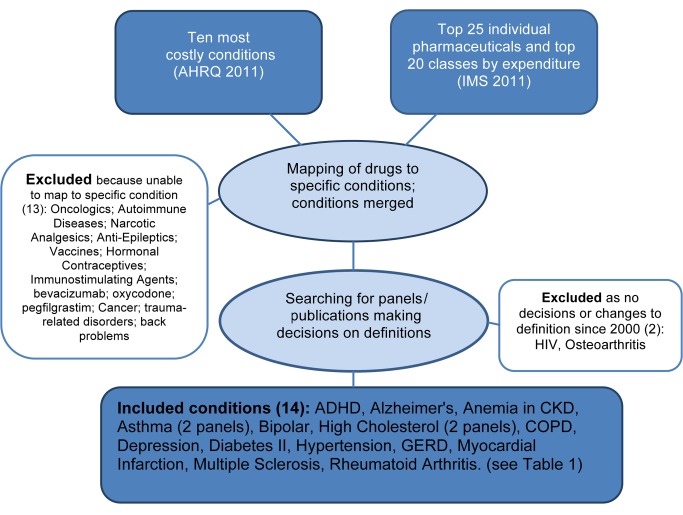
Methods and findings: We undertook a cross-sectional study of the most recent publication between 2000 and 2013 from national and international guideline panels making decisions about definitions or diagnostic criteria for common conditions in the United States. We assessed whether proposed changes widened or narrowed disease definitions, rationales offered, mention of potential harms of those changes, and the nature and extent of disclosed ties between members and pharmaceutical or device companies. Of 16 publications on 14 common conditions, ten proposed changes widening and one narrowing definitions. For five, impact was unclear. Widening fell into three categories: creating "pre-disease"; lowering diagnostic thresholds; and proposing earlier or different diagnostic methods. Rationales included standardising diagnostic criteria and new evidence about risks for people previously considered to not have the disease. No publication included rigorous assessment of potential harms of proposed changes. Among 14 panels with disclosures, the average proportion of members with industry ties was 75%. Twelve were chaired by people with ties. For members with ties, the median number of companies to which they had ties was seven. Companies with ties to the highest proportions of members were active in the relevant therapeutic area. Limitations arise from reliance on only disclosed ties, and exclusion of conditions too broad to enable analysis of single panel publications.
Conclusions: For the common conditions studied, a majority of panels proposed changes to disease definitions that increased the number of individuals considered to have the disease, none reported rigorous assessment of potential harms of that widening, and most had a majority of members disclosing financial ties to pharmaceutical companies. Please see later in the article for the Editors' Summary.
Conflict of interest statement
RM, JD, and PG are involved in planning an international conference called Preventing Overdiagnosis. GC is a board member of General Practice Education and Training, Ltd; a registrar for the Medical Administration of the Princess Alexandra Hospital in Brisbane, Australia; and a former board member of the Royal Australian College of General Practitioners. SH is a member of the PLOS Medicine editorial board and chairs the Australian Pharmaceutical Benefits Advisory Committee, an independent advisory body for the Australian government. LB declares that no competing interests exist.
Figures
Comment in
-
[Comment on ‘‘expanding disease definitions in guidelines and expert panel ties to industry: a cross-sectional study of common conditions in the United States’’ Moynihan RN, Cooke GP, Doust JA, et al. PLoS Medicine; 10(8): e1001500].Rev Port Cardiol. 2013 Dec;32(12):1053-4. doi: 10.1016/j.repc.2013.10.003. Rev Port Cardiol. 2013. PMID: 24482828 Portuguese. No abstract available.
-
Clinical guidelines at stake.J Epidemiol Community Health. 2014 Oct;68(10):906-8. doi: 10.1136/jech-2014-203862. Epub 2014 Apr 3. J Epidemiol Community Health. 2014. PMID: 24700580 No abstract available.
References
-
- Welch HG, Schwartz LM, Woloshin S (2011) Overdiagnosed: making people sick in the pursuit of health. Boston: Beacon.
-
- Hoffman J, Cooper R (2012) Overdiagnosis of disease: a modern epidemic. Arch Intern Med 172: 1123–1124. - PubMed
-
- Moynihan R, Doust J, Henry D (2012) Preventing overdiagnosis: how to stop harming the healthy. BMJ 344: e3502. - PubMed
-
- Lo B, Field MJ (2009) Conflict of interest in medical research, education, and practice. Summary. Washington (D.C.): Institute of Medicine National Academies of Science. - PubMed
Publication types
MeSH terms
LinkOut - more resources
Full Text Sources
Other Literature Sources