. 2013 Aug 16:4:320.
doi: 10.3389/fpls.2013.00320. eCollection 2013.

The influence of inorganic nitrogen fertilizer forms on micronutrient retranslocation and accumulation in grains of winter wheat

Affiliations

The influence of inorganic nitrogen fertilizer forms on micronutrient retranslocation and accumulation in grains of winter wheat

Nunun Barunawati et al. Front Plant Sci. .

Abstract

The fortification of cereal grains with metal micronutrients is a major target to combat human malnutrition of Fe and Zn. Based on recent studies showing that N fertilization can promote Fe and Zn accumulation in cereal grains, we investigated here the influence of nitrate- or ammonium-based N fertilization on the accumulation of Fe, Zn, and Cu as well as metal chelator pools in flag leaves and grains of winter wheat. Fertilization with either N form increased the concentrations of N and of the metal chelator nicotianamine (NA) in green leaves, while 2'-deoxymugineic acid (DMA) remained unaffected. Despite the differential response to N fertilization of NA and DMA levels in flag leaves, N fertilization remained without any significant effect on the net export of these metals during flag leaf senescence, which accounted for approximately one third of the total Fe, Zn, or Cu content in leaves. The significant increase in the accumulation of Fe, Zn, and Cu found in the grains of primarily ammonium-fertilized plants was unrelated to the extent of metal retranslocation from flag leaves. These results indicate that an increased N nutritional status of flag leaves promotes the accumulation of Fe, Zn, and Cu in flag leaves, which is accompanied by an increased pool of NA but not of DMA. With regard to the far higher concentrations of DMA relative to NA in leaves and leaf exudates, DMA may be more relevant for the mobilization and retranslocation of these metals in high-yielding wheat production.

Keywords: ammonium; biofortification; iron; nitrate; phytosiderophores; zinc.


Figures
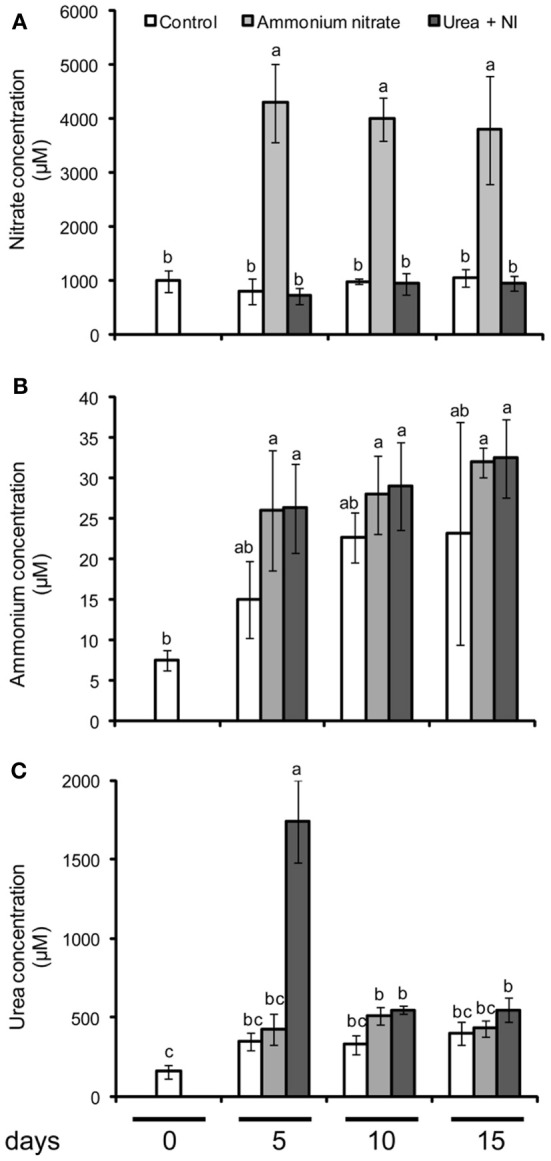
Figure 1
Figure 1
Concentration of nitrate (A), ammonium (B), and urea (C) in soils after the fertilization of ammonium nitrate or urea + nitrification inhibitor (NI). Control soils did not receive any N fertilization. Shown are means ± SD (n = 4) Different letters indicate significant differences according to Tukey's test (P ≤ 0.05).
Figure 2
Figure 2
Dry weight (A), chlorophyll concentrations (B), and N contents in flag leaves (C), thousand grain weight (D), grain yield (E), and N contents in grains (F) of winter wheat as affected by the supply of nitrate- or ammonium-based fertilizer (80 kg N ha−1) at anthesis (EC65). Bars represent the means of 4 independent replicates ± SD, and 4 plants per replicate. Means followed by different letters indicate significant differences between treatments according to One-Way (D,E) or Two-Way ANOVA (A,B,C,F) followed by Tukey's test (P ≤ 0.05). In (B) and (C), different lower-case letters indicate significant differences between harvest points within each N treatment, whereas different upper-case letters indicate significant differences among N forms within each harvest point (green or senescent leaves; immature or mature grains). The absence of letters indicates no significant difference for main factors or their interaction according to One-Way (D,E) or Two-Way (A) ANOVA.
Figure 3
Figure 3
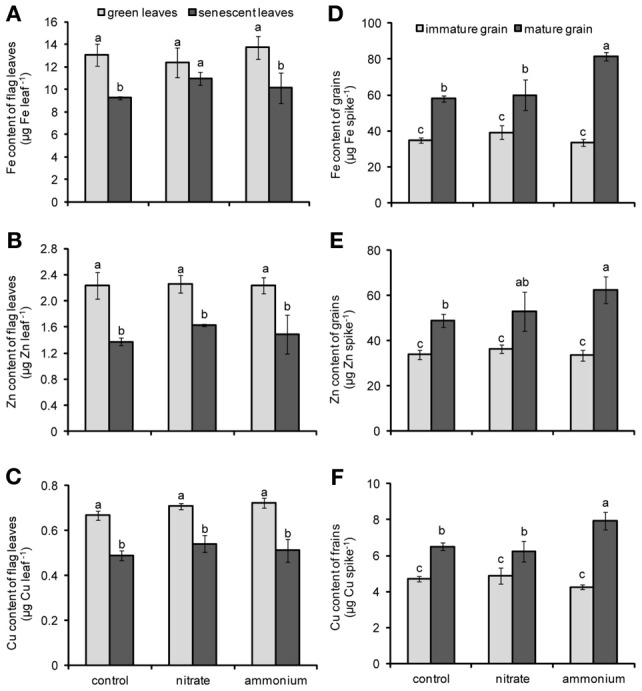
Contents of Fe (A,D) Zn (B,E), and Cu (C,F) in flag leaves (A,B,C) or grains (D,E,F) of winter wheat as affected by nitrate- or ammonium-based fertilization (80 kg N ha−1) at anthesis (EC65). Bars represent the means of 4 independent replicates ± SD, and 4 plants per replicate. Means followed by different letters indicate significant differences between treatments according to Two-Way ANOVA followed by Tukey's test (P ≤ 0.05).
Figure 4
Figure 4
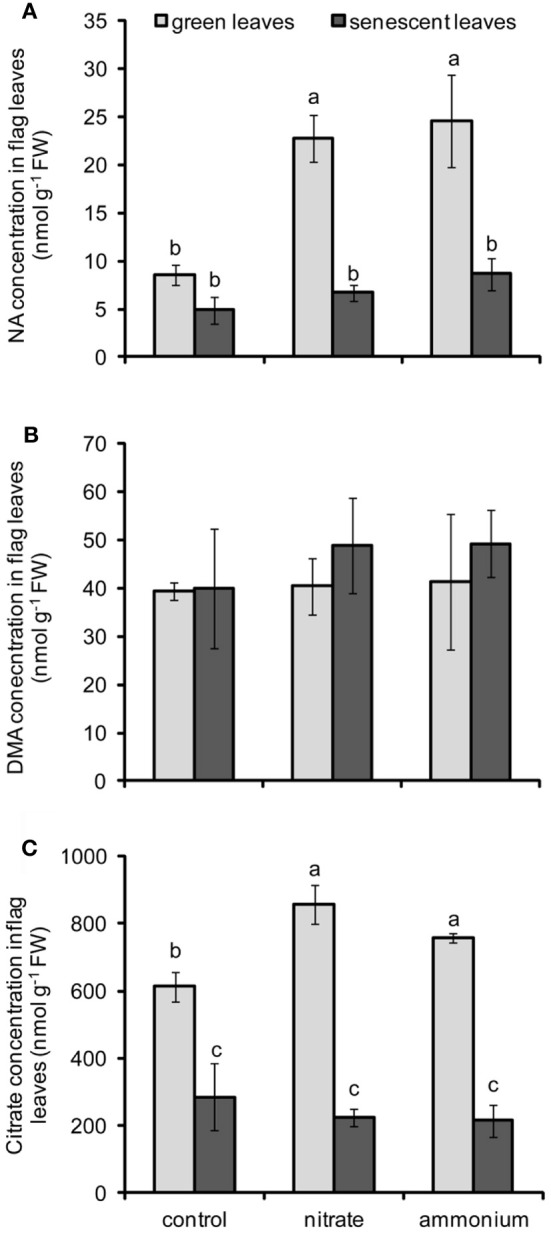
Concentrations of NA (A), DMA (B), and citrate (C) in flag leaves of winter wheat as affected by nitrate- or ammonium-based fertilization (80 kg N ha−1) at anthesis (EC65). Bars represent the means of 4 independent replicates ± SD, and 4 plants per replicate. Means followed by different letters indicate significant differences between treatments according to Two-Way ANOVA followed by Tukey's test (P ≤ 0.05). The absence of letters (B) indicates no significant difference for the main factors or their interaction according to Two-Way ANOVA.
Figure 5
Figure 5
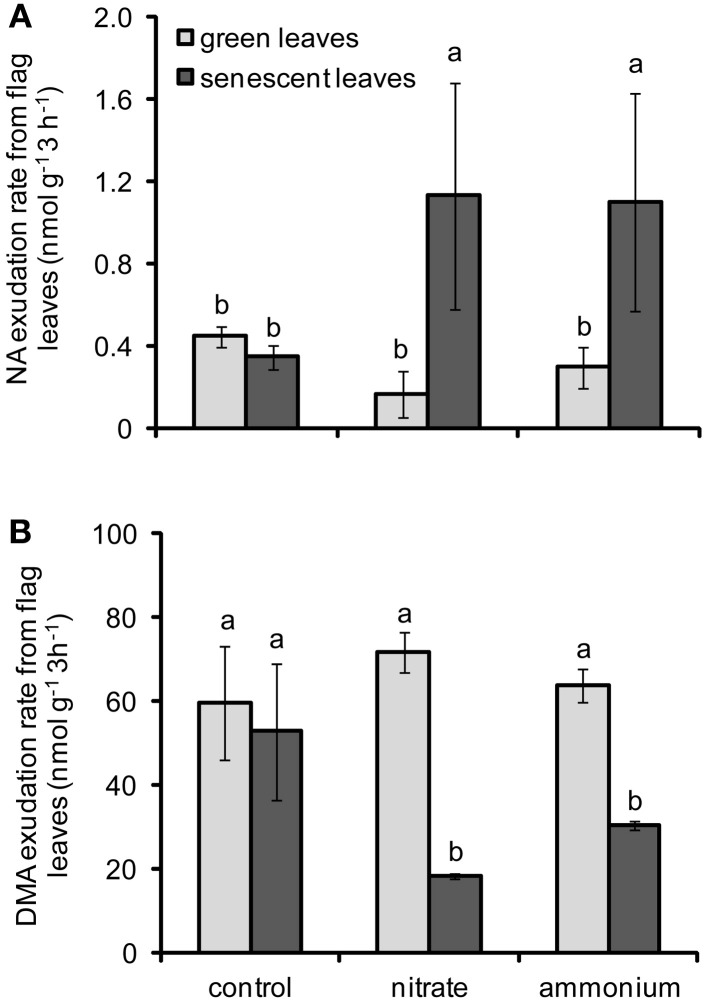
Exudation rates of NA (A) and DMA (B) from flag leaves of winter wheat as affected by nitrate- or ammonium-based fertilization (80 kg N ha−1) at anthesis (EC65). Bars represent the means of 4 independent replicates ± SD, and 4 plants per replicate. Means followed by different letters indicate significant differences between treatments according to Two-Way ANOVA followed by Tukey's test (P ≤ 0.05).
Figure A1
Figure A1
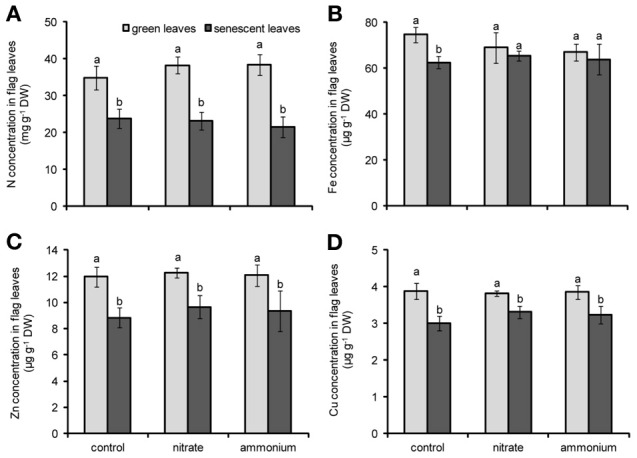
Concentrations of N (A), Fe (B), Zn (C), and Cu (D) in flag leaves of winter wheat as affected by nitrate- or ammonium-based fertilization (80 kg N ha−1) at anthesis (EC65). Bars represent the means of 4 independent replicates ± SD, and 4 plants per replicate. Means followed by different letters indicate significant differences between treatments according to Two-Way ANOVA followed by Tukey’s test (P ≤ 0.05).
Figure A2
Figure A2
Concentrations of Fe (A), Zn (B), and Cu (C) in grains of winter wheat as affected by nitrate- or ammonium-based fertilization (80 kg N ha−1) at anthesis (EC65). Bars represent the means of 4 independent replicates ± SD, and 4 plants per replicate. Means followed by different letters indicate significant differences between treatments according to Two-Way ANOVA followed by Tukey’s test (P ≤ 0.05). The absence of letters (B) indicates no significant difference between treatments or their interactions according to Two-Way ANOVA.

References

    1. Aciksoz S. B., Yazici A., Ozturk L., Cakmak I. (2011). Biofortification of wheat with iron through soil and foliar application of nitrogen and iron fertilizers. Plant Soil 349, 215–225 10.1007/s11104-011-0863-2 - DOI
    1. Bergmann W. (1992). Nutritional Disorders in Plants: Development, Visual and Analytical Diagnosis. Jena: Gustav Fisher
    1. Bouis H. E., Hotz C., McClafferty B., Meenakshi J. V., Pfeiffer W. H., Eozenou P., et al. (2009). Biofortification: a new tool to reduce micronutrient malnutrition. Ann. Nutr. Metab. 55, 57–58 - PubMed
    1. Briat J. F., Curie C., Gaymard F. (2007). Iron utilization and metabolism in plants. Curr. Opin. Plant Biol. 10, 276–282 10.1016/j.pbi.2007.04.003 - DOI - PubMed
    1. Cakmak I. (2008). Enrichment of cereal grains with zinc: agronomic or genetic biofortification? Plant Soil 302, 1–17 10.1007/s11104-007-9466-3 - DOI

LinkOut - more resources