


Red and processed meat intake is associated with higher gastric cancer risk: a meta-analysis of epidemiological observational studies
- PMID: 23967140
- PMCID: PMC3743884
- DOI: 10.1371/journal.pone.0070955
Red and processed meat intake is associated with higher gastric cancer risk: a meta-analysis of epidemiological observational studies
Abstract
Background: Red and processed meat was concluded as a limited-suggestive risk factor of gastric cancer by the World Cancer Research Fund. However, recent epidemiological studies have yielded inconclusive results.
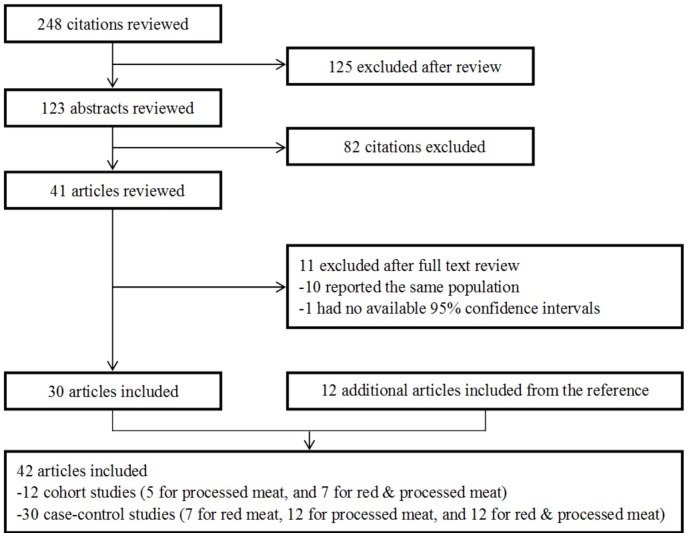
Methods: We searched Medline, EMBASE, and the Cochrane Library from their inception to April 2013 for both cohort and case-control studies which assessed the association between red and/or processed meat intake and gastric cancer risk. Study-specific relative risk estimates were polled by random-effect or fixed-effect models.
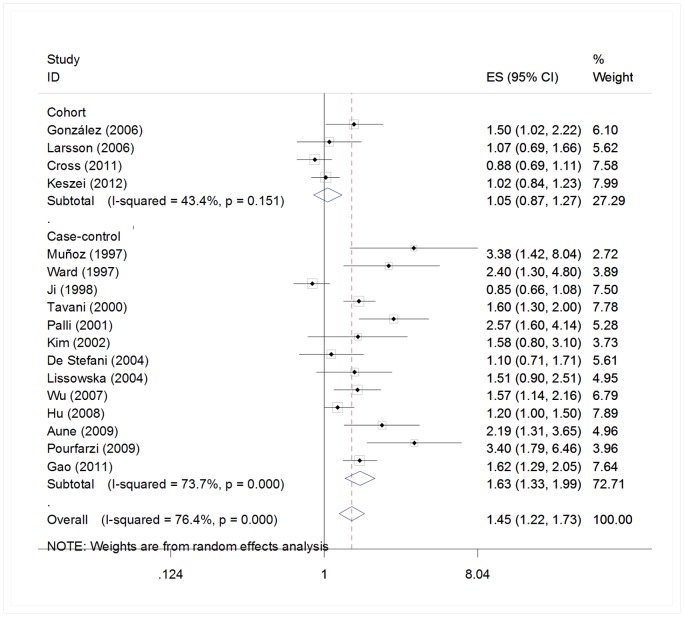
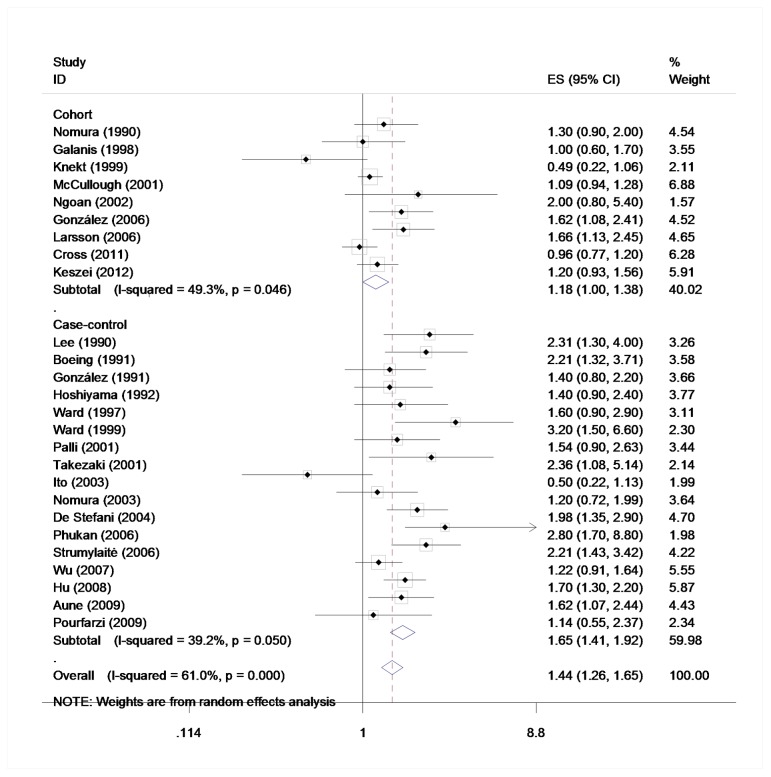
Results: Twelve cohort and thirty case-control studies were included in the meta-analysis. Significant associations were found between both red (RR: 1.45, 95% CI: 1.22-1.73) and processed (RR: 1.45, 95% CI: 1.26-1.65) meat intake and gastric cancer risk generally. Positive findings were also existed in the items of beef (RR: 1.28, 95% CI: 1.04-1.57), bacon (RR: 1.37, 95% CI: 1.17-1.61), ham (RR: 1.44, 95% CI: 1.00-2.06), and sausage (RR: 1.33, 95% CI: 1.16-1.52). When conducted by study design, the association was significant in case-control studies (RR: 1.63, 95% CI: 1.33-1.99) but not in cohort studies (RR: 1.02, 95% CI: 0.90-1.17) for red meat. Increased relative risks were seen in high-quality, adenocarcinoma, cardia and European-population studies for red meat. And most subgroup analysis confirmed the significant association between processed meat intake and gastric cancer risk.
Conclusions: Our findings indicate that consumption of red and/or processed meat contributes to increased gastric cancer risk. However, further investigation is needed to confirm the association, especially for red meat.
Conflict of interest statement
Figures

References
-
- Carr JS, Zafar SF, Saba N, Khuri FR, El-Rayes BF (2013) Risk Factors for Rising Incidence of Esophageal and Gastric Cardia Adenocarcinoma. J Gastrointest Cancer. Feb 26. [Epub ahead of print]. - PubMed
-
- Jemal A (2010) Center MM, DeSantis C, Ward EM (2010) Global patterns of cancer incidence and mortality rates and trends. Cancer Epidemiol Biomarkers Prev 19: 1893–1907. - PubMed
-
- Tricker AR (1997) N-nitroso compounds and man: sources of exposure, endogenous formation and occurrence in body fluids. Eur J Cancer Prev 6: 226–268. - PubMed
-
- Skog KI, Johansson MA, Jägerstad MI (1998) Carcinogenic heterocyclic amines in model systems and cooked foods: a review on formation, occurrence and intake. Food Chem Toxicol 36: 879–896. - PubMed
Publication types
MeSH terms
LinkOut - more resources
Full Text Sources
Other Literature Sources
Medical
Miscellaneous
