. 2013 Aug 13;8(8):e71728.
doi: 10.1371/journal.pone.0071728. eCollection 2013.

Functional testing of an inhalable nanoparticle based influenza vaccine using a human precision cut lung slice technique

Affiliations

Functional testing of an inhalable nanoparticle based influenza vaccine using a human precision cut lung slice technique

Vanessa Neuhaus et al. PLoS One. .

Abstract

Annual outbreaks of influenza infections, caused by new influenza virus subtypes and high incidences of zoonosis, make seasonal influenza one of the most unpredictable and serious health threats worldwide. Currently available vaccines, though the main prevention strategy, can neither efficiently be adapted to new circulating virus subtypes nor provide high amounts to meet the global demand fast enough. New influenza vaccines quickly adapted to current virus strains are needed. In the present study we investigated the local toxicity and capacity of a new inhalable influenza vaccine to induce an antigen-specific recall response at the site of virus entry in human precision-cut lung slices (PCLS). This new vaccine combines recombinant H1N1 influenza hemagglutinin (HAC1), produced in tobacco plants, and a silica nanoparticle (NP)-based drug delivery system. We found no local cellular toxicity of the vaccine within applicable concentrations. However higher concentrations of NP (≥10(3) µg/ml) dose-dependently decreased viability of human PCLS. Furthermore NP, not the protein, provoked a dose-dependent induction of TNF-α and IL-1β, indicating adjuvant properties of silica. In contrast, we found an antigen-specific induction of the T cell proliferation and differentiation cytokine, IL-2, compared to baseline level (152±49 pg/mg vs. 22±5 pg/mg), which could not be seen for the NP alone. Additionally, treatment with 10 µg/ml HAC1 caused a 6-times higher secretion of IFN-γ compared to baseline (602±307 pg/mg vs. 97±51 pg/mg). This antigen-induced IFN-γ secretion was further boosted by the adjuvant effect of silica NP for the formulated vaccine to a 12-fold increase (97±51 pg/mg vs. 1226±535 pg/mg). Thus we were able to show that the plant-produced vaccine induced an adequate innate immune response and re-activated an established antigen-specific T cell response within a non-toxic range in human PCLS at the site of virus entry.


Conflict of interest statement

Competing Interests: Fraunhofer ITEM is a public non-profit research organisation doing contract research for e.g. pharmaceutical and biotech industry. The authors have declared that no competing interests exist.

Figures

Figure 1
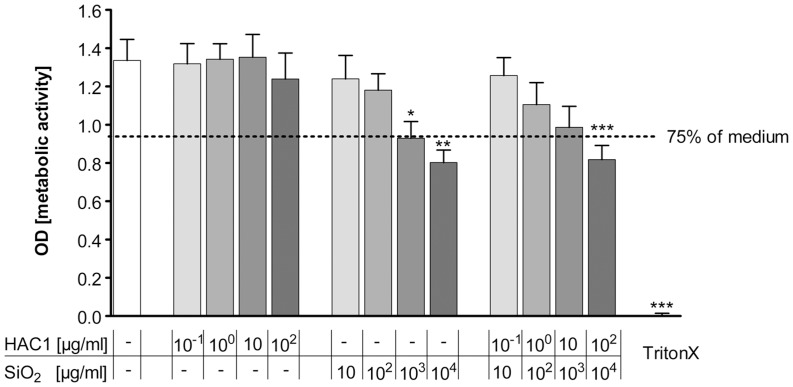
Figure 1. Effects of the recombinant hemagglutinin protein HAC1 and SiO2 on metabolic activity of human PCLS.
Increasing concentrations of the plant-derived recombinant hemagglutinin protein HAC1 from the H1N1 virus had no significant influence on the metabolic activity of the human lung tissue. In contrast to HAC1, the SiO2 nanoparticles had in higher concentrations (≥103 µg/ml) a significant effect on the metabolic activity in human PCLS compared to the tissue control after 24 hours. Similarly the combined treatment (HAC1+ SiO2 nanoparticles) also caused in the highest concentrations (102 µg/ml HAC1 bound onto 104 µg/ml SiO2) a significant decrease in the metabolic activity of the cells. Data are presented as mean±SEM, *p<0.05, **p<0.01 compared to untreated tissue control, Friedman test and Dunn’s Multiple Comparison Post-hoc test (n = 13). Doted line marks 75% of the tissue control. PCLS = precision cut lung slices, HAC1 =  plant-derived recombinant hemagglutinin protein, SiO2 = silica nanoparticles.
Figure 2
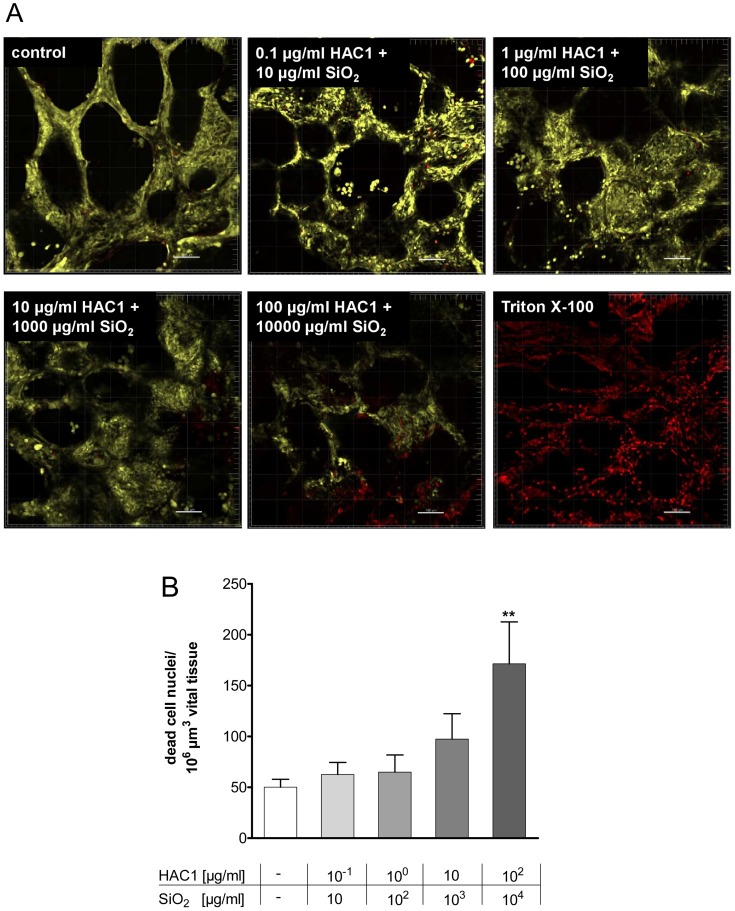
Figure 2. Three dimensional detection and semi-quantitative image analysis of viability staining after 24 h of incubation with HAC1 bound onto SiO2 nanoparticles in human PCLS.
Human lung slices were treated without (control) or with increasing concentrations of the plant-derived recombinant hemagglutinin protein HAC1 bound onto increasing concentrations of SiO2 nanoparticles (ratio HAC1:SiO2 = 1∶100) or with triton X as a negative control (A). The images were analyzed with the IMARIS 5.5.3. Software and semi-quantitatively evaluated (B). Viability of PCLS is expressed as quantity of spots (>4 µm diameter) in 106 µm3 yellow tissue volume. Data are presented as mean±SEM, **p<0.01 compared to untreated tissue control, Friedman test and Dunn’s Multiple Comparison Post-hoc test (n = 11). HAC1 = plant-derived recombinant hemagglutinin protein, SiO2 = silica nanoparticles.
Figure 3
Figure 3. Extracellular release of the pro-inflammatory cytokine TNF-α in human PCLS after 24 h of treatment with HAC1, SiO2 or HAC1-SiO2.
Human PCLS were treated without (control) or with increasing concentrations of either the plant-derived recombinant hemagglutinin protein HAC1 or the SiO2 nanoparticles or the protein bound onto SiO2 nanoparticles (ratio HAC1:SiO2 = 1∶100) or with LPS as an inflammatory control. The cytokine levels of TNF-α in PCLS culture supernatants were determined by Multiplex MSD technology. Data are presented as mean±SEM, *p<0.05, **p<0.01 & ***p<0.001 compared to untreated tissue control, Xp<0.05 compared to corresponding concentration of combined treatment (HAC1 vs. HAC1-SiO2 or SiO2 vs. HAC1-SiO2), Friedman test and Dunn’s Multiple Comparison Post-hoc test (n = 13). HAC1 =  plant-derived recombinant hemagglutinin protein, SiO2 = silica nanoparticles.
Figure 4
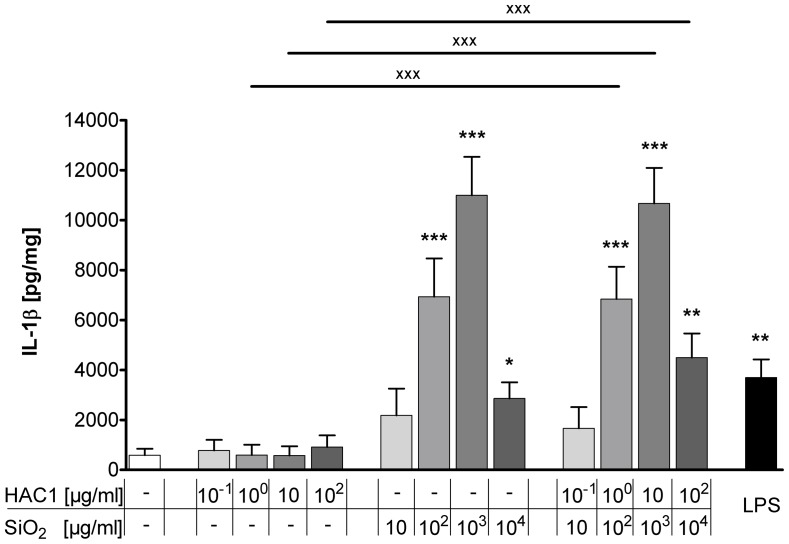
Figure 4. Extracellular IL-1β release in human PCLS after 24 h treatment with HAC1, SiO2 or HAC1-SiO2.
Human PCLS were treated without (control) or with increasing concentrations of either the plant-derived recombinant hemagglutinin protein HAC1 (A) or the SiO2 nanoparticles (B) or a combination of both (ratio HAC1:SiO2 = 1∶100; C) or with LPS as an inflammatory control. The cytokine levels of IL-1β in PCLS culture supernatants were determined by Multiplex MSD technology. Data are presented as mean±SEM, *p<0.05, **p<0.01compared to untreated tissue control, XXXp<0.001 compared to corresponding concentration of combined treatment (HAC1 vs. HAC1-SiO2 or SiO2 vs. HAC1-SiO2) Friedman test and Dunn’s Multiple Comparison Post-hoc test (n = 13). HAC1 =  plant-derived recombinant hemagglutinin protein, SiO2 = silica nanoparticles.
Figure 5
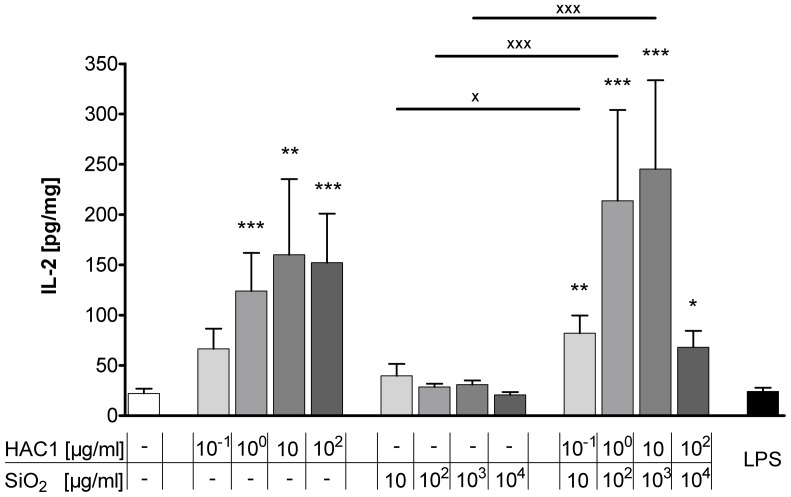
Figure 5. Release of extracellular IL-2 in human PCLS after 24 h treatment with the test substances.
Human PCLS were treated without (control) or with increasing concentrations of either the plant-derived recombinant hemagglutinin protein HAC1 or the SiO2 nanoparticles or a combination of both (ratio HAC1:SiO2 = 1∶100) or with LPS. The cytokine levels of IL-2 in PCLS culture supernatants were determined by Multiplex MSD technology. Data are presented as mean±SEM, *p<0.05, **p<0.01 & ***p<0.001 compared to untreated tissue control, Xp<0.05 & XXXp<0.001 compared to corresponding concentration of combined treatment (HAC1 vs. HAC1-SiO2 or SiO2 vs. HAC1-SiO2), Friedman test and Dunn’s Multiple Comparison Post-hoc test (n = 13). HAC1 =  plant-derived recombinant hemagglutinin protein, SiO2 = silica nanoparticles.
Figure 6
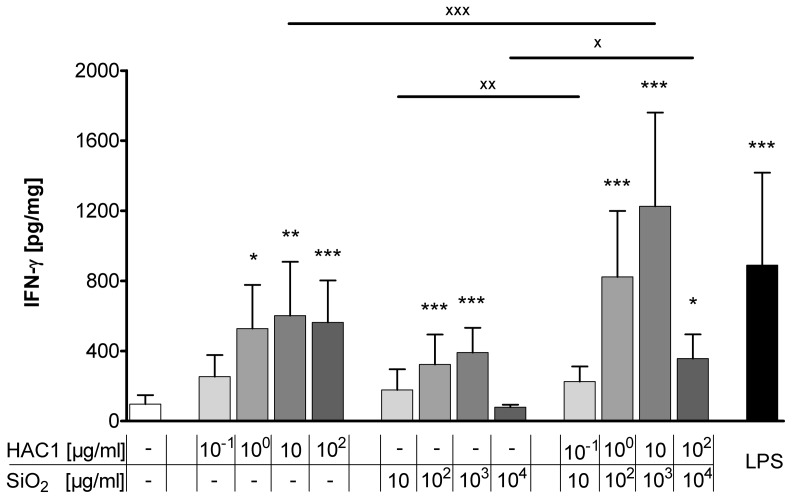
Figure 6. Release of extracellular Interferon-gamma in human PCLS after 24 h treatment with the test substances.
Human PCLS were treated without (control) or with increasing concentrations of either the plant-derived recombinant hemagglutinin protein HAC1 or the SiO2 nanoparticles or a combination of both (ratio HAC1:SiO2 = 1∶100) or with LPS. The cytokine levels of Interferon-gamma (IFN-γ) in PCLS culture supernatants were determined by Multiplex MSD technology. Data are presented as mean±SEM, *p<0.05, **p<0.01 & ***p<0.001 compared to untreated tissue control, Xp<0.05, XXp<0.01 & XXXp<0.001 compared to corresponding concentration of combined treatment (HAC1 vs. HAC1-SiO2 or SiO2 vs. HAC1-SiO2), Friedman test and Dunn’s Multiple Comparison Post-hoc test (n = 13). HAC1 =  plant-derived recombinant hemagglutinin protein, SiO2 = silica nanoparticles.

References

    1. World health organization website (2009) Influenza (Seasonal); Fact sheet N°211. Available: http://www.who.int/mediacentre/factsheets/fs211/en/. Accessed: 23-2-2013.
    1. Bulletin of the World health organization (1980) A revision of the system of nomenclature for influenza viruses: a WHO memorandum. Bull World Health Organ 58: 585–591. - PMC - PubMed
    1. Gupta V, Earl DJ, Deem MW (2006) Quantifying influenza vaccine efficacy and antigenic distance. Vaccine 24: 3881–3888 S0264-410X(06)00004-1 [pii];10.1016/j.vaccine.2006.01.010 [doi] - DOI - PMC - PubMed
    1. Thangavel RR, Reed A, Norcross EW, Dixon SN, Marquart ME, et al. (2011) “Boom” and “Bust” cycles in virus growth suggest multiple selective forces in influenza a evolution. Virol J 8: 180 1743-422X-8-180 [pii];10.1186/1743-422X-8-180 [doi] - DOI - PMC - PubMed
    1. Pereira HG, Rinaldi A, Nardelli L (1967) Antigenic variation among avian influenza A viruses. Bull World Health Organ 37: 553–558. - PMC - PubMed

Publication types

MeSH terms