


Clinical relevance of gain-of-function mutations of p53 in high-grade serous ovarian carcinoma
- PMID: 23967324
- PMCID: PMC3742716
- DOI: 10.1371/journal.pone.0072609
Clinical relevance of gain-of-function mutations of p53 in high-grade serous ovarian carcinoma
Abstract
Purpose: Inactivation of TP53, which occurs predominantly by missense mutations in exons 4-9, is a major genetic alteration in a subset of human cancer. In spite of growing evidence that gain-of-function (GOF) mutations of p53 also have oncogenic activity, little is known about the clinical relevance of these mutations.
Methods: The clinicopathological features of high-grade serous ovarian carcinoma (HGS-OvCa) patients with GOF p53 mutations were evaluated according to a comprehensive somatic mutation profile comprised of whole exome sequencing, mRNA expression, and protein expression profiles obtained from the Cancer Genome Atlas (TCGA).
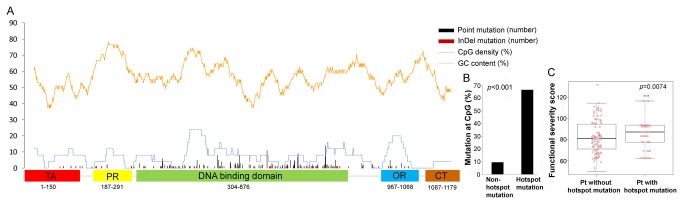
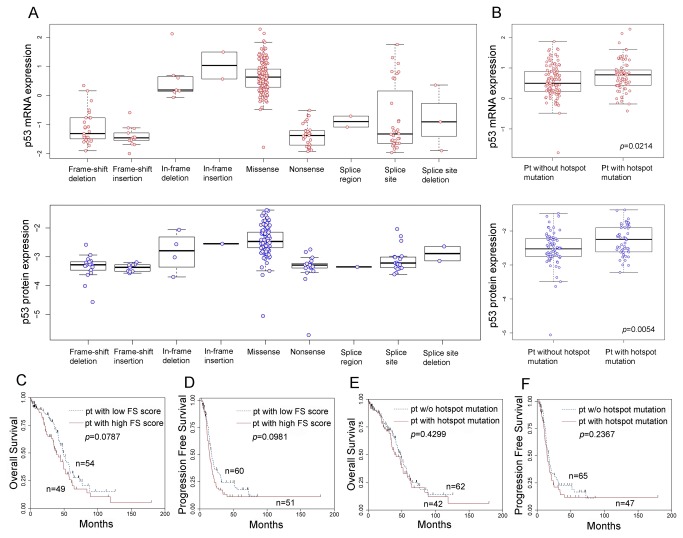
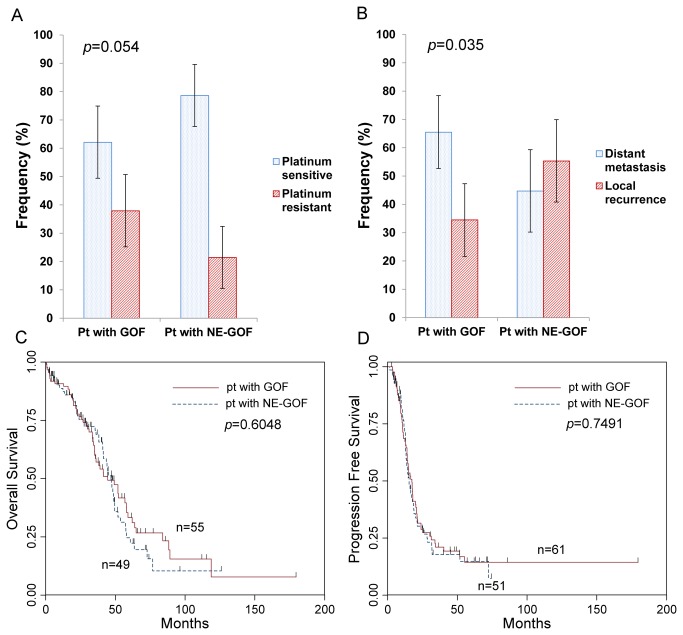
Results: Patients with a mutant p53 protein (mutp53) with a GOF mutation showed higher p53 mRNA and protein expression levels than patients with p53 mutation with no evidence of GOF (NE-GOF). GOF mutations were more likely to occur within mutational hotspots, and at CpG sites, and resulted in mutp53 with higher functional severity (FS) scores. Clinically, patients with GOF mutations showed a higher frequency of platinum resistance (22/58, 37.9%) than patients with NE-GOF mutations (12/56, 21.4%) (p=0.054). Furthermore, patients with GOF mutations were more likely to develop distant metastasis (36/55, 65.5%) than local recurrence (19/55, 34.5%), whereas patients with NE-GOF mutations showed a higher frequency of locoregional recurrence (26/47, 55.3%) than distant metastasis (21/47, 44.7%) (p=0.035). There were no differences in overall or progression-free survival between patients with GOF or NE-GOF mutp53.
Conclusion: This study demonstrates that patient with GOF mutp53 is characterized by a greater likelihood of platinum treatment resistance and distant metastatic properties in HGS-OvCa.
Conflict of interest statement
Figures
References
-
- Muller PA, Vousden KH (2013) p53 mutations in cancer. Nat Cell Biol 15: 2-8. doi:10.1038/ncb2641. PubMed: 23263379. - DOI - PubMed
-
- Olivier M, Hollstein M, Hainaut P (2010) TP53 mutations in human cancers: origins, consequences, and clinical use. Cold Spring Harb Perspect Biol 2: a001008. doi:10.1101/cshperspect.a001008. PubMed: 20182602. - DOI - PMC - PubMed
-
- Rivlin N, Brosh R, Oren M, Rotter V (2011) Mutations in the p53 Tumor Suppressor Gene: Important Milestones at the Various Steps of Tumorigenesis. Genes Cancer 2: 466-474. doi:10.1177/1947601911408889. PubMed: 21779514. - DOI - PMC - PubMed
-
- Oren M, Rotter V (2010) Mutant p53 gain-of-function in cancer. Cold Spring Harb Perspect Biol 2: a001107. doi:10.1101/cshperspect.a001107. PubMed: 20182618. - DOI - PMC - PubMed
Publication types
MeSH terms
Substances
LinkOut - more resources
Full Text Sources
Other Literature Sources
Medical
Research Materials
Miscellaneous
