


High antibody responses against Plasmodium falciparum in immigrants after extended periods of interrupted exposure to malaria
- PMID: 23967347
- PMCID: PMC3743903
- DOI: 10.1371/journal.pone.0073624
High antibody responses against Plasmodium falciparum in immigrants after extended periods of interrupted exposure to malaria
Abstract
Background: Malaria immunity is commonly believed to wane in the absence of Plasmodium falciparum exposure, based on limited epidemiological data and short-lived antibody responses in some longitudinal studies in endemic areas.
Methods: A cross-sectional study was conducted among sub-Saharan African adults residing in Spain for 1 up to 38 years (immigrants) with clinical malaria (n=55) or without malaria (n=37), naïve adults (travelers) with a first clinical malaria episode (n=20) and life-long malaria exposed adults from Mozambique (semi-immune adults) without malaria (n=27) or with clinical malaria (n=50). Blood samples were collected and IgG levels against the erythrocytic antigens AMA-1 and MSP-1₄₂ (3D7 and FVO strains), EBA-175 and DBL-α were determined by Luminex. IgG levels against antigens on the surface of infected erythrocytes (IEs) were measured by flow cytometry.
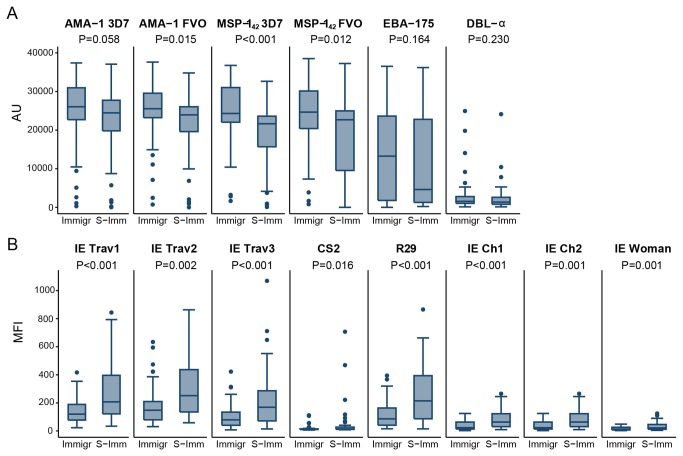
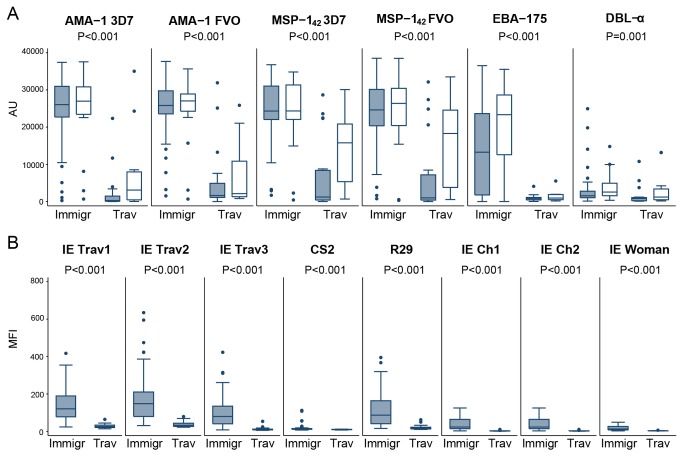
Results: Immigrants without malaria had lower IgG levels than healthy semi-immune adults regardless of the antigen tested (P≤0.026), but no correlation was found between IgG levels and time since migration. Upon reinfection, immigrants with malaria had higher levels of IgG against all antigens than immigrants without malaria. However, the magnitude of the response compared to semi-immune adults with malaria depended on the antigen tested. Thus, immigrants had higher IgG levels against AMA-1 and MSP-1₄₂ (P≤0.015), similar levels against EBA-175 and DBL-α, and lower levels against IEs (P≤0.016). Immigrants had higher IgG levels against all antigens tested compared to travelers (P≤0.001), both with malaria.
Conclusions: Upon cessation of malaria exposure, IgG responses to malaria-specific antigens were maintained to a large extent, although the conservation and the magnitude of the recall response depended on the nature of the antigen. Studies on immigrant populations can shed light on the factors that determine the duration of malaria specific antibody responses and its effect on protection, with important implications for future vaccine design and public health control measures.
Conflict of interest statement
Figures

References
-
- Doolan DL, Dobaño C, Baird JK (2009) Acquired immunity to malaria. Clin Microbiol Rev 22: 13–36. doi:10.1128/CMR.00025-08. PubMed: 19136431. - DOI - PMC - PubMed
-
- Amanna IJ, Carlson NE, Slifka MK (2007) Duration of humoral immunity to common viral and vaccine antigens. N. Engl. J. Med. 357: 1903–1915. doi:10.1056/NEJMoa066092. PubMed: 17989383. - DOI - PubMed
-
- Langhorne J, Ndungu FM, Sponaas A-M, Marsh K (2008) Immunity to malaria: more questions than answers. Nat Immunol 9: 725–732. doi:10.1038/ni.f.205. PubMed: 18563083. - DOI - PubMed
-
- Cohen S, McGregor IA, Carrington S (1961) Gamma-globulin and acquired immunity to human malaria. Nature 192: 733–737. doi:10.1038/192733a0. PubMed: 13880318. - DOI - PubMed
Publication types
MeSH terms
Substances
LinkOut - more resources
Full Text Sources
Other Literature Sources
Research Materials
