


Effects of betaine on body composition, performance, and homocysteine thiolactone
- PMID: 23967897
- PMCID: PMC3844502
- DOI: 10.1186/1550-2783-10-39
Effects of betaine on body composition, performance, and homocysteine thiolactone
Abstract
Background: This study investigated the effects of long term betaine supplementation on body composition, performance, and homocysteine thiolactone (HCTL) in experienced strength trained men.
Methods: Twenty-three subjects were matched for training experience (4.8 ± 2.3 years) and body fat percentage (BF%: 16.9 ± 8.0%), randomly assigned to either a placebo (PL; n = 12) or betaine group (BET; n = 11; 2.5 g/day), and completed a 6 week periodized training program consisting of 3 two-week micro-cycles. Bench press and back squat training volumes were recorded and changes in training volume were assessed at each micro-cycle. Fasting urine was collected at baseline (BL), weeks 2, 4 and 6, and assayed for HCTL. Subjects were tested prior to and following 6 weeks of treatment. Arm and thigh cross sectional area (CSA) was estimated via girth and skin fold measurements. Body density was estimated via skin fold calipers and used to estimate BF%, fat mass (FM), and lean body mass (LBM). Performance was assessed via vertical jump (VJ), bench press 1 RM (BP), and back squat 1 RM (BS).
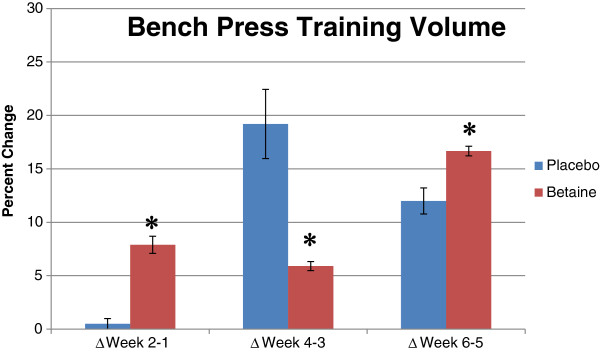
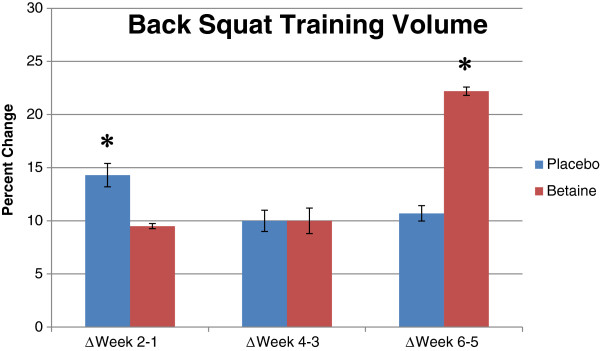
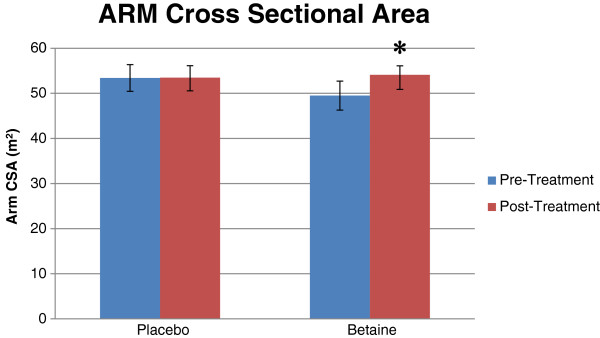
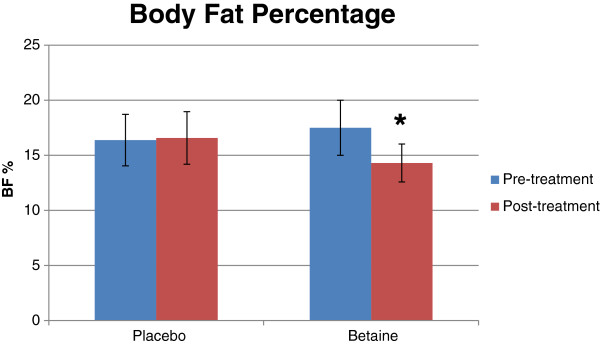
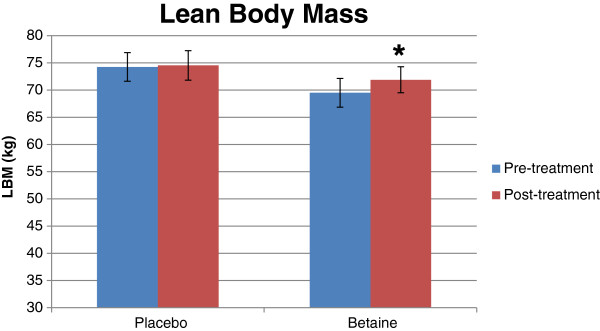
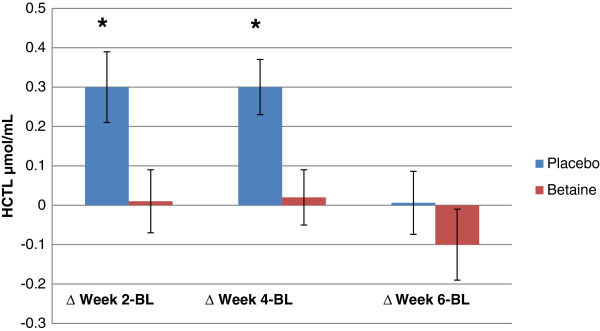
Results: Arm CSA increased significantly (p < .05) in BET but not PL. No differences existed between group and time for changes in thigh CSA. Back squat training volume increased significantly (p < .05) for both groups throughout training. Bench press training volume was significantly (p < .05) improved for BET compared to PL at microcycles one and three. Body composition (BF%, FM, LBM) improved significantly (p < .05) in BET but not PL. No differences were found in performance variables (BP, BS, VJ) between groups, except there was a trend (p = .07) for increased VJ power in BET versus PL. A significant interaction (p < .05) existed for HCTL, with increases from BL to week 2 in PL, but not BET. Additionally, HCTL remained elevated at week 4 in PL, but not BET.
Conclusion: Six-weeks of betaine supplementation improved body composition, arm size, bench press work capacity, attenuated the rise in urinary HCTL, and tended to improve power (p = .07) but not strength.
Figures
References
-
- Craig SAS. Betaine in human nutrition. Am J Clin Nutr. 2004;80:539–549. - PubMed
-
- Trepanowski JF, Farney TM, McCarthy CG, Schilling BK, Craig SA, Bloomer RJ. The effects of chronic betaine supplementation on exercise performance, skeletal muscle oxygen saturation and associated biochemical parameters in resistance trained men. J Strength Cond Res. 2011;25:3461–3471. doi: 10.1519/JSC.0b013e318217d48d. - DOI - PubMed
-
- Del Favero S, Roschel H, Artioli G, Ugrinowitsch C, Tricoli V, Costa A, Barroso R, Negrelli AL, Otaduy MC, da Costa Leite C, Lancha-Junior AH, Gualano B. Creatine but not betaine supplementation increases muscle phosphorylcreatine content and strength performance. Amino Acids. 2011. - PubMed
LinkOut - more resources
Full Text Sources
Other Literature Sources
Miscellaneous
