NADPH oxidases, reactive oxygen species, and the kidney: friend and foe
- PMID: 23970124
- PMCID: PMC3785272
- DOI: 10.1681/ASN.2012111112
NADPH oxidases, reactive oxygen species, and the kidney: friend and foe
Abstract
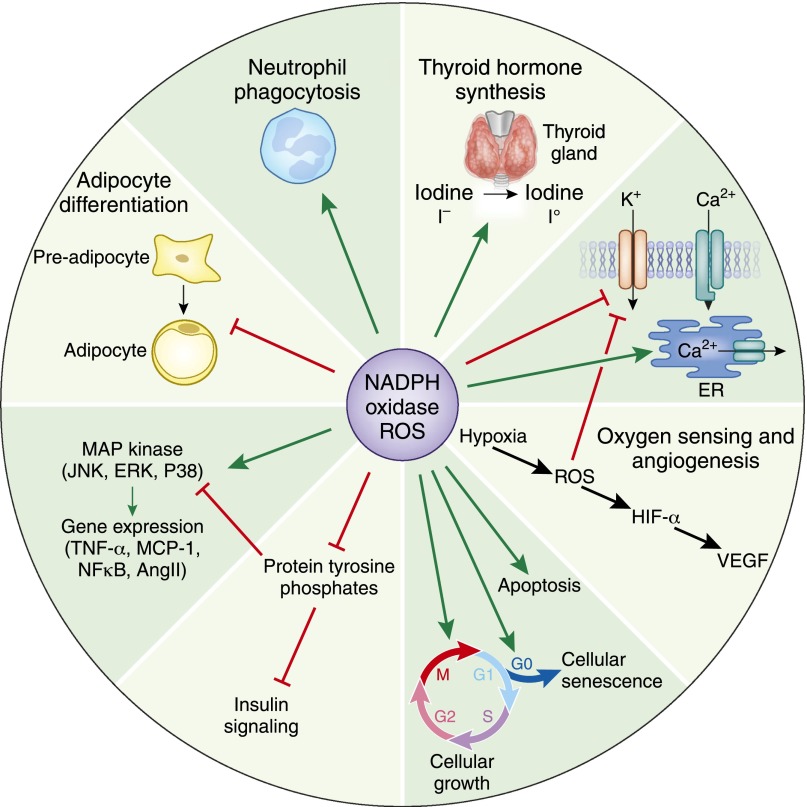
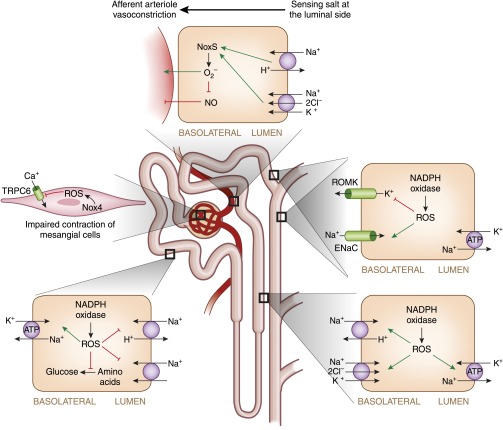
Reactive oxygen species (ROS) play an important role in normal cellular physiology. They regulate different biologic processes such as cell defense, hormone synthesis and signaling, activation of G protein-coupled receptors, and ion channels and kinases/phosphatases. ROS are also important regulators of transcription factors and gene expression. On the other hand, in pathologic conditions, a surplus of ROS in tissue results in oxidative stress with various injurious consequences such as inflammation and fibrosis. NADPH oxidases are one of the many sources of ROS in biologic systems, and there are seven isoforms (Nox1-5, Duox1, Duox2). Nox4 is the predominant form in the kidney, although Nox2 is also expressed. Nox4 has been implicated in the basal production of ROS in the kidney and in pathologic conditions such as diabetic nephropathy and CKD; upregulation of Nox4 may be important in renal oxidative stress and kidney injury. Although there is growing evidence indicating the involvement of NADPH oxidase in renal pathology, there is a paucity of information on the role of NADPH oxidase in the regulation of normal renal function. Here we provide an update on the role of NADPH oxidases and ROS in renal physiology and pathology.
Figures
References
-
- Opitz N, Drummond GR, Selemidis S, Meurer S, Schmidt HH: The ‘A’s and ‘O’s of NADPH oxidase regulation: A commentary on “Subcellular localization and function of alternatively spliced Noxo1 isoforms”. Free Radic Biol Med 42: 175–179, 2007 - PubMed
-
- Cheng G, Cao Z, Xu X, van Meir EG, Lambeth JD: Homologs of gp91phox: Cloning and tissue expression of Nox3, Nox4, and Nox5. Gene 269: 131–140, 2001 - PubMed
-
- Suh YA, Arnold RS, Lassegue B, Shi J, Xu X, Sorescu D, Chung AB, Griendling KK, Lambeth JD: Cell transformation by the superoxide-generating oxidase Mox1. Nature 401: 79–82, 1999 - PubMed
-
- Touyz RM, Briones AM, Sedeek M, Burger D, Montezano AC: NOX isoforms and reactive oxygen species in vascular health. Mol Interv 11: 27–35, 2011 - PubMed
Publication types
MeSH terms
Substances
Grants and funding
LinkOut - more resources
Full Text Sources
Other Literature Sources
Miscellaneous