Syndecan-4 signaling at a glance
- PMID: 23970415
- PMCID: PMC3757327
- DOI: 10.1242/jcs.124636
Syndecan-4 signaling at a glance
Abstract
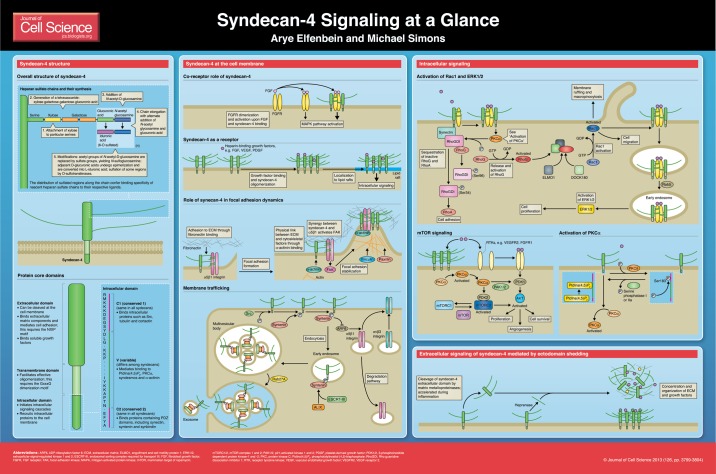
Syndecan-4, a ubiquitous cell surface proteoglycan, mediates numerous cellular processes through signaling pathways that affect cellular proliferation, migration, mechanotransduction and endocytosis. These effects are achieved through syndecan-4 functioning as both a co-receptor for the fibroblast growth factor receptors (FGFR1-FGFR4) and its ability to independently activate signaling pathways upon ligand binding. As an FGFR co-receptor, syndecan-4 strengthens the duration and intensity of downstream signaling upon ligand binding; this is particularly evident with regard to mitogen-activated protein kinase (MAPK) signaling. In contrast, syndecan-4 also functions as an independent receptor for heparin-binding growth factors, such as fibroblast growth factors (FGFs), vascular endothelial growth factors (VEGFs) and platelet-derived growth factors (PDGFs). These signaling cascades affect canonical signaling components, such as the mammalian target of rapamycin (mTOR), AKT1 and the Rho family of GTPases. In combination with the integrin family of proteins, syndecan-4 is also able to form physical connections between the extracellular matrix (ECM) and cytoskeletal signaling proteins, and it has a key role in regulation of integrin turnover. This unique versatility of the interactions of syndecan-4 is characterized in this Cell Science at a Glance article and illustrated in the accompanying poster.
References
-
- Bass M. D., Roach K. A., Morgan M. R., Mostafavi-Pour Z., Schoen T., Muramatsu T., Mayer U., Ballestrem C., Spatz J. P., Humphries M. J. (2007b). Syndecan-4-dependent Rac1 regulation determines directional migration in response to the extracellular matrix. J. Cell Biol. 177, 527–538 10.1083/jcb.200610076 - DOI - PMC - PubMed
Publication types
MeSH terms
Substances
Grants and funding
LinkOut - more resources
Full Text Sources
Other Literature Sources
Research Materials
Miscellaneous