


Gonadotrophins for idiopathic male factor subfertility
- PMID: 23970458
- PMCID: PMC11513186
- DOI: 10.1002/14651858.CD005071.pub4
Gonadotrophins for idiopathic male factor subfertility
Abstract
Background: Male factors leading to subfertility account for at least half of all cases of subfertility worldwide. Although some causes of male subfertility are treatable, treatment of idiopathic male factor subfertility remains empirical. Researchers have used gonadotrophins to improve sperm parameters in idiopathic male factor subfertility with the ultimate goal of increasing birth and pregnancy rates, but results have been conflicting.
Objectives: To determine the effect of systemic follicle-stimulating hormone (FSH) on live birth and pregnancy rates when administered to men with idiopathic male factor subfertility .
Search methods: We searched the Cochrane Menstrual Disorders and Subfertility Group Specialised Register (14 January 2013), the Cochrane Central Register of Controlled Trials (CENTRAL; The Cochrane Library, Issue 12 of 12, 2012), Ovid MEDLINE In-Process & Other Non-Indexed Citations, Ovid MEDLINE Daily and Ovid MEDLINE (1946 to 14 January 2013), Ovid EMBASE (1980 to week 2 of 2013), Ovid PsycINFO (1806 to week 2 of 2013), trial registers for ongoing and registered trials at ClinicalTrials.gov (19 January 2013), the World Health Organisation International Trials Registry Platform (19 January 2013), The Cochrane Library Database of Abstracts of Reviews of Effects (19 January 2013) and OpenGrey for grey literature from Europe (19 January 2013). Searches were not limited by language. Bibliographies of included and excluded trials and abstracts of major meetings were searched for additional trials.
Selection criteria: Randomised controlled trials (RCTs) in which gonadotrophins were compared with placebo or no treatment for participants with idiopathic male factor subfertility.
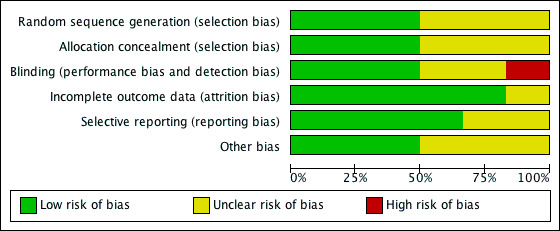
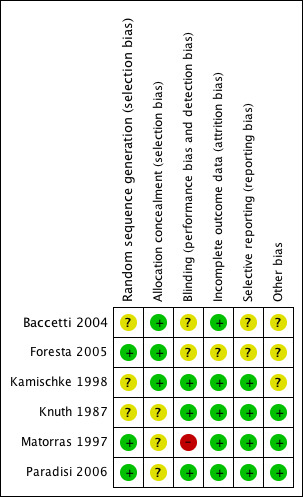
Data collection and analysis: Two review authors independently selected the trials, assessed risk of bias and extracted data on live birth, pregnancy and adverse effects. We included data on pregnancies that occurred during or after gonadotrophin therapy. Study authors and pharmaceutical companies were asked to provide missing and unpublished data and/or additional information.
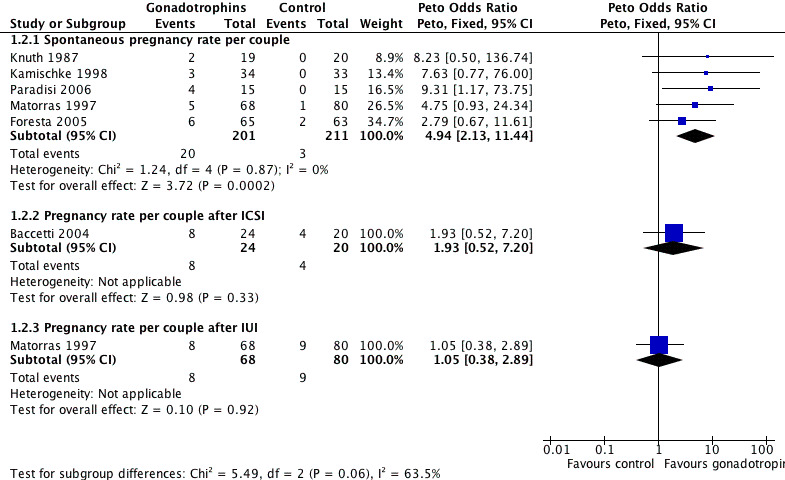
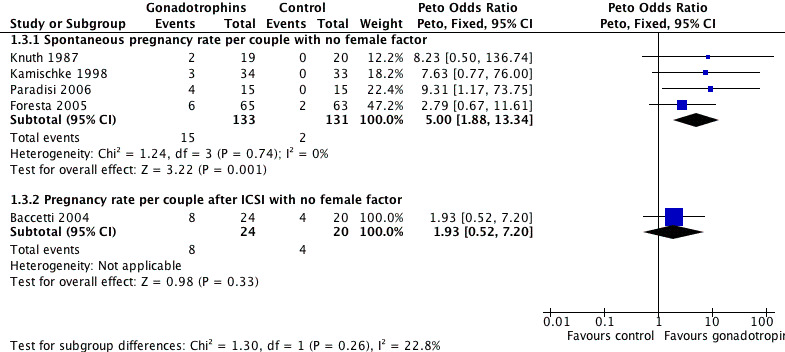
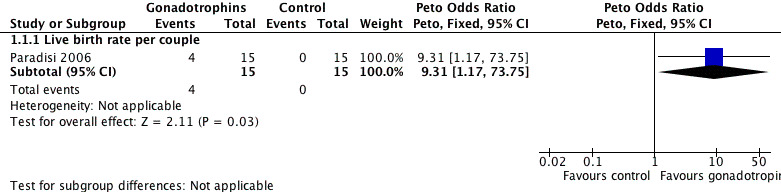
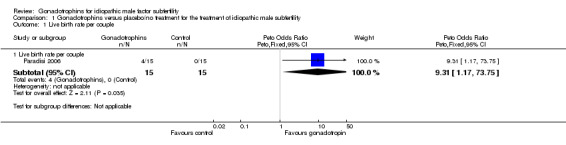
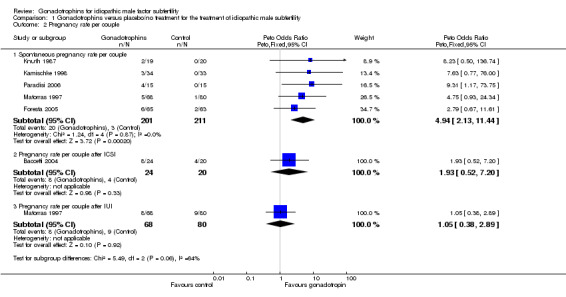
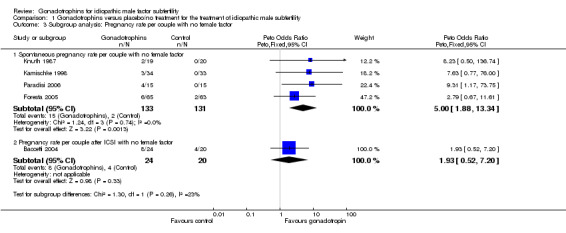
Main results: Six RCTs with 456 participants and variable treatment and follow-up periods were included. From the limited data, the live birth rate per couple randomly assigned (27% vs 0%; Peto odds ratio (OR) 9.31, 95% confidence interval (CI) 1.17 to 73.75, one study, 30 participants, very low-quality evidence) and the spontaneous pregnancy rate per couple randomly assigned (16% vs 7%; Peto OR 4.94, 95% CI 2.13 to 11.44, five studies, 412 participants, I(2) = 0%, moderate-quality evidence) were significantly higher in men receiving gonadotrophin treatment than in men receiving placebo or no treatment. No significant difference between groups was noted when intracytoplasmic sperm injection (ICSI) or intrauterine insemination (IUI) was performed. None of the included studies reported miscarriage rates, and adverse events data were sparse.
Authors' conclusions: Encouraging preliminary data suggest a beneficial effect on live birth and pregnancy of gonadotrophin treatment for men with idiopathic male factor subfertility, but because the numbers of trials and participants are small, evidence is insufficient to allow final conclusions. Large multi-centre trials with adequate numbers of participants are needed.
Conflict of interest statement
None known.
Figures
Update of
-
Gonadotrophins for idiopathic male factor subfertility.Cochrane Database Syst Rev. 2007 Oct 17;(4):CD005071. doi: 10.1002/14651858.CD005071.pub3. Cochrane Database Syst Rev. 2007. Update in: Cochrane Database Syst Rev. 2013 Aug 23;(8):CD005071. doi: 10.1002/14651858.CD005071.pub4. PMID: 17943837 Updated.
References
References to studies included in this review
Baccetti 2004 {published data only}
-
- Baccetti B, Piomboni P, Bruni E, Capitani S, Gambera L, Moretti E, et al. Effect of follicle‐stimulating hormone on sperm quality and pregnancy rate. Asian Journal of Andrology 2004;6:133‐7. - PubMed
Foresta 2005 {published data only}
-
- Foresta C, Bettella A, Garolla A, Ambrosini G Ferlin A. Treatment of male idiopathic infertility with recombinant human follicle‐stimulating hormone: a prospective, controlled, randomized clinical study. Fertility and Sterility 2005;84:654–61. - PubMed
Kamischke 1998 {published data only}
-
- Kamischke A, Behre HM, Bergmann M, Simoni M, Shafer T, Nieschlag E. Recombinant follicle stimulating hormone for treatment of male idiopathic infertility: a randomised, double‐blind, placebo‐controlled, clinical trial. Human Reproduction 1998;13:596‐603. - PubMed
Knuth 1987 {published data only}
-
- Knuth UA, Honigl W, Bals‐Pratsch M, Schleicher G, Nieschlag E. Treatment of severe oligospermia with human chorionic gonadotropin/human menopausal gonadotropin: a placebo‐controlled, double blind trial. Journal of Clinical Endocrinology and Metabolism 1987;65(6):1081‐7. - PubMed
Matorras 1997 {published data only}
-
- Matorras R, Perez C, Corcostegui B, Pijoan JI, Ramon O, Delgado P, Rodriguez‐Escudero FJ. Treatment of the male with follicle‐stimulating hormone in intrauterine insemination with husband's spermatozoa: a randomized study. Human Reproduction 1997;12:24‐8. - PubMed
Paradisi 2006 {published data only}
-
- Paradisi R, Busacchi P, Seracchioli R, Porcu E, Venturoli S. Effects of high doses of recombinant human follicle‐stimulating hormone in the treatment of male factor infertility: results of a pilot study. Fertility & Sterility 2006;86(3):728‐31. - PubMed
References to studies excluded from this review
Ashkenazi 1999 {published data only}
-
- Ashkenazi J, Bar‐Hava I, Farhi J, Levy T, Feldberg D, Orvieto R, Ben‐Rafael Z. The role of purified follicle stimulating hormone therapy in the male partner before intracytoplasmic sperm injection. Fertility and Sterility 1999;72:670‐3. - PubMed
Ben‐Rafael 2000 {published data only}
-
- Ben‐Rafael Z, Farhi J, Feldberg D, Bartoov B, Kovo M, Eltes F, et al. Follicle‐stimulating hormone treatment for men with idiopathic oligoteratoasthenozoospermia before in vitro fertilization: its impact on sperm microstructure and fertilization potential. Fertility and Sterility 2000;73:24‐30. - PubMed
Bouloux 2003 {published data only}
-
- Bouloux PM, Nieschlag E, Burger HG, Skakkebaek NE, Wu FC, Handelsman DJ, et al. Induction of spermatogenesis by recombinant follicle‐stimulating hormone (puregon) in hypogonadotropic azoospermic men who failed to respond to human chorionic gonadotropin alone. Journal of Andrology 2003;4:604‐11. - PubMed
Caroppo 2003 {published data only}
-
- Caroppo E, Niederberger C, Vizziello GM, D'Amato G. Recombinant human follicle‐stimulating hormone as a pretreatment for idiopathic oligoasthenoteratozoospermic patients undergoing intracytoplasmic sperm injection. Fertility and Sterility 2003;80:1398‐403. - PubMed
Dirnfeld 2000 {published data only}
-
- Dirnfeld M, Katz G, Calderon I, Abramovici H, Bider D. Pure follicle‐stimulating hormone as an adjuvant therapy for selected cases in male infertility during in‐vitro fertilization is beneficial. European Journal of Obstetrics and Gynecology and Reproductive Biology 2000;93:105‐8. - PubMed
Foresta 1998 {published data only}
-
- Foresta C, Bettella A, Ferlin A, Garolla A, Rossato M. Evidence for a stimulatory role of follicle‐stimulating hormone on the spermatogonial population in adult males. Fertility and Sterility 1998;69:636‐42. - PubMed
Foresta 2002 {published data only}
-
- Foresta C, Bettella A, Merico M, Garolla A, Ferlin A, Rossato M. Use of recombinant human follicle‐stimulating hormone in the treatment of male factor infertility. Fertility and Sterility 2002;77:238‐44. - PubMed
Iacono 1996 {published data only}
-
- Iacono F, Barra S, Montano L, Lotti T. Value of high‐dose pure FSH in the treatment of idiopathic male infertility. Journal of Urology (Paris) 1996;102:81‐4. - PubMed
Thomalla‐Sauter 2001 {published data only}
-
- Thomalla‐Sauter B, Denschlag D, Henze C, Bergmann M, Keck C. Recombinant follicle‐stimulating hormone for treatment of idiopathic male infertility [Behandlung der idiopathischen m?nnlichen Infertilit?t mit rekombinantem FSH: Ergebnisse einer kontrollierten Studie]. Geburtshilfe und Frauenheilkunde 2001;61:127‐32.
Additional references
Acosta 1991
-
- Acosta AA, Oehninger S, Ertunc H, Philput C. Possible role of pure human follicle‐stimulating hormone in the treatment of severe male factor infertility by assisted reproduction: preliminary report. Fertility and Sterility 1991;55:1150‐6. - PubMed
Acosta 1992
-
- Acosta AA, Khalifa E, Oehninger S. Pure human follicle stimulating hormone has a role in the treatment of severe male infertility by assisted reproduction: Norfolk's total experience. Human Reproduction 1992;7:1067‐72. - PubMed
Higgins 2011
-
- Higgins JPT, Green S (editors). Cochrane Handbook for Systematic Reviews of Interventions Version 5.1.0 [updated March 2011]. www.cochrane‐handbook.org. The Cochrane Collaboration, 2011.
Liu 2002
-
- Liu DY, Baker HW. Evaluation and assessment of semen for IVF/ICSI. Asian Journal of Andrology 2002;4:281‐5. - PubMed
Mecham 1996
-
- Meacham RB, Lipshultz LI, Howards SS. Male infertility. In: Gillenwater JY, Grayhack JT, Howards SS, Duckett JW editor(s). Adult and Pediatric Urology. St Louis: Mosby‐Year Book Inc, 1996:1747‐802.
Moudgal 1992
-
- Moudgal NR, Ravindranath N, Murthy GS, Dighe RR, Aravindan GR, Martin F. Long‐term contraceptive efficacy of vaccine of ovine follicle‐stimulating hormone in male bonnet monkeys (Macaca radiata). Journal of the Society of Reproduction and Fertility 1992;96:91‐102. - PubMed
Moudgal 1997
-
- Moudgal NR, Murthy GS, Prasanna Kumar KM, Martin F, Suresh R, Medhamurthy R, et al. Responsiveness of human male volunteers to immunization with ovine follicle stimulating hormone vaccine: results of a pilot study. Human Reproduction 1997;12:457‐63. - PubMed
WHO 1987
-
- World Health Organization. WHO: Towards more objectivity in diagnosis and management of male infertility. Results of a World Health Organization multi‐centre study. International Journal of Andrology 1987;(Suppl 7)10:1‐35.
WHO 1999
-
- World Health Organization. WHO Laboratory Manual for the Examination of Human Semen and Sperm‐Cervical Mucus Interaction. 4th Edition. Cambridge (UK): Cambridge University Press, 1999:p.62.
Wickings 1980
-
- Wickings EJ, Nieschlag E. Suppression of spermatognesis over two years in rhesus monkeys actively immunized with follicle stimulating hormone. Fertility and Sterility 1980;34:269‐74. - PubMed
Publication types
MeSH terms
Substances
LinkOut - more resources
Full Text Sources
Other Literature Sources
Medical
