


No independent, but an interactive, role of calcium-activated potassium channels in human cutaneous active vasodilation
- PMID: 23970531
- PMCID: PMC3841827
- DOI: 10.1152/japplphysiol.00358.2013
No independent, but an interactive, role of calcium-activated potassium channels in human cutaneous active vasodilation
Abstract
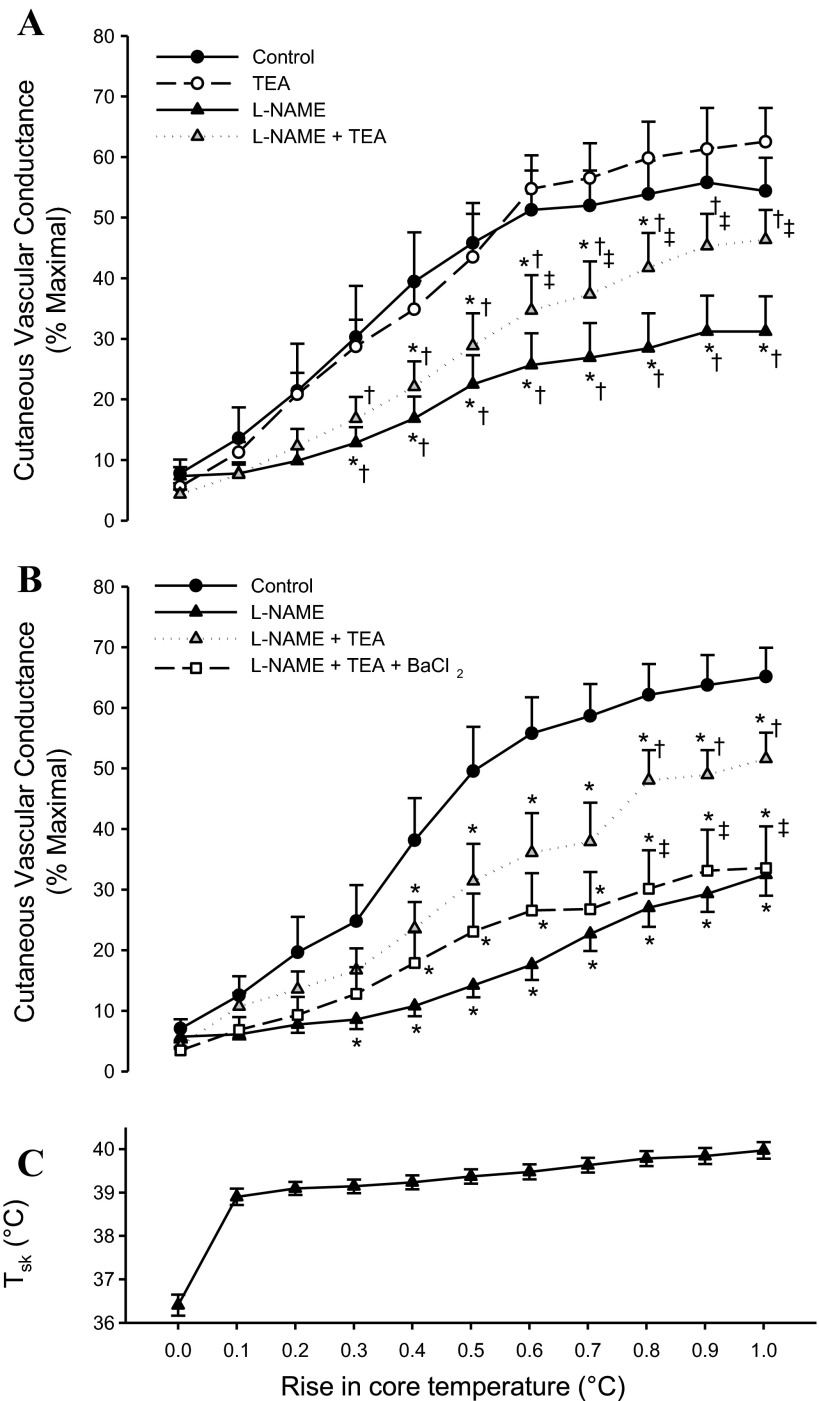
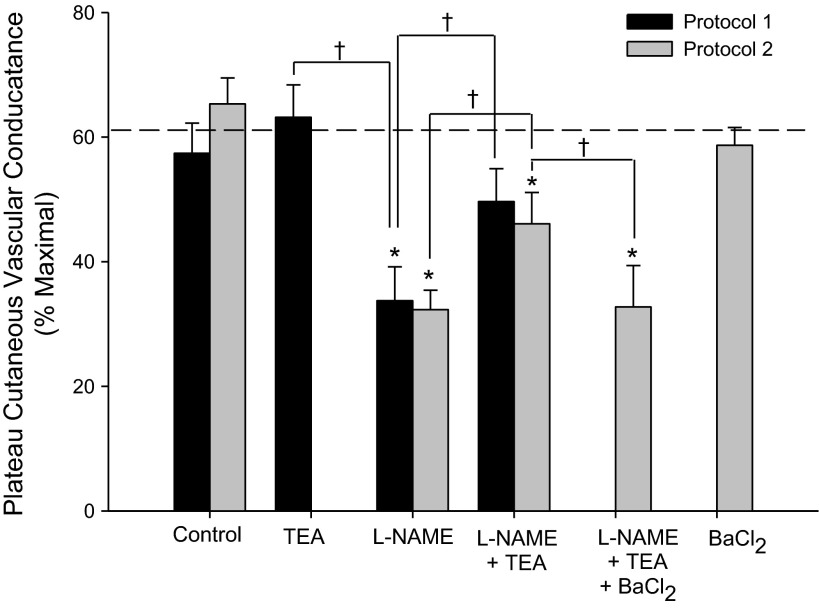
In human cutaneous microvasculature, endothelium-derived hyperpolarizing factors (EDHFs) account for a large portion of vasodilation associated with local stimuli. Thus we sought to determine the role of EDHFs in active vasodilation (AVD) to passive heating in two protocols. Whole body heating was achieved using water-perfused suits (core temperature increase of 0.8-1.0°C), and skin blood flow was measured using laser-Doppler flowmetry. In the first protocol, four sites were perfused continuously via microdialysis with: 1) control; 2) tetraethylammonium (TEA) to block calcium-activated potassium (KCa) channels, and thus the actions of EDHFs; 3) N-nitro-l-arginine methyl ester (l-NAME) to inhibit nitric oxide synthase (NOS); and 4) TEA + l-NAME (n = 8). Data are presented as percent maximal cutaneous vascular conductance (CVC). TEA had no effect on AVD (CVC during heated plateau: control 57.4 ± 4.9% vs. TEA 63.2 ± 5.2%, P = 0.27), indicating EDHFs are not obligatory. l-NAME attenuated plateau CVC to 33.7 ± 5.4% (P < 0.01 vs. control); while TEA + l-NAME augmented plateau CVC compared with l-NAME alone (49.7 ± 5.3%, P = 0.02). From these data, it appears combined blockade of EDHFs and NOS necessitates dilation through other means, possibly through inward rectifier (KIR) and/or ATP-sensitive (KATP) potassium channels. To test this second hypothesis, we measured AVD at the following sites (n = 8): 1) control, 2) l-NAME, 3) l-NAME + TEA, and 4) l-NAME + TEA + barium chloride (BaCl2; KIR and KATP blocker). The addition of BaCl2 to l-NAME + TEA reduced plateau CVC to 32.7 ± 6.6% (P = 0.02 vs. l-NAME + TEA), which did not differ from the l-NAME site. These data combined demonstrate a complex interplay between vasodilatory pathways, with cross-talk between NO, KCa channels, and KIR and/or KATP channels.
Keywords: endothelium-derived hyperpolarizing factors; inward rectifier potassium channels; nitric oxide; thermoregulation; whole body heating.
Figures
References
-
- Bauersachs J, Popp R, Hecker M, Sauer E, Fleming I, Busse R. Nitric oxide attenuates the release of endothelium-derived hyperpolarizing factor. Circulation 94: 3341–3347, 1996 - PubMed
-
- Bolotina VM, Najibi S, Palacino JJ, Pagano PJ, Cohen RA. Nitric oxide directly activates calcium-dependent potassium channels in vascular smooth muscle. Nature 368: 850–853, 1994 - PubMed
-
- Bonev AD, Nelson MT. ATP-sensitive potassium channels in smooth muscle cells from guinea pig urinary bladder. Am J Physiol Cell Physiol 264: C1190–C1200, 1993 - PubMed
Publication types
MeSH terms
Substances
Grants and funding
LinkOut - more resources
Full Text Sources
Other Literature Sources
