. 2013 Sep 5;93(3):530-7.
doi: 10.1016/j.ajhg.2013.07.004. Epub 2013 Aug 22.

BMP9 mutations cause a vascular-anomaly syndrome with phenotypic overlap with hereditary hemorrhagic telangiectasia

Affiliations

BMP9 mutations cause a vascular-anomaly syndrome with phenotypic overlap with hereditary hemorrhagic telangiectasia

Whitney L Wooderchak-Donahue et al. Am J Hum Genet. .

Abstract

Hereditary hemorrhagic telangiectasia (HHT), the most common inherited vascular disorder, is caused by mutations in genes involved in the transforming growth factor beta (TGF-β) signaling pathway (ENG, ACVRL1, and SMAD4). Yet, approximately 15% of individuals with clinical features of HHT do not have mutations in these genes, suggesting that there are undiscovered mutations in other genes for HHT and possibly vascular disorders with overlapping phenotypes. The genetic etiology for 191 unrelated individuals clinically suspected to have HHT was investigated with the use of exome and Sanger sequencing; these individuals had no mutations in ENG, ACVRL1, and SMAD4. Mutations in BMP9 (also known as GDF2) were identified in three unrelated probands. These three individuals had epistaxis and dermal lesions that were described as telangiectases but whose location and appearance resembled lesions described in some individuals with RASA1-related disorders (capillary malformation-arteriovenous malformation syndrome). Analyses of the variant proteins suggested that mutations negatively affect protein processing and/or function, and a bmp9-deficient zebrafish model demonstrated that BMP9 is involved in angiogenesis. These data confirm a genetic cause of a vascular-anomaly syndrome that has phenotypic overlap with HHT.


Figures

Figure 1
Figure 1
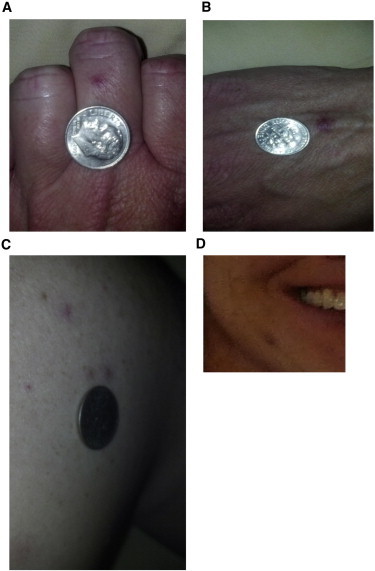
Cutaneous Vascular Lesions in Individual 2 Shown are the middle digit of the left hand (A), the dorsal aspect of the right hand (B), several of approximately 20 lesions on the back and shoulders (C), and a vascular lesion previously treated by laser ablation on the right jawline (D).
Figure 2
Figure 2
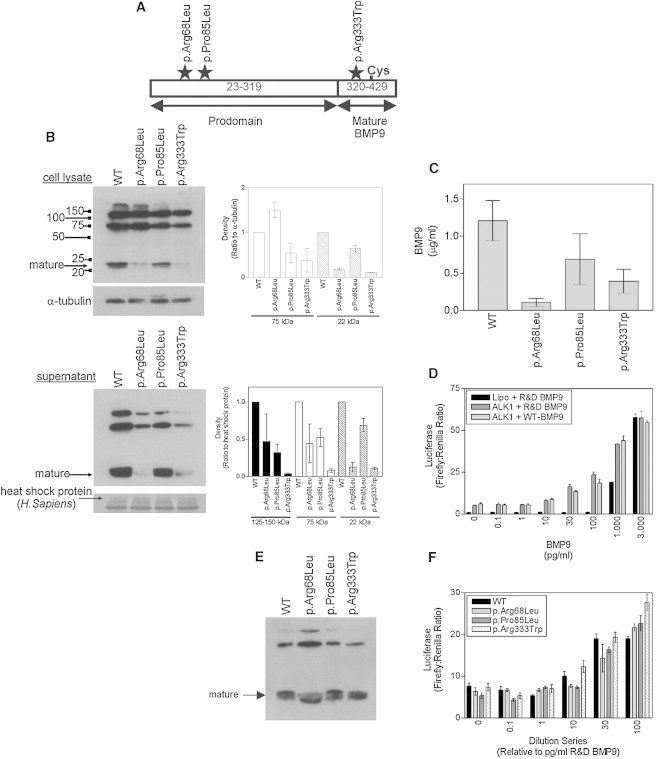
BMP9 Variants Alter Protein Processing and Binding of Ligands to ALK1 (A) BMP9 diagram depicting the alteration locations, prodomain, and mature protein. The BMP9 precursor encodes a signal sequence from amino acids 1–22, a prodomain from amino acids 23–319 (proBMP9), and the mature BMP9 from amino acids 320–429. Secreted BMP9 comprises amino acids 23–429; furin-type proteases cleave its prodomain to generate mature BMP9. (B) Plasmids encoding human WT BMP9 or the p.Arg68Leu, p.Pro85Leu, or p.Arg333Trp variants were transfected into HEK EBNA cells. Cell lysates and conditioned media were fractionated with nonreducing SDS-PAGE and immunoblotted for BMP9 with a mouse monoclonal BMP9 antibody (clone #360107, R&D Systems). For cell lysates, equal protein loading was confirmed by subsequent immunoblotting for α-tubulin and densitometry of the bands normalized to the α-tubulin bands. Supernatants were also fractionated and immunoblotted for BMP9. A parallel gel was run and stained with Coomassie blue. For verification, the Coomassie-stained bands were sequenced. WT and variant BMP9 proteins fractionated as three bands corresponding to the mature BMP9 dimer associated with both prodomains (∼125–150 kDa), the mature BMP9 dimer associated with a single prodomain (75 kDa), and mature BMP9 (22 kDa). Mature BMP9 is indicated by an arrow. Densitometry graphs are also shown. (C) BMP9 levels were determined by a specific ELISA (n = 3). The ELISA was developed with a colorimetric substrate comprising 1 mg/ml 4-nitrophenyl phosphate disodium salt hexahydrate in 1 M diethanolamine (pH 9.8) containing 0.5 mM MgCl2. The assay was developed in the dark at room temperature, and the absorbance was measured at 405 nm. Unknown values were extrapolated from the standard curve with a 4-parameter log curve fit. (D) C2C12 cells were transfected with human ALK1 and treated with R&D Systems BMP9 (between 0.1 and 3,000 pg/ml) or WT BMP9 diluted to equivalent activities. Cells exposed to Lipofectamine (“Lipo”) alone were treated in parallel with R&D Systems BMP9. All cells were cotransfected with BRE-luciferase and pTK-Renilla. BMP9-driven firefly luciferase responses were normalized to Renilla activity. Data are the mean ± SEM (n = 4 wells) for a representative experiment. The activity of the WT protein was titrated in comparison to commercial BMP9 for the establishment of an activity profile. C2C12 cells transfected with ALK1 became sensitive to commercial BMP9 (mature BMP9, amino acids 320–429) at concentrations as low as 1 pg/ml. (E) Supernatants from (B) were diluted so that there were equal amounts of mature BMP9 in the media conditioned with WT and variant BMP9. The activity profiles for WT BMP9 were similar to the commercial BMP9 profile, albeit with reduced activity at the lowest concentrations of 1 and 10 pg/ml. For each variant, relative supernatant volumes necessary for achieving equivalent amounts of the mature WT BMP9 were determined. (F) C2C12 cells were transfected with human ALK1 and treated with WT or variant BMP9. Cells exposed to Lipofectamine alone were treated in parallel with WT BMP9. All cells were cotransfected with BRE-luciferase and pTK-Renilla. BMP9-driven firefly luciferase responses were normalized to Renilla activity. The range over which ALK1 activation occurs is indicated. Data are the mean ± SEM for n = 4 wells from a representative experiment. Top dilutions were prepared at 1 (WT) to 8.3 (p.Arg68Leu) to 1.3 (p.Pro85Leu) to 4 (p.Arg333Trp), and serial dilutions of each BMP9 variant were prepared with the same dilution series as with commercial BMP9. Assays of these BMP9 variants in C2C12 cells transfected with ALK1 revealed that the p.Arg68Leu and p.Pro85Leu variants exhibited less activity than WT BMP9 at 10 pg/ml (p.Arg68Leu: 79.2% ± 10.3% of WT; p.Pro85Leu: 82.2% ± 7.6% of WT) and 30 pg/ml (p.Arg68Leu: 78.9% ± 4.3% of WT; p.Pro85Leu: 78.6% ± 7.2% of WT) equivalent dilutions, but the p.Arg333Trp variant did not (10 pg/ml equivalent: 100.92% ± 11.8% of WT; 30 pg/ml equivalent: 99.6% ± 2.1% of WT).
Figure 3
Figure 3
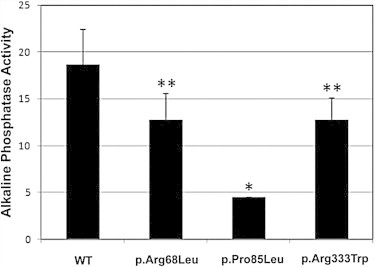
Missense Substitutions in BMP9 Alter Protein Activity The mouse chondrogenic cell line ATDC5 was incubated with 1 ng/ml of WT BMP9 or the p.Arg68Leu, p.Pro85Leu, or p.Arg333Trp variants produced in HepG2 cells, as shown in Figure S2. Alkaline phosphatase activity was measured in permeabilized ATDC5 cells with the use of p-nitrophenyl phosphate as a soluble substrate. Relative activity units are shown in the vertical axis. p < 0.001; ∗∗p < 0.07.
Figure 4
Figure 4
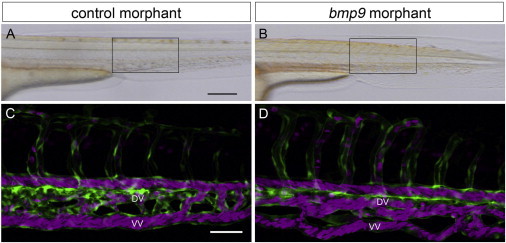
bmp9 Morphant Zebrafish Display Impaired Venous Remodeling (A and B) Bright-field images of live embryos; boxed areas in (A) and (B) designate regions of focus in (C) and (D), respectively. The scale bar represents 200 μm. (C and D) Two-photon confocal images of circulation in the caudal vein plexus at 2 dpf. Endothelial cells are green, and red blood cells are magenta. The scale bar represents 50 μm. Abbreviations are as follows: DV, dorsal vein; and VV, ventral vein. Zebrafish Tg(kdrl:egfp);Tg(gata1:dsRed2) embryos were injected at the 1- to 4-cell stage with 7 ng control morpholino (A and C) or 7 ng bmp9 morpholino (B and D) and imaged at 2 dpf. Embryos were imaged with a Leica TCS SP5 confocal microscope (Leica Microsystems) outfitted with an APO L 20×/1.00 water-immersion objective, standard visible lasers, and Mai Tai DeepSee IR laser (Spectra-Physics, Newport Corp.). EGFP was imaged at 900 nm, and DsRed2 was imaged at 561 nm. Z-series were collected at 2 μm intervals, and two-dimensional projections were generated with MetaMorph 7.7 (Molecular Devices). All images show left anterior lateral views.
Figure 5
Figure 5
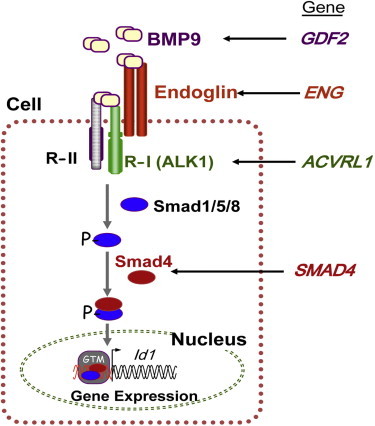
BMP9 and the TGF-β Signaling Pathway BMP9 binds to specific type I and type II cell-surface receptors (R-I and R-II, respectively) that exhibit serine-threonine kinase activity, as well as to the auxiliary receptor endoglin. Upon ligand binding, R-II transphosphorylates ALK1 (R-I), which then propagates the signal by phosphorylating receptor-regulated (R-Smads) Smad1, Smad5, and Smad8 (“Smad1/5/8”). Once phosphorylated, R-Smads form heteromeric complexes with a cooperating homolog, Smad4, and translocate into the nucleus where they regulate the transcriptional activity of target genes, including Id1. Endoglin, ALK1, and Smad4 are encoded by ENG, ACVRL1 and SMAD4, respectively, whose pathogenic mutations give rise to HHT1, HHT2, and JP-HHT, respectively. BMP9 is encoded by GFDF2, whose pathogenic variants are described here. The following abbreviation is used: GTM, general transcription machinery. This figure was adapted from Figure 2 in Fernández et al.

References

    1. Richards-Yutz J., Grant K., Chao E.C., Walther S.E., Ganguly A. Update on molecular diagnosis of hereditary hemorrhagic telangiectasia. Hum. Genet. 2010;128:61–77. - PubMed
    1. Shovlin C.L., Guttmacher A.E., Buscarini E., Faughnan M.E., Hyland R.H., Westermann C.J., Kjeldsen A.D., Plauchu H. Diagnostic criteria for hereditary hemorrhagic telangiectasia (Rendu-Osler-Weber syndrome) Am. J. Med. Genet. 2000;91:66–67. - PubMed
    1. McDonald M.T., Papenberg K.A., Ghosh S., Glatfelter A.A., Biesecker B.B., Helmbold E.A., Markel D.S., Zolotor A., McKinnon W.C., Vanderstoep J.L. A disease locus for hereditary haemorrhagic telangiectasia maps to chromosome 9q33-34. Nat. Genet. 1994;6:197–204. - PubMed
    1. Johnson D.W., Berg J.N., Gallione C.J., McAllister K.A., Warner J.P., Helmbold E.A., Markel D.S., Jackson C.E., Porteous M.E., Marchuk D.A. A second locus for hereditary hemorrhagic telangiectasia maps to chromosome 12. Genome Res. 1995;5:21–28. - PubMed
    1. Gallione C.J., Repetto G.M., Legius E., Rustgi A.K., Schelley S.L., Tejpar S., Mitchell G., Drouin E., Westermann C.J., Marchuk D.A. A combined syndrome of juvenile polyposis and hereditary haemorrhagic telangiectasia associated with mutations in MADH4 (SMAD4) Lancet. 2004;363:852–859. - PubMed

Publication types

MeSH terms