


Is the relationship between early-onset cannabis use and educational attainment causal or due to common liability?
- PMID: 23972999
- PMCID: PMC3818343
- DOI: 10.1016/j.drugalcdep.2013.07.034
Is the relationship between early-onset cannabis use and educational attainment causal or due to common liability?
Abstract
Background: Several studies have shown that early cannabis use is correlated with poor educational performance including high school drop-out. The predominant explanation for this relationship is that cannabis use causes disengagement from education. Another explanation is that the association between early cannabis use and educational attainment is not causal, but the result of overlapping risk factors that increase the likelihood of both early cannabis use and disengagement from education. These confounding factors could be of genetic and/or environmental origin.
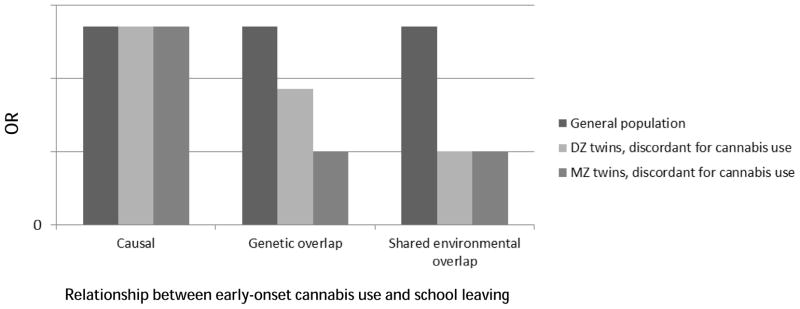
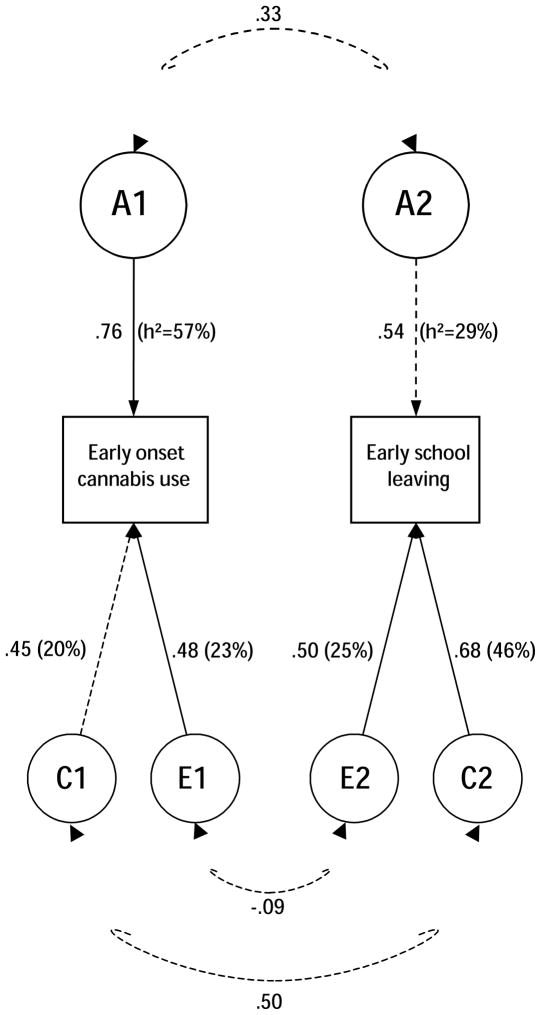
Methods: Here we use data from a large community-based sample of adult twins (N=3337) who completed a comprehensive semi-structured telephone interview. We first apply the classical twin-design to determine whether genetic and/or environmental influences underlie the relationship between early-onset cannabis use (prior to age 18) and early school leaving. Next, with a co-twin control design we investigate whether the relationship between the two variables is more likely due to direct causality or overlapping risk factors.
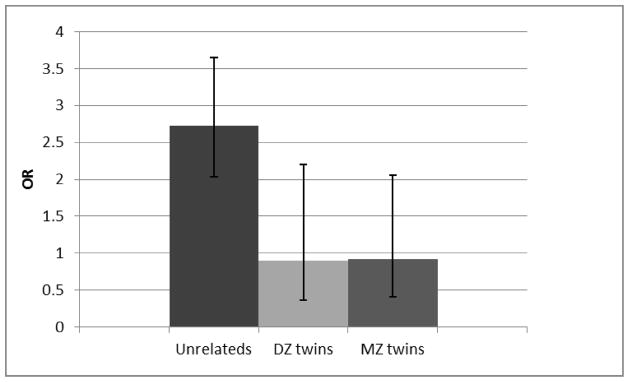
Results: We find a significant phenotypic correlation between early-onset cannabis use and early school leaving (r=0.26), which could be explained by familial influences (of genetic and/or shared environmental origin). The pattern of odds ratios found in the co-twin control design is not consistent with direct causation, but rather suggests that the association is due to shared environmental factors influencing both variables.
Conclusion: Our findings suggest that the relationship between early-onset cannabis use and school leaving is due to shared environmental risk factors influencing both the risk of early-onset cannabis use and early school leaving.
Keywords: Cannabis; Education; Environment; Genetics; School drop-out; Twin research.
Copyright © 2013 Elsevier Ireland Ltd. All rights reserved.
Conflict of interest statement
Figures
References
-
- Baker LA, Treloar SA, Reynolds CA, Heath AC, Martin NG. Genetics of educational attainment in Australian twins: Sex differences and secular changes. Behav Genet. 1996;26:89–102. - PubMed
-
- Battin-Pearson S, Newcomb MD, Abbott RD, Hill KG, Catalano RF, Hawkins JD. Predictors of early high school dropout: A test of five theories. J Educ Psychol. 2000;92:568–582.
-
- Beauvais F, Chavez EL, Oetting ER, Deffenbacher JL, Cornell GR. Drug use, violence, and victimization among white American, Mexican American, and American Indian dropouts, students with academic problems, and students in good academic standing. J Couns Psychol. 1996;43:292–299.
Publication types
MeSH terms
Grants and funding
LinkOut - more resources
Full Text Sources
Other Literature Sources
Medical
