


The relationship between quadriceps muscle weakness and worsening of knee pain in the MOST cohort: a 5-year longitudinal study
- PMID: 23973125
- PMCID: PMC3774035
- DOI: 10.1016/j.joca.2013.05.016
The relationship between quadriceps muscle weakness and worsening of knee pain in the MOST cohort: a 5-year longitudinal study
Abstract
Objective: To determine whether quadriceps weakness is associated with elevated risk of worsening knee pain over 5 years.
Methods: The Multicenter Osteoarthritis Study (MOST) is a longitudinal study of 50-79-year-old adults with knee osteoarthritis (OA) or known risk factors for knee OA. The predictor variable was baseline isokinetic quadriceps strength. Covariates included baseline body mass index (BMI), physical activity level, and history of knee surgery. The outcome was worsening pain reported on the Western Ontario and McMaster Universities (WOMAC) Osteoarthritis Index pain subscale or knee replacement surgery between baseline and 5-year follow-up. Analyses were knee-based and used generalized estimating equations, stratified by sex to assess whether the lowest compared with the highest tertile of baseline quadriceps strength was associated with an increased risk of worsening knee pain at 5-year follow-up, controlling for age, BMI, history of knee surgery, and physical activity level as well as correlation between knees within participants.
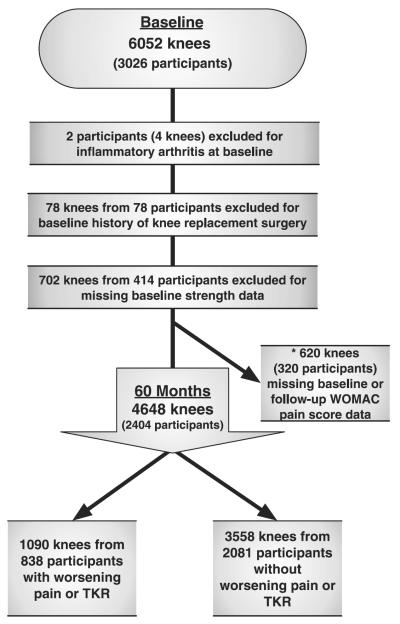
Results: Analyses of worsening knee pain included 4,648 knees from 2,404 participants (61% female). Men with lower quadriceps strength did not have a higher risk of worsening knee pain (RR {95% CI} = 1.01 {0.78-1.32}, P = 0.9183). However, women in the lowest compared with the highest strength tertile had a 28% increased risk of worsening knee pain (RR {95% CI} = 1.28 {1.08-1.52}, P = 0.0052).
Conclusion: Quadriceps weakness was associated with an increased risk of worsening of knee pain over 5 years in women, but not in men.
Keywords: Knee osteoarthritis; Knee pain; Quadriceps weakness.
Copyright © 2013 Osteoarthritis Research Society International. Published by Elsevier Ltd. All rights reserved.
Figures
References
-
- Hannan MT, Felson DT, Pincus T. Analysis of the discordance between radiographic changes and knee pain in osteoarthritis of the knee. J Rheumatol. 2000;27:1513–7. - PubMed
-
- Dieppe PA, Cushnaghan J, Shepstone L. The Bristol 'OA500' study: progression of osteoarthritis (OA) over 3 years and the relationship between clinical and radiographic changes at the knee joint. Osteoarthritis Cartilage. 1997;5:87–97. - PubMed
-
- Creamer P, Lethbridge-Cejku M, Hochberg MC. Factors associated with functional impairment in symptomatic knee osteoarthritis. Rheumatology (Oxford) 2000;39:490–6. - PubMed
Publication types
MeSH terms
Grants and funding
LinkOut - more resources
Full Text Sources
Other Literature Sources
Medical
