


Osteoarthritis pain mechanisms: basic studies in animal models
- PMID: 23973145
- PMCID: PMC3771690
- DOI: 10.1016/j.joca.2013.06.013
Osteoarthritis pain mechanisms: basic studies in animal models
Abstract
Objective: Osteoarthritis (OA) is a complex and painful disease of the whole joint. At present there are no satisfying agents for treating OA. To promote OA research and improved treatment, this review summarizes current preclinical evidence on the development of OA.
Methods: Preclinical OA research was searched and key findings are summarized and commented.
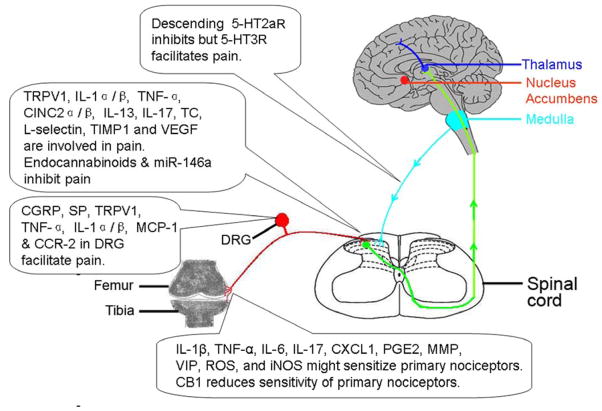
Results: Mechanisms of OA-associated pain have been studied in rodent knee OA models produced by intra-knee injection of the chondrocyte glycolytic inhibitor mono-iodoacetate (MIA), surgery, or spontaneous development in some species. These models are clinically relevant in terms of histological damage and functional changes, and are used to study mechanisms underlying mechanical, thermal, ambulatory, body weight supporting-evoked, and ongoing OA pain. Recent peripheral, spinal, and supraspinal biochemical and electrophysiological studies in these models suggest that peripheral pro-inflammatory mediators and neuropeptides sensitize knee nociceptors. Spinal cytokines and neuropeptides promote OA pain, and peripheral and spinal cannabinoids inhibit OA pain respectively through cannabinoid-1 (CB1) and CB1/CB2 receptors. TRPV1 and metalloproteinases contribute and supraspinal descending facilitation of 5-hydroxytryptamine (5-HT)/5-HT 3 receptors may also contribute to OA pain. Conditioned place preference tests demonstrate that OA pain induces aversive behaviors, suggesting the involvement of brain. During OA, brain functional connectivity is enhanced, but at present it is unclear how this change is related to OA pain.
Conclusion: Animal studies demonstrate that peripheral and central sensitization contributes to OA pain, involving inflammatory cytokines, neuropeptides, and a variety of chemical mediators. Interestingly, brainstem descending facilitation of 5-HT/5-HT3 receptors plays a role OA pain.
Keywords: Allodynia; Hyperalgesia; Monoiodoacetate; Osteoarthritis; Pain; Spinal cord.
Copyright © 2013 Osteoarthritis Research Society International. Published by Elsevier Ltd. All rights reserved.
Conflict of interest statement
The authors declare no conflicts of interest.
Figures
References
-
- Sofat N, Ejindu V, Kiely P. What makes osteoarthritis painful? The evidence for local and central pain processing. Rheumatology (Oxford) 2011;50:2157–2165. - PubMed
-
- Hochberg MC, Hunter DJ, Felson DT. Osteoarthritis. Br Med J. 2006;332:640–642.
-
- Fernihough J, Gentry C, Malcangio M, Fox A, Rediske J, Pellas T, et al. Pain related behaviour in two models of osteoarthritis in the rat knee. Pain. 2004;112:83–93. - PubMed
Publication types
MeSH terms
Substances
Grants and funding
LinkOut - more resources
Full Text Sources
Other Literature Sources
