


Contribution of CA3 and CA1 pyramidal neurons to the tonic α7 nAChR-dependent glutamatergic input to CA1 pyramidal neurons
- PMID: 23973303
- PMCID: PMC3825813
- DOI: 10.1016/j.neulet.2013.08.025
Contribution of CA3 and CA1 pyramidal neurons to the tonic α7 nAChR-dependent glutamatergic input to CA1 pyramidal neurons
Abstract
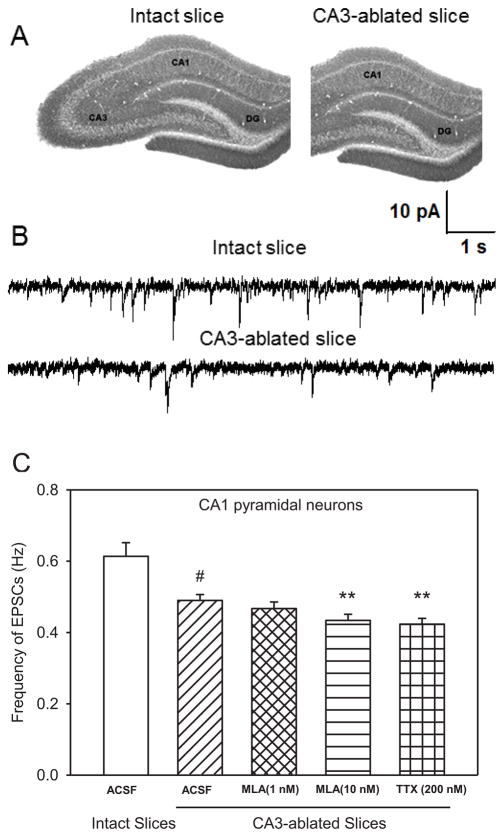
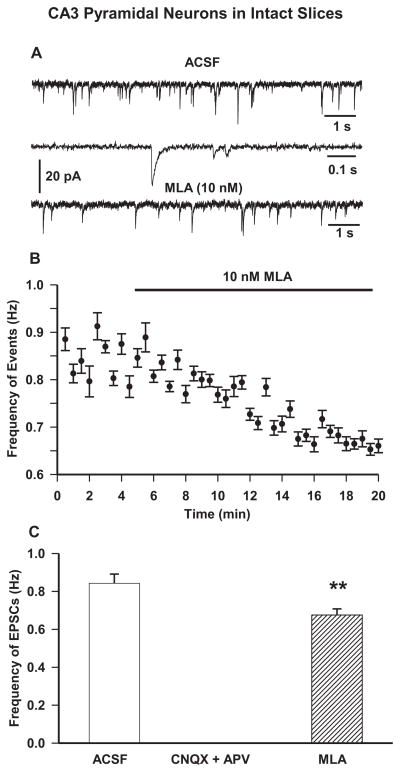
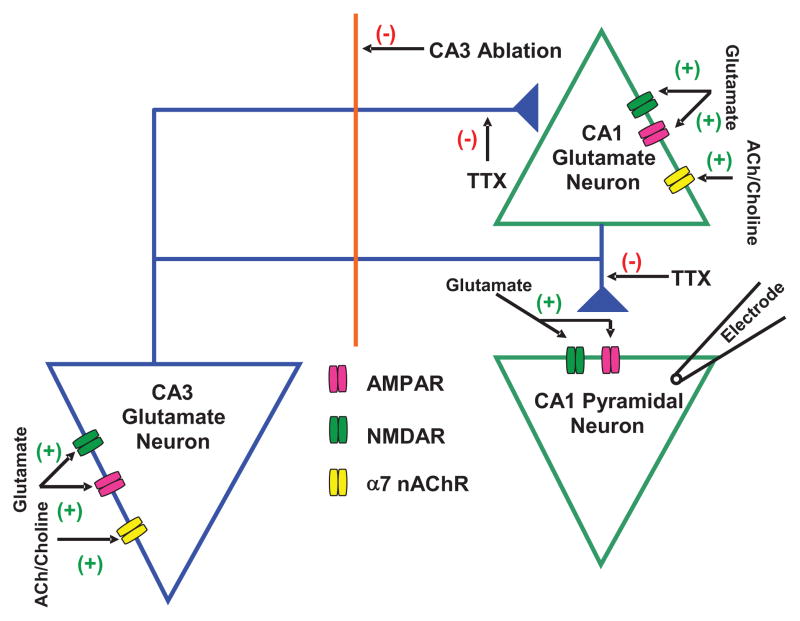
The Schaffer collaterals are among the major glutamatergic inputs to CA1 pyramidal neurons, the primary output of the hippocampus, which also receive sparse recurrent inputs from pyramidal neurons in the CA1 field. Although tonically active α7 nicotinic acetylcholine receptors (nAChRs) have been shown to sustain spontaneous glutamate transmission to CA1 pyramidal neurons in hippocampal slices under resting conditions, it remains to be determined whether these receptors are those expressed by CA3 or CA1 pyramidal neurons. This study was designed to test the hypothesis that the CA3 field of the hippocampus is a significant source of α7 nAChR-sustained glutamatergic transmission to CA1 pyramidal neurons. To this end, spontaneous excitatory postsynaptic currents (EPSCs) were recorded from CA1 and CA3 pyramidal neurons in intact rat hippocampal slices as well as from CA1 pyramidal neurons in CA3-ablated slices under various experimental conditions. Surgical removal of the CA3 region from the slices reduced by 20% the frequency of spontaneous EPSCs recorded from CA1 pyramidal neurons. This finding is in agreement with the concept that the CA3 field contributes significantly to the maintenance of spontaneous glutamatergic synaptic activity in CA1 pyramidal neurons. In addition, the α7 nAChR antagonist methyllycaconitine (MLA, 10nM) reduced the frequency of spontaneous EPSCs recorded from CA1 pyramidal neurons by 30% in intact slices and 12% in CA3-ablated slices. Taken together, these results demonstrate that tonically active α7 nAChRs in CA3 pyramidal neurons and/or in the Mossy fibers that innervate the CA3 pyramidal neurons do in fact contribute to the maintenance of glutamatergic synaptic activity in CA1 pyramidal neurons of hippocampal slices under resting conditions.
Keywords: 2-amino-5-phosphonovaleric acid; 6-cyano-7-nitroquinoxaline-2,3-dione; ACSF; APV; CNQX; EPSC; Hippocampus; IPSC; MLA; Methyllycaconitine; Pyramidal neuron; TTX; Tetrodotoxin; artificial cerebrospinal fluid; excitatory postsynaptic current; inhibitory postsynaptic current; methyllycaconitine; nAChR; nicotinic acetylcholine receptor; tetrodotoxin; time constant of decay; α7 nAChR; τ(d).
Copyright © 2013 Elsevier Ireland Ltd. All rights reserved.
Conflict of interest statement
The authors report no conflict of interest.
Figures
References
-
- Bekkers JM, Stevens CF. Presynaptic mechanism for long-term potentiation in the hippocampus. Nature. 1990;1990(346):724–729. - PubMed
-
- Banerjee J, Alkondon M, Albuquerque EX. Kynurenic acid inhibits glutamatergic transmission to CA1 pyramidal neurons via α7 nAChR-dependent and -independent mechanisms. Biochem Pharmacol. 2012b;84:1078–1087. - PubMed
Publication types
MeSH terms
Substances
Grants and funding
LinkOut - more resources
Full Text Sources
Other Literature Sources
Miscellaneous
