


Low levels of high-density lipoprotein cholesterol and increased risk of cardiovascular events in stable ischemic heart disease patients: A post-hoc analysis from the COURAGE Trial (Clinical Outcomes Utilizing Revascularization and Aggressive Drug Evaluation)
- PMID: 23973693
- PMCID: PMC5661970
- DOI: 10.1016/j.jacc.2013.07.051
Low levels of high-density lipoprotein cholesterol and increased risk of cardiovascular events in stable ischemic heart disease patients: A post-hoc analysis from the COURAGE Trial (Clinical Outcomes Utilizing Revascularization and Aggressive Drug Evaluation)
Abstract
Objectives: This study sought to assess the independent effect of high-density lipoprotein-cholesterol (HDL-C) level on cardiovascular risk in patients with stable ischemic heart disease (SIHD) who were receiving optimal medical therapy (OMT).
Background: Although low HDL-C level is a powerful and independent predictor of cardiovascular risk, recent data suggest that this may not apply when low-density lipoprotein-cholesterol (LDL-C) is reduced to optimal levels using intensive statin therapy.
Methods: We performed a post-hoc analysis in 2,193 men and women with SIHD from the COURAGE trial. The primary outcome measure was the composite of death from any cause or nonfatal myocardial infarction (MI). The independent association between HDL-C levels measured after 6 months on OMT and the rate of cardiovascular events after 4 years was assessed. Similar analyses were performed separately in subjects with LDL-C levels below 70 mg/dl (1.8 mmol/l).
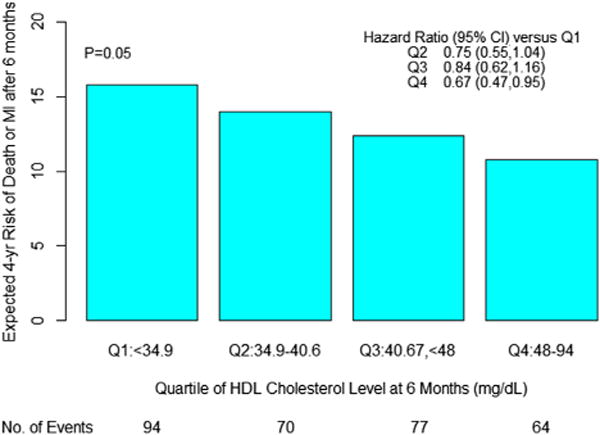
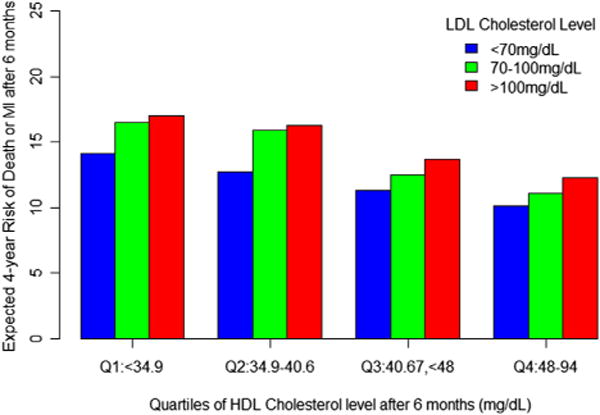
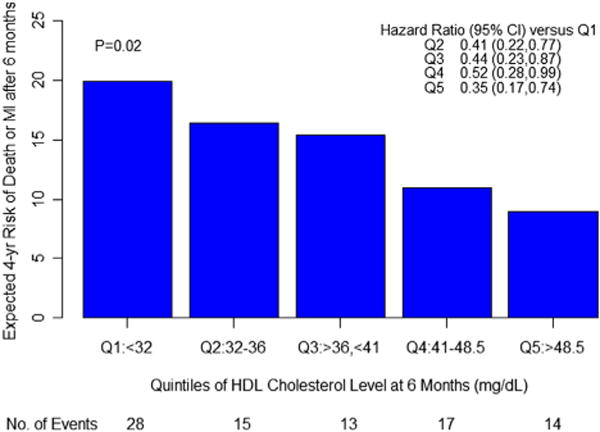
Results: In the overall population, the rate of death/MI was 33% lower in the highest HDL-C quartile as compared with the lowest quartile, with quartile of HDL-C being a significant, independent predictor of death/MI (p = 0.05), but with no interaction for LDL-C category (p = 0.40). Among subjects with LDL-C levels <70 mg/dl, those in the highest quintile of HDL-C had a 65% relative risk reduction in death or MI as compared with the lowest quintile, with HDL-C quintile demonstrating a significant, inverse predictive effect (p = 0.02).
Conclusions: In this post-hoc analysis, patients with SIHD continued to experience incremental cardiovascular risk associated with low HDL-C levels despite OMT during long-term follow-up. This relationship persisted and appeared more prominent even when LDL-C was reduced to optimal levels with intensive dyslipidemic therapy. (Clinical Outcomes Utilizing Revascularization and Aggressive Drug Evaluation; NCT00007657).
Keywords: ACS; ATP; Adult Treatment Panel; BMI; CETP; HDL cholesterol; HDL-C; LDL-C; MI; OMT; PCI; SIHD; acute coronary syndrome(s); body mass index; cholesteryl ester transfer protein; high-density lipoprotein cholesterol; low-density lipoprotein cholesterol; myocardial infarction; optimal medical therapy; percutaneous coronary intervention; residual risk; stable ischemic heart disease.
Copyright © 2013 American College of Cardiology Foundation. Published by Elsevier Inc. All rights reserved.
Figures
Comment in
-
High-density lipoprotein and residual cardiovascular risk: De minimis non curat medicus or the COURAGE to be SMART?J Am Coll Cardiol. 2013 Nov 12;62(20):1842-4. doi: 10.1016/j.jacc.2013.05.087. Epub 2013 Aug 21. J Am Coll Cardiol. 2013. PMID: 23973697 No abstract available.
-
The missing link between high-density lipoprotein cholesterol and inflammatory response in cardiovascular disease.J Am Coll Cardiol. 2014 Jun 24;63(24):2747-8. doi: 10.1016/j.jacc.2013.12.057. Epub 2014 Mar 26. J Am Coll Cardiol. 2014. PMID: 24681137 No abstract available.
References
-
- Gordon T, Castelli WP, Hjortland MC, Kannel WB, Dawber TR. High density lipoprotein as a protective factor against coronary heart disease. The Framingham Study. Am J Med. 1977;62:707–14. - PubMed
-
- Wilson PW, Garrison RJ, Castelli WP, Feinleib M, McNamara PM, Kannel WB. Prevalence of coronary heart disease in the Framingham Offspring Study: role of lipoprotein cholesterols. Am J Cardiol. 1980;46:649–54. - PubMed
-
- Castelli WP, Garrison RJ, Wilson PW, Abbott RD, Kalousdian S, Kannel WB. Incidence of coronary heart disease and lipoprotein cholesterol levels. The Framingham Study. JAMA. 1986;256:2835–8. - PubMed
-
- Gordon DJ, Probstfield JL, Garrison RJ, et al. High-density lipoprotein cholesterol and cardiovascular disease. Four prospective American studies. Circulation. 1989;79:8–15. - PubMed
-
- Assmann G, Schulte H, von Eckardstein A, Huang Y. High-density lipoprotein cholesterol as a predictor of coronary heart disease risk. The PROCAM experience and pathophysiological implications for reverse cholesterol transport. Atherosclerosis. 1996;124(Suppl):S11–20. - PubMed
Publication types
MeSH terms
Substances
Associated data
Grants and funding
LinkOut - more resources
Full Text Sources
Other Literature Sources
Medical
Miscellaneous
