


Alternative Measures of Self-Rated Health for Predicting Mortality Among Older People: Is Past or Future Orientation More Important?
- PMID: 23974701
- PMCID: PMC4683363
- DOI: 10.1093/geront/gnt098
Alternative Measures of Self-Rated Health for Predicting Mortality Among Older People: Is Past or Future Orientation More Important?
Abstract
Purpose: The purpose of this study was to compare the prognostic validity of alternative measures of health ratings, including those that tap temporal reflections, on adult mortality.
Design and methods: The study uses a national sample of 1,266 Americans 50-74 years old in 1995, with vital status tracked through 2005, to compare the effect of 3 types of health ratings on mortality: conventional indicator of self-rated health (SRH), age comparison form of SRH, and health ratings that incorporate temporal dimensions. Logistic regression was used to estimate the odds of mortality associated with alternative health ratings while adjusting for health conditions, lifestyle factors, and status characteristics and resources.
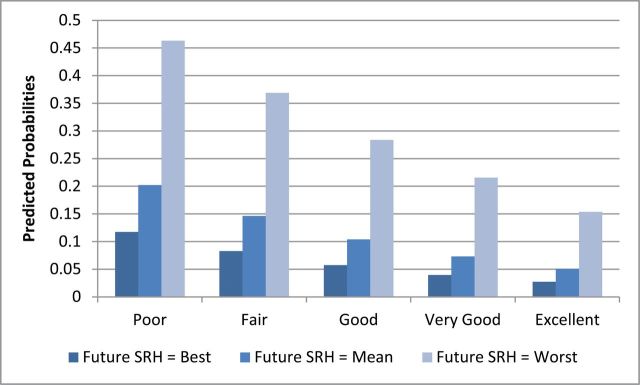
Results: Self-rated health was a consistent predictor of mortality, but the respondent's expected health rating-10 years in the future-was an independent predictor. Future health expectations were more important than past (recalled change) in predicting mortality risk: People with more negative expectations of future health were less likely to survive.
Implications: The findings reveal the importance of future time perspective for older people and suggest that it is more useful to query older people about their future health expectations than about how their health has changed.
Keywords: Self-assessed health; Survival; Time orientation.
© The Author 2013. Published by Oxford University Press on behalf of The Gerontological Society of America. All rights reserved. For permissions, please e-mail: journals.permissions@oup.com.
Figures
References
-
- Acock A. C. (2010). A gentle introduction to Stata (3rd ed.). College Station, TX: Stata Press.
-
- Baars J. (2007). A triple temporality of aging: Chronological measurement, personal experience, and narrative articulation. In Baars J., Visser H. (Eds.), Aging and time: Multidisciplinary perspectives (pp. 15–42). Amityville, NY: Baywood.
-
- Bath P. A. (2003). Differences between older men and women in the self-rated health-mortality relationship. The Gerontologist, 43, 387–395. 10.1093/geront/43.3.387 - PubMed
-
- Benyamini Y., Blumstein T., Lusky A., Modan B. (2003). Gender differences in the self-rated health-mortality association: Is it poor self-rated health that predicts mortality or excellent self-rated health that predicts survival?. The Gerontologist, 43, 396–405. 10.1093/geront/43.3.396 - PubMed
-
- Brim O. G., Baltes P. B., Bumpass L. L., Cleary P. D., Featherman D. L., Hazard W. R, et al. (2000). National Survey of Midlife Development in the United States MIDUS, 1995–1996. Ann Arbor, MI: Inter-University Consortium for Political and Social Research [distributor].
Publication types
MeSH terms
Grants and funding
LinkOut - more resources
Full Text Sources
Other Literature Sources
Medical
Miscellaneous
