


Relationship between patient-based outcome score and conventional objective outcome scales in post-operative total knee arthroplasty patients
- PMID: 23974838
- PMCID: PMC3923928
- DOI: 10.1007/s00264-013-2064-5
Relationship between patient-based outcome score and conventional objective outcome scales in post-operative total knee arthroplasty patients
Abstract
Purpose: Evaluations for knee osteoarthritis (OA) or post-operative total knee arthroplasty (TKA) have mainly been assessed by objective scales. Though the Knee injury and Osteoarthritis Outcome Score (KOOS) is attracting attention as a patient-based outcome score, the relationship with conventional objective scales after TKA remains controversial. The purpose of this study was to investigate the relationship between KOOS and conventional objective scales and evaluate the features of patient-based outcome scores.
Methods: Subjects were 130 post-operative patients involving 186 knees treated with TKA. Their mean age was 74.0 ± 8.0 years, and the follow-up period was 43 months. Japanese Orthopaedic Association (JOA) score, original Knee Society Score (KSS) and surgeon's satisfaction score were scored as conventional objective scales besides KOOS. Spearman's correlation coefficient was estimated between these scales. Comparisons between OA and rheumatoid arthritis (RA) as well as primary and revision surgery were performed by the Mann-Whitney U test.
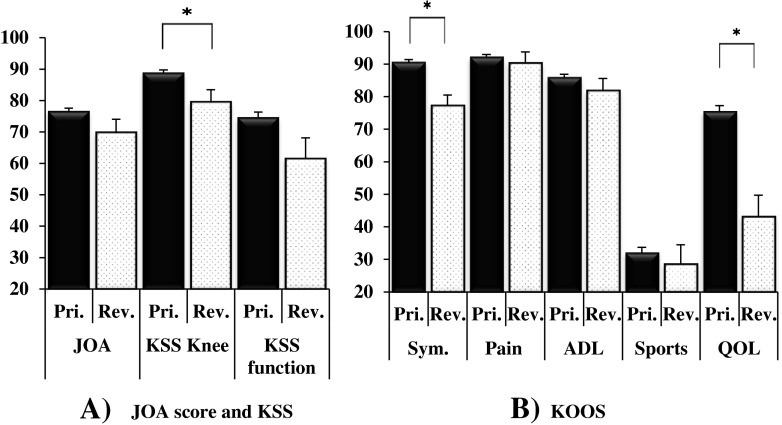
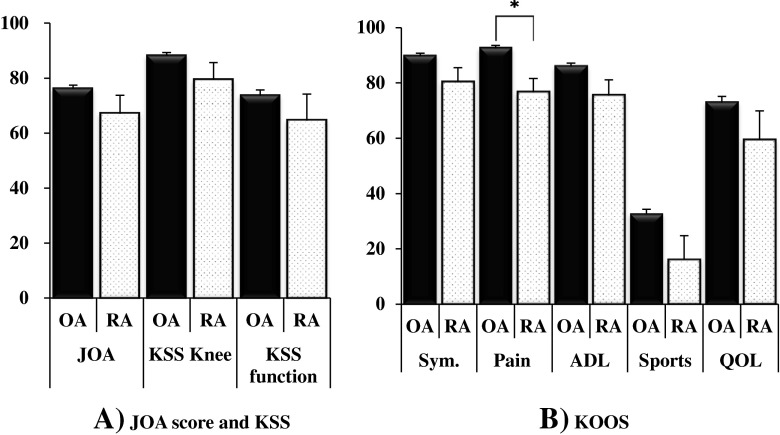
Results: There were strong correlations between KOOS activities of daily living (ADL) and JOA score (r = 0.806), KSS function score (r = 0.803) and between KOOS pain and KSS knee score (r = 0.689). However, there was a poor correlation between KOOS and surgeon's satisfaction score (r = 0.188-0.321). TKA for RA showed poorer results only in KOOS pain (p = 0.003), and revision surgery showed poorer results in KSS function, KOOS symptoms and KOOS quality of life (QOL).
Conclusions: This study suggested that conventional objective scales reflected mainly ADL disturbances in post-operative TKA patients. Furthermore, patient-based outcome scores made it possible to evaluate and detect a minute change of knee pain and QOL in TKA patients. The Japanese KOOS was a useful tool to evaluate conditions after TKA.
Figures
References
-
- Yoshimura N, Muraki S, Oka H, Mabuchi A, En-Yo Y, Yoshida M, Saika A, Yoshida H, Suzuki T, Yamamoto S, Ishibashi H, Kawaguchi H, Nakamura K, Akune T. Prevalence of knee osteoarthritis, lumbar spondylosis, and osteoporosis in Japanese men and women: the research on osteoarthritis/osteoporosis against disability study. J Bone Miner Metab. 2009;27:620–628. doi: 10.1007/s00774-009-0080-8. - DOI - PubMed
-
- Felson DT. Epidemiology of hip and knee osteoarthritis. Epidemiol Rev. 1988;10:1–28. - PubMed
-
- Muraki S, Akune T, Oka H, Ishimoto Y, Nagata K, Yoshida M, Tokimura F, Nakamura K, Kawaguchi H, Yoshimura N. Physical performance, bone and joint diseases, and incidence of falls in Japanese men and women: a longitudinal cohort study. Osteoporos Int. 2012;24:459–466. doi: 10.1007/s00198-012-1967-0. - DOI - PubMed
-
- Zhang W, Nuki G, Moskowitz RW, Abramson S, Altman RD, Arden NK, Bierma-Zeinstra S, Brandt KD, Croft P, Doherty M, Dougados M, Hochberg M, Hunter DJ, Kwoh K, Lohmander LS, Tugwell P. OARSI recommendations for the management of hip and knee osteoarthritis: part III: changes in evidence following systematic cumulative update of research published through January 2009. Osteoarthritis Cartilage. 2010;18:476–499. doi: 10.1016/j.joca.2010.01.013. - DOI - PubMed
Publication types
MeSH terms
LinkOut - more resources
Full Text Sources
Other Literature Sources
Medical
