


Developing a conceptual framework of urban health observatories toward integrating research and evidence into urban policy for health and health equity
- PMID: 23974945
- PMCID: PMC3907625
- DOI: 10.1007/s11524-013-9812-0
Developing a conceptual framework of urban health observatories toward integrating research and evidence into urban policy for health and health equity
Abstract
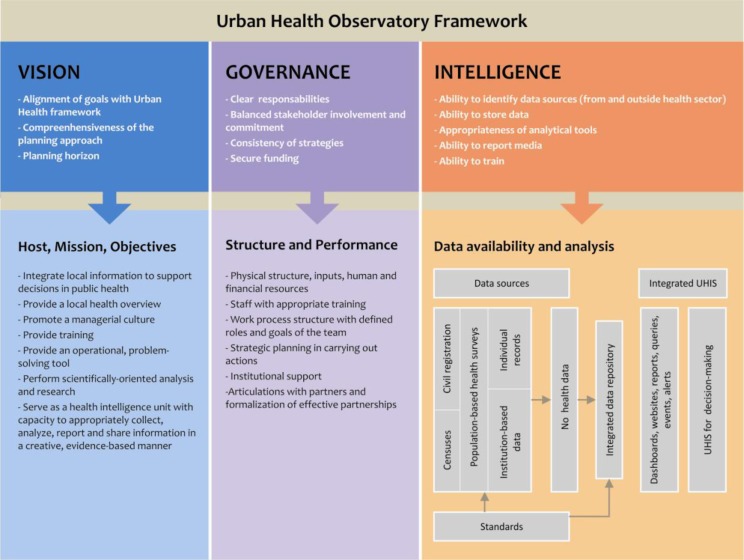
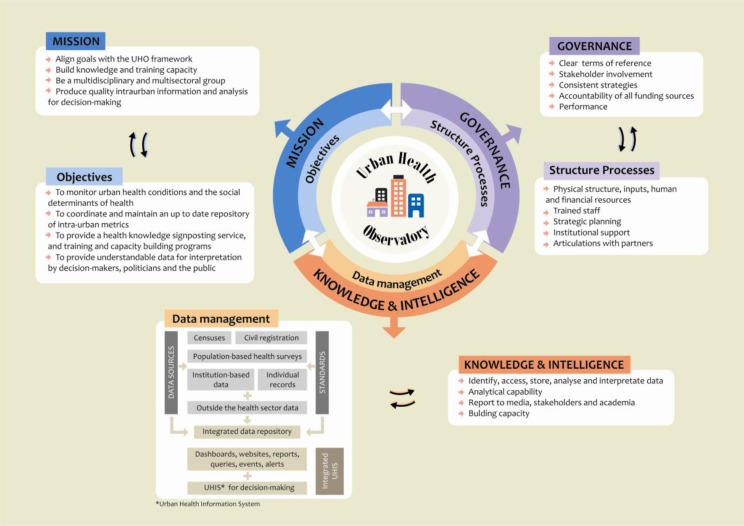
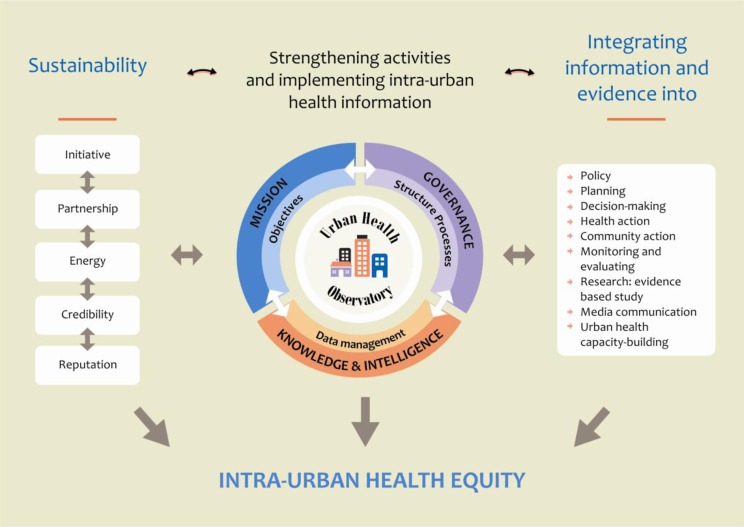
Detailed information on health linked to geographic, sociodemographic, and environmental data are required by city governments to monitor health and the determinants of health. These data are critical for guiding local interventions, resource allocation, and planning decisions, yet they are too often non-existent or scattered. This study aimed to develop a conceptual framework of Urban Health Observatories (UHOs) as an institutional mechanism which can help synthesize evidence and incorporate it into urban policy-making for health and health equity. A survey of a select group of existent UHOs was conducted using an instrument based on an a priori conceptual framework of key structural and functional characteristics of UHOs. A purposive sample of seven UHOs was surveyed, including four governmental, two non-governmental, and one university-based observatory, each from a different country. Descriptive and framework analysis methods were used to analyze the data and to refine the conceptual framework in light of the empirical data. The UHOs were often a product of unique historical circumstances. They were relatively autonomous and capable of developing their own locally sensitive agenda. They often had strong networks for accessing data and were able to synthesize them at the urban level as well as disaggregate them into smaller units. Some UHOs were identified as not only assessing but also responding to local needs. The findings from this study were integrated into a conceptual framework which illustrates how UHOs can play a vital role in monitoring trends in health determinants, outcomes, and equity; optimizing an intersectoral urban information system; incorporating research on health into urban policies and systems; and providing technical guidance on research and evidence-based policy making. In order to be most effective, UHOs should be an integral part of the urban governance system, where multiple sectors of government, the civil society, and businesses can participate in taking the right actions to promote health equity.
Figures
References
-
- Vlahov D, Boufford JI, et al. Urban health in a global perspective. In: Vlahov D, et al., editors. Urban health: global perspectives. New York: Wiley; 2010. pp. 1–12.
-
- Putra BS, Vallespín AF. Democratization of local government (decentralization). University of Freiburg web site. http://www.southeastasianstudies.uni-freiburg.de/areastudies/activities/.... Accessed September 8, 2011.
-
- Faguet JP. Does decentralization increase responsiveness to local needs? Evidence from Bolivia. Journal of Public Economics. 2004;88(3–4):867–893. doi: 10.1016/S0047-2727(02)00185-8. - DOI
-
- UN Department of Economic and Social Affairs. The 2010 Revision of the World Population Prospects. http://esa.un.org/unpd/wpp/index.htm. Accessed September 5, 2011.
Publication types
MeSH terms
Grants and funding
LinkOut - more resources
Full Text Sources
Other Literature Sources
Medical
