


The perfect neuroimaging-genetics-computation storm: collision of petabytes of data, millions of hardware devices and thousands of software tools
- PMID: 23975276
- PMCID: PMC3933453
- DOI: 10.1007/s11682-013-9248-x
The perfect neuroimaging-genetics-computation storm: collision of petabytes of data, millions of hardware devices and thousands of software tools
Abstract
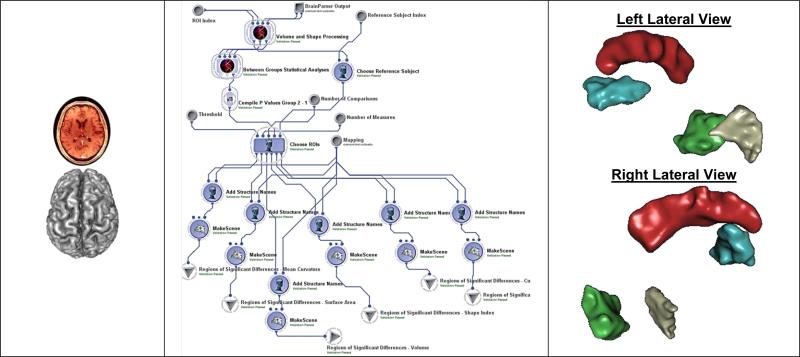
The volume, diversity and velocity of biomedical data are exponentially increasing providing petabytes of new neuroimaging and genetics data every year. At the same time, tens-of-thousands of computational algorithms are developed and reported in the literature along with thousands of software tools and services. Users demand intuitive, quick and platform-agnostic access to data, software tools, and infrastructure from millions of hardware devices. This explosion of information, scientific techniques, computational models, and technological advances leads to enormous challenges in data analysis, evidence-based biomedical inference and reproducibility of findings. The Pipeline workflow environment provides a crowd-based distributed solution for consistent management of these heterogeneous resources. The Pipeline allows multiple (local) clients and (remote) servers to connect, exchange protocols, control the execution, monitor the states of different tools or hardware, and share complete protocols as portable XML workflows. In this paper, we demonstrate several advanced computational neuroimaging and genetics case-studies, and end-to-end pipeline solutions. These are implemented as graphical workflow protocols in the context of analyzing imaging (sMRI, fMRI, DTI), phenotypic (demographic, clinical), and genetic (SNP) data.
Figures
References
-
- Foster K, Spicer M, Nathan S. IBM Infosphere Streams: Assembling Continuous Insight in the Information Revolution. International Technical Support Organization; San Jose, California: 2011.
-
- Lynch C. Big data: How do your data grow? Nature. 2008;455(7209):28–29. - PubMed
-
- Walter C. Kryder's law. Scientific American. 2005;293(2):32–33. - PubMed
-
- Sood A, et al. Predicting the Path of Technological Innovation: SAW vs. Moore, Bass, Gompertz, and Kryder. Marketing Science. 2012;31(6):964–979.
Publication types
MeSH terms
Grants and funding
- P41 EB015922/EB/NIBIB NIH HHS/United States
- R01 LM005639/LM/NLM NIH HHS/United States
- U01 AG024904/AG/NIA NIH HHS/United States
- P20 MH065166/MH/NIMH NIH HHS/United States
- U24-RR021992/RR/NCRR NIH HHS/United States
- P41EB015922/EB/NIBIB NIH HHS/United States
- U24 RR021992/RR/NCRR NIH HHS/United States
- LM05639/LM/NLM NIH HHS/United States
- U24-RR025736/RR/NCRR NIH HHS/United States
- R01 MH071940/MH/NIMH NIH HHS/United States
- P 50 AG16570/AG/NIA NIH HHS/United States
- U24 GM104203/GM/NIGMS NIH HHS/United States
- U24 RR025736/RR/NCRR NIH HHS/United States
LinkOut - more resources
Full Text Sources
Other Literature Sources
Molecular Biology Databases
