


Patterns of plant biomass allocation in temperate grasslands across a 2500-km transect in northern China
- PMID: 23977135
- PMCID: PMC3748100
- DOI: 10.1371/journal.pone.0071749
Patterns of plant biomass allocation in temperate grasslands across a 2500-km transect in northern China
Abstract
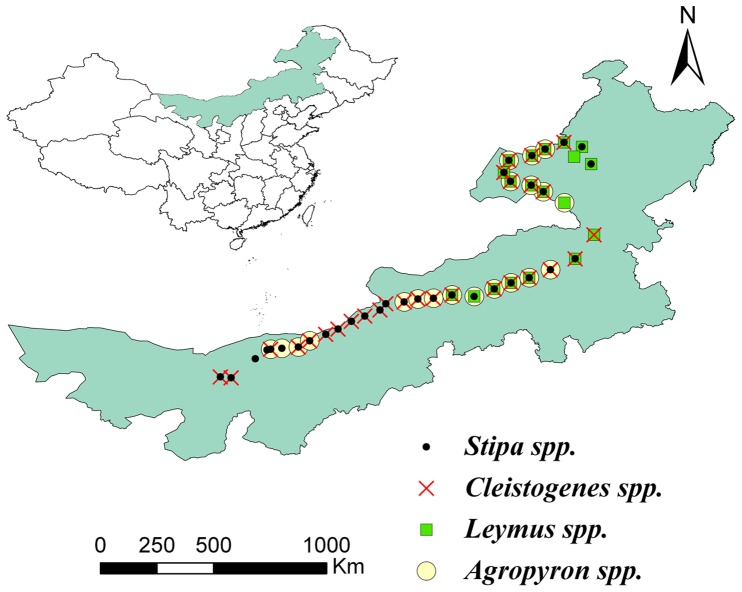
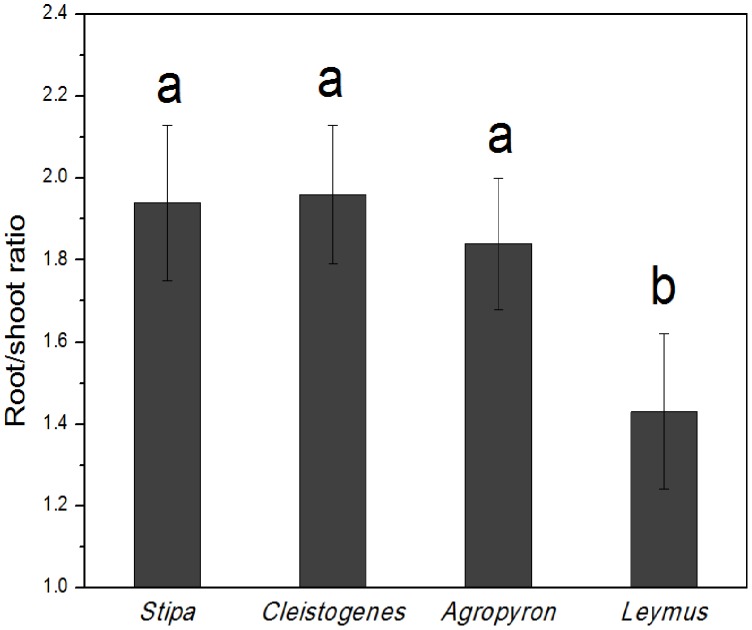
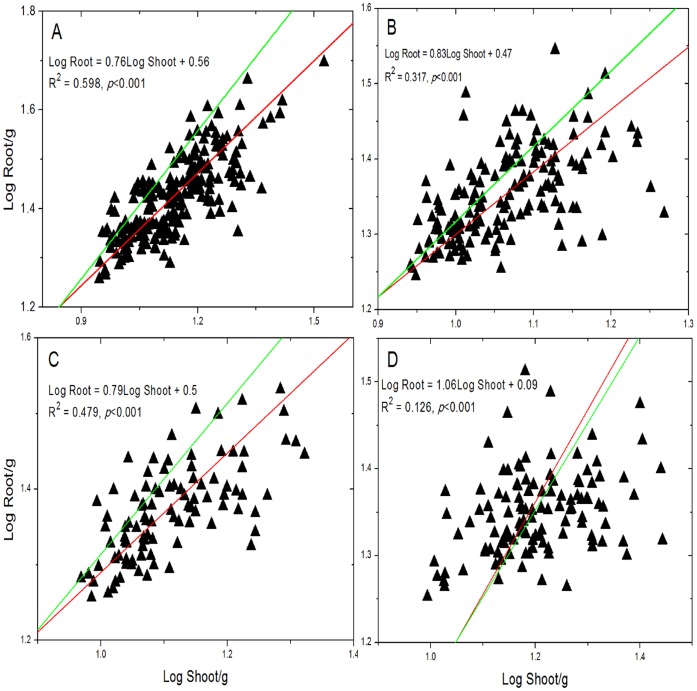
Plant biomass allocation between below- and above-ground parts can actively adapt to the ambient growth conditions and is a key parameter for estimating terrestrial ecosystem carbon (C) stocks. To investigate how climatic variations affect patterns of plant biomass allocation, we sampled 548 plants belonging to four dominant genera (Stipa spp., Cleistogenes spp., Agropyron spp., and Leymus spp.) along a large-scale (2500 km) climatic gradient across the temperate grasslands from west to east in northern China. Our results showed that Leymus spp. had the lowest root/shoot ratios among the each genus. Root/shoot ratios of each genera were positively correlated with mean annual temperature (MAT), and negatively correlated with mean annual precipitation (MAP) across the transect. Temperature contributed more to the variation of root/shoot ratios than precipitation for Cleistogenes spp. (C4 plants), whereas precipitation exerted a stronger influence than temperature on their variations for the other three genera (C3 plants). From east to west, investment of C into the belowground parts increased as precipitation decreased while temperature increased. Such changes in biomass allocation patterns in response to climatic factors may alter the competition regimes among co-existing plants, resulting in changes in community composition, structure and ecosystem functions. Our results suggested that future climate change would have great impact on C allocation and storage, as well as C turnover in the grassland ecosystems in northern China.
Conflict of interest statement
Figures
References
-
- Jackson RB, Canadell J, Ehleringer JR, Mooney HA, Sala OE, et al. (1996) A global analysis of root distributions for terrestrial biomes. Oecologia 108: 389–411. - PubMed
-
- Saugier B, Roy J, Mooney HA (2001) Academic Press, San Diego. In: Roy J, Saugier B, Mooney HA, editors. Estimations of global terrestrial productivity: converging toward a single number? In: Terrestrial Global Productivity. 543–556.
-
- Yang YH, Fang JY, Ji CJ, Ma WH, Mohammat A, et al. (2012) Widespread decreases in topsoil inorganic carbon stocks across China’s grasslands during 1980s–2000s. Global Change Biology 18: 3672–3680.
-
- Mokany K, Raison RJ, Prokushkin AS (2006) Critical analysis of root: shoot ratios in terrestrial biomes. Global Change Biology 12: 84–96.
-
- Milchunas DG (2009) Estimating root production: comparison of 11 methods in shortgrass steppe and review of biases. Ecosystems 12: 1381–1402.
Publication types
MeSH terms
LinkOut - more resources
Full Text Sources
Other Literature Sources
Miscellaneous
